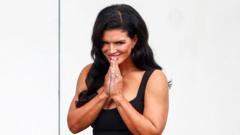
The air inside a fighter’s gym doesn’t smell like glory. It smells like bleach, dried blood, old leather, and the heavy, sour humidity of human desperation. For years, Gina Carano lived in that humidity. She knew the exact cadence of a speed bag bouncing against wooden platforms, the rhythmic thwack-thwack-thwack that acts as a metronome for people trying to outrun their own ghosts.
Then, she stepped away. The cage doors closed behind her, and the bright, artificial lights of Hollywood clicked on.
To the casual observer watching from a couch, she had made it. She was the pioneer who validated women’s mixed martial arts, transitioning into a movie star who didn't need to cut weight or take shin kicks to the ribs to pay her rent. But Hollywood has its own kind of bruising. It is a place where you can be surrounded by thousands of people under blinding hot lights and still feel entirely invisible, trapped in a creative and emotional vacuum.
By 2014, Carano was adrift. The movie roles were there, but the fire wasn't. The industry wanted her to be a symbol, an action figure, a specific shape of womanhood dictated by studio executives who had never wrapped their knuckles in canvas. She was suffocating in the quiet.
Then came the rumor. A whisper that grew into an avalanche. Ronda Rousey wanted to fight her.
The Ghost in the Mirror
To understand why a phone call from UFC President Dana White could alter the chemistry of a person's life, you have to understand what happens to an athlete when their prime begins to evaporate in real-time.
Imagine an artist who is suddenly forbidden from using the color blue, or a musician struck deaf. Carano wasn't just a retired fighter; she was a creator whose medium had been stripped away. When she walked away from MMA after her grueling loss to Cris Cyborg in 2009, she didn't just leave a record of 7-1. She left a piece of her identity on the canvas.
The standard sports page reported the potential Carano-Rousey superfight as a business transaction. They crunched the pay-per-view numbers. They argued about weight classes. They debated whether a woman who hadn't fought in five years deserved a title shot against the most dominant, terrifying athlete on the planet.
They missed the entire point.
For Carano, the fight wasn't about a belt. It wasn’t about a paycheck, though the money would have been substantial. It was about exorcising a haunting.
When you spend your youth conditioning your body to be an instrument of violent precision, you develop a hyper-awareness of your own existence. Every heartbeat matters. Every breath is calibrated. In the civilian world, that heightened state disappears. Life becomes dull, padded, and agonizingly safe. Carano found herself sitting in rooms, looking at scripts, and realizing she was merely going through the motions of living.
Ronda Rousey was the mirror. Rousey was tearing through the UFC bantamweight division with an aggressive, snarling fury that looked deeply familiar to Carano. Watching Rousey wasn't just entertaining for her; it was deeply provocative. It was a reminder of who she used to be before she started wearing designer dresses on red carpets.
The Secret Meeting in the Desert
The public saw the public statements, but the reality unfolded in tense, quiet negotiations behind closed doors. Dana White traveled to Los Angeles. Text messages were sent in the dead of night.
Think about the sheer psychological weight of that moment. Carano was being offered a chance to step directly into the path of a buzzsaw. Rousey wasn't just winning her fights; she was dismantling women in seconds, breaking arms with an armbar that seemed as inevitable as a tax audit. To casual fans, taking that fight after a half-decade layoff looked like professional suicide.
But true competitors don't think like casual fans.
The prospect of the fight acted as an immediate catalyst. The moment the discussions became serious, something shifted in Carano's daily existence. The fog lifted. She started training again, not for a movie role where she had to look fit, but for a cage where she had to survive.
The physical toll of returning to that world is agonizing. Your muscles remember the movements, but your joints protest. The first week back in a serious camp is a grueling inventory of pain. Lactic acid burns through your shoulders. Your lungs feel like they are coated in broken glass.
Yet, for someone who has been emotionally numb, that pain is a luxury. It is proof of life.
Consider the contrast: on one hand, a comfortable life of script readings, stunt coordinators, and safety nets. On the other, the terrifying certainty of standing across from a woman who genuinely wants to separate your arm from your shoulder socket. Carano chose to pursue the terror. Why? Because the terror made her feel authentic.
Why the Absence of a Contract Didn't Matter
The fight never happened. The negotiations eventually stalled out, trapped in the swamp of corporate politics, weight stipulations, and UFC contract complexities. The fans groaned. The pundits wrote their post-mortems about what would have been the biggest female fight in combat sports history.
From a purely journalistic, fact-driven perspective, the story ended there. A failed negotiation. A missed opportunity.
But if you look closer at how Carano spoke about that period afterward, you realize the outcome of the negotiation was secondary to the internal shift it caused. The mere idea of Ronda Rousey saved her.
It gave her permission to stop pretending she was content with a softer life. It woke her up.
Sometimes we need an antagonist to define our purpose. We need a challenge so monumentally terrifying that it forces us to strip away the trivialities of our daily routines and look at our raw architecture. Rousey was that challenge for Carano. The champion's dominance provided a north star for a fighter who had lost her way in the wilderness of celebrity.
The Architecture of the Return
When an athlete admits that a fight proposal "saved their life," they aren't talking about physical survival. They are talking about spiritual preservation.
The training sessions Carano logged during those months of speculation weren't wasted just because the cameras never rolled. They rebuilt her foundation. Every morning she woke up at 5:00 AM to run, every afternoon she spent grappling on sweat-stained mats, she was reclaiming a territory within herself that she had ceded to public expectation.
She remembered what it felt like to be dangerous.
That is the invisible currency of combat sports. It isn’t the money in the bank or the fame that comes with a title. It is the quiet, internal knowledge that when everything else is stripped away, you can look another human being in the eye in an enclosed space and hold your ground. Hollywood could give Carano applause, but it could never give her that specific flavor of self-reliance.
The Final Chime
The gym grows quiet again. The rumors fade, replaced by new contenders, new headlines, and new pay-per-view main events. The world moves on because the sports machine requires constant feeding.
Carano didn't step back into the Octagon, but she didn't return to the dark room either.
The ghost was gone, replaced by a clear-eyed understanding of her own worth. She had looked into the abyss of a potential comeback against the most feared woman on earth, and instead of flinching, she had started wrapping her hands. The fight itself was an illusion, a date on a calendar that never materialized, but the awakening was entirely real.
Sitting in a quiet room far from the cameras, she could still feel the phantom ache in her knuckles, a permanent reminder that she was, and always would be, a fighter who chose the fire over the shade.


