The chandeliers inside the Los Angeles County Museum of Art do not merely illuminate the room. They judge it. Beneath that crystalline glare during the annual Art + Film Gala, the air smells faintly of white truffles, expensive wool, and the quiet desperation of three hundred people trying to look like they belong at the center of the universe.
I have covered enough of these black-tie marathons to know the exact frequency of a room about to lose its composure. Usually, it is a low, polite hum—the sound of studio executives trading non-answers over crystal stemware. Then, a single voice cuts through the static, and every fork in the tent freezes mid-air. Read more on a connected issue: this related article.
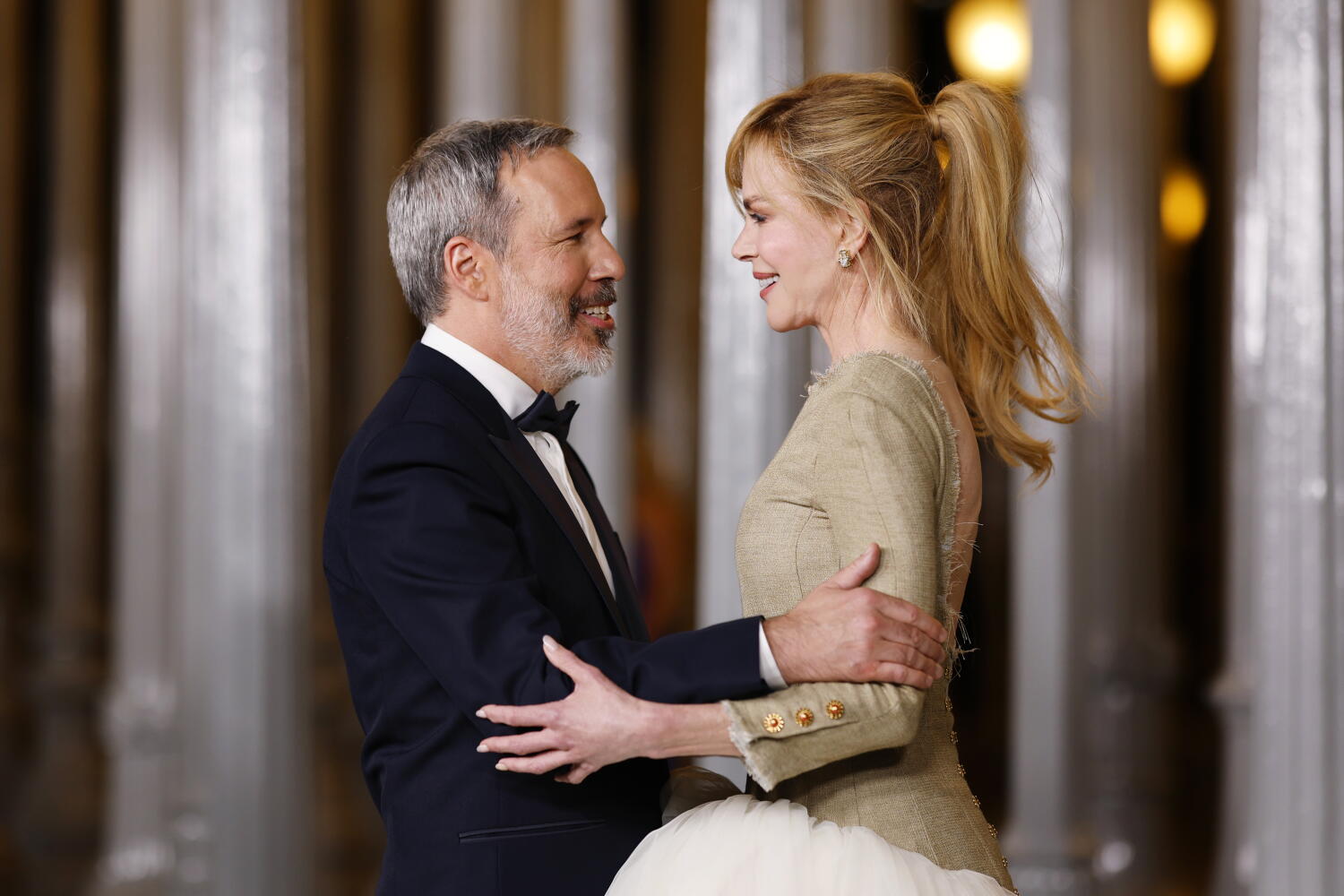
Denis Villeneuve stepped to the podium that night carrying the weight of an empire that isn't even his yet.
If you only read the wire reports the next morning, you got the sanitized, bloodless version of what happened. The headlines told you that the acclaimed director of Dune made a cheeky joke about revealing the next James Bond, teased the crowd, and walked away without giving up the ghost. That is the skeleton of the event. It misses the pulse entirely. It misses the sheer, suffocating pressure sitting on the shoulders of a French-Canadian auteur who has spent his career painting on massive, silent canvases, suddenly thrust into the most ravenous, unforgiving casting parlor in modern cinema. Further journalism by Rolling Stone delves into similar views on the subject.
Silence.
That is what Villeneuve demanded when he leaned into the microphone, offering a wry, almost boyish grin that belied the machinery grinding behind his eyes. For three seconds, the most powerful room in Los Angeles actually gave it to him. Nobody breathed. Nobody checked their phones. Because when a man who spends years crafting sandworms and replicants threatens to drop the single biggest piece of intellectual property news on the planet over dessert, you listen.
To understand why a half-joking feint at a museum fundraiser sent shockwaves from Wilshire Boulevard to Pinewood Studios, you have to understand what James Bond actually is right now. He is not just a fictional British spy with a license to kill and a taste for shaken martinis. He is a billion-dollar anxiety attack.
The Ghost in the Tuxedo
Let’s strip away the velvet ropes and the flashbulbs for a moment. Picture a hypothetical studio executive—let’s call him Arthur—sitting at table four near the back of the LACMA pavilion. Arthur doesn't care about the art being honored that night, though he wrote a very large check to pretend he does. Arthur cares about Q3 projections, theatrical windows, and the terrifying reality that theatrical attendance is still limping back from the brink. To Arthur, James Bond is not a character. Bond is a load-bearing wall. If you pick the wrong guy to wear the Walther PPK, the whole ceiling comes down.
Daniel Craig walked away from the role in 2021, detonating himself on a poison island in No Time to Die with a finality that left Barbara Broccoli and Michael G. Wilson—the longtime guardians of Eon Productions—staring at a blank page for the first time in nearly two decades. Since then, the void has been filled by noise. Every British actor with a sharp jawline and a passing familiarity with a tailored suit has been crowned the next 007 by internet betting markets at least twice. Aaron Taylor-Johnson. Henry Cavill. Theo James. Callum Turner. The names cycle through the rumor mill like laundry in a commercial dryer, hot and noisy and completely devoid of substance.
And then there is the Villeneuve factor.
For years, Villeneuve has been open about his childhood obsession with Ian Fleming’s creation. Growing up in rural Quebec, Bond wasn't just escapism for him; it was a masterclass in tone, scale, and the geometry of suspense. When his name began circulating as a dream candidate to helm the twenty-sixth installment—or perhaps even to shepherd the franchise into its next era following Amazon’s massive acquisition of MGM—the industry took notice. Villeneuve represents prestige. He represents the rare alchemy of critical adoration and box-office muscle.
So when he stood at that podium at LACMA, surrounded by the very people who finance, distribute, and profit from Hollywood’s biggest bets, his little theatrical fake-out wasn't just a throwaway gag. It was a stress test.
He played them like a cello. He leaned in, dropped his voice into that familiar, conspiratorial cadence, and let the words hang in the air: he was going to tell them who the next Bond was. You could practically hear the collective intake of breath from the entertainment journalists tucked near the press risers. thumbs hovered over glass screens. Draft tweets were mentally composed.
Then came the pivot. The shrug. The gentle, devastating realization that he was simply holding a mirror up to their own obsession. He didn't have a name to give them—or if he did, he wasn't about to burn down his own house just to warm up a charity gala.
Why Secrecy is the Last Currency Left
We live in an era where mystery is treated like a software bug that needs to be patched immediately. Drone photographers hover over closed sets in the Scottish Highlands. Extras sign non-disclosure agreements thicker than tax codes, only to leak call sheets on Reddit twenty minutes after lunch. Algorithms scrape casting agency databases looking for sudden spikes in stunt-training bookings.
In that environment, keeping the identity of the next James Bond under lock and key isn't just a marketing strategy. It is an act of survival.
Think about the mechanics of a magic trick. If I tell you before the show starts that the dove is tucked inside a false lining in my left sleeve, you don't watch my hands anymore. You just stare at my elbow, waiting for the seam to split. Casting Bond works on the exact same principle. The moment a name becomes official, the myth collapses into a biography. Suddenly, the audience isn't watching a dangerous, unknowable operative walk into a Monte Carlo casino; they are watching a thirty-something actor they remember from a period drama on BBC Two, wondering how many months he spent eating boiled chicken to get his shoulders to fill out a Tom Ford jacket.
Broccoli and Wilson understand this better than anyone in the business. Historically, their casting announcements are less like press releases and more like papal conclaves. Remember the sheer vitriol that greeted Daniel Craig in October 2005 when he stepped off a Royal Navy boat onto the Thames wearing a life jacket over a tailored suit? The British tabloids called him "James Bland." Fans threatened boycotts because he had blond hair. The producers absorbed every ounce of that fury because they knew the announcement wasn't the end of the story—it was just the opening note of a long, calculated symphony.
Consider what happens next if that symphony is interrupted prematurely at a Los Angeles gala.
If Villeneuve—or anyone else near the inner circle—actually let a name slip before the ink was dry, the machine would chew the actor alive before he ever stepped onto a soundstage. The media cycle doesn't allow for slow burns anymore. Within four hours of an accidental reveal, there would be think pieces dissecting the actor's old tweets, frame-by-frame analyses of his jawline compared to Sean Connery's, and stock market fluctuations tied to box-office projections three years out.
By teasing the reveal and pulling the rug out at the last second, Villeneuve accomplished something remarkably clever. He acknowledged the elephant in the room without letting it trample the furniture. He reminded everyone in that tent that he understands the gravity of the franchise, even as he refused to play their game on their timeline.
The Weight of the Crown
I confess, watching the footage of that moment later on a laptop screen, I felt a strange pang of sympathy for whoever actually ends up getting the call.
We talk about landing the role of James Bond as if it is winning the lottery. In reality, it is closer to signing a ten-year lease on a gilded cage. You become the custodian of a sixty-year-old cultural artifact that belongs to everyone and no one at the same time. Every generation demands a slightly different reflection in that mirror. Connery was the cold-blooded postwar carnivore. Moore was the raised-eyebrow diplomat of the seventies. Brosnan was the sleek, post-Cold War technocrat. Craig was the bruised, existential blunt instrument for a world that no longer trusted its own institutions.
Who is Bond in the late 2020s?
That is the question keeping the real decision-makers awake at three in the morning, and it is infinitely harder to answer than simply picking a handsome guy from a lineup. If you make him too ruthless, he feels like a relic from an era we have rightly outgrown. If you make him too sensitive, he stops being James Bond and turns into just another conflicted action hero brooding on a rooftop. You have to thread a needle while sprinting through a minefield.
And if Denis Villeneuve truly is in the mix—or even orbiting the creative gravitational pull of the next chapter—the stakes climb even higher. Villeneuve is not a hired gun. He does not show up to shoot second-unit car chases while a committee of studio executives edits the movie in another zip code. His films breathe. They take their time. Imagine the deliberate, suffocating tension of Sicario colliding with the globe-trotting elegance of From Russia with Love. That is the fever dream keeping cinephiles up at night.
Yet, standing at that podium at LACMA, Villeneuve looked entirely unburdened by the weight of those expectations. Maybe that was the real performance of the evening. In a town built on manufactured urgency, where every mid-budget streaming thriller is pitched as a cultural watershed, there is immense power in simply smiling, withholding the punchline, and walking off stage.
The Echo in the Tent
After the laughter died down and the gala moved on to its next honoree, the room eventually returned to its usual rhythm. Glasses clinked. Deals were whispered over petit fours. Valets began the nightly ballet of retrieving black sedans from the underground garage.
On the surface, nothing had changed. Nobody walked out of LACMA knowing who would next order a Vesper martini or drive an Aston Martin off a cliff in the Italian Alps. The wire stories filed that night treated it as a cute piece of gala ephemera—a brief, amusing detour on the road to the awards season that dominates Hollywood's winter months.
They missed the point.
The real story wasn't that Denis Villeneuve failed to reveal the next James Bond. The real story was how easily a single sentence brought the most jaded, cynical room in the entertainment industry to a dead halt. It proved that despite the rise of fragmented streaming feeds, AI-generated content, and a thousand competing distractions fighting for our eyeballs every second of the day, the old magic still holds a terrifying amount of power over us. We still want to believe in the man in the tuxedo. We still want to be surprised in the dark.
Outside on Wilshire Boulevard, the fog began rolling in from the Pacific, swallowing the streetlights one by one until the museum’s famous Urban Light installation looked like a cluster of glowing ghosts standing guard over an empty sidewalk. Somewhere out there, an actor was probably waking up in London, checking his phone, and wondering if his life was about to change forever. He didn't know yet. Nobody did. And for one glorious, infuriating night, Hollywood had to sit with the silence.