Ice does not care about your intentions. It cares only about edges, friction, and the brutal physics of a body moving at thirty miles per hour toward a wall of tempered glass.
Standing in the tunnel before the third period, you can smell the specific composition of a professional hockey arena. It is a dense, violent mixture of melting polyurethane, stale sweat, skate-sharpening metal dust, and the sharp, freezing exhaust of the zamboni bay. Your thighs burn. Your ribs ache from a cross-check you took in the corner six minutes ago. You look down at your stick, tape frayed at the heel where the puck has kissed it a thousand times, and you wonder, quietly, if anyone outside this concrete bunker actually understands what it costs to survive out there.
Then the buzzer sounds.
We measure excellence in this league with cold, statistical indifference. We talk about goals against averages, Corsi ratings, primary assists, and save percentages as if human achievement can be neatly filed into spreadsheets. But numbers are ghosts. They are the dry residue of a terrifying amount of human suffering and joy. When the National Hockey League hands out its weekly honors, it is not merely tallying digits on a page. It is recognizing the exact moment a human being conquered panic, fatigue, and the entire weight of a city's expectations.
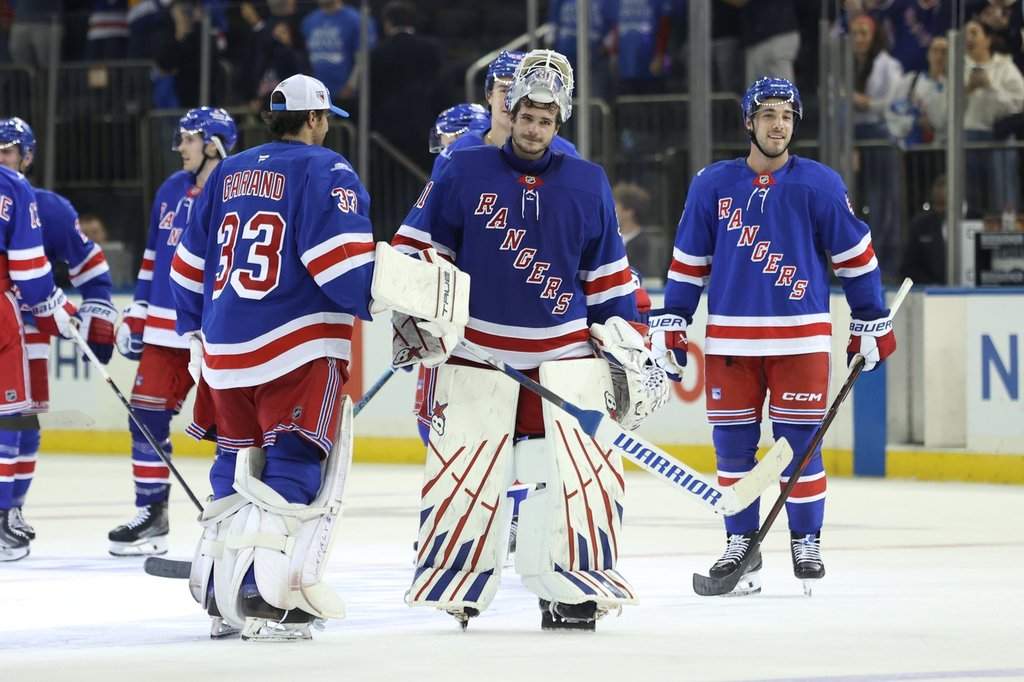
Consider what it takes to be Igor Shesterkin on any given Tuesday night inside Madison Square Garden.
To play goaltender in New York is to stand at the center of an open-air psychological experiment. Twenty thousand people are screaming your name, half in adoration, half in sudden, collective dread. Every time an opponent enters the blue line with a head of steam, you have roughly four-tenths of a second to calculate trajectory, screen vision, blade angle, and the agonizing probability of a deflection.
When Shesterkin locks into his stance, he is not just positioning his body; he is building a fortress out of pure focus. The puck leaves a stick three feet away, a black rubber missile traveling at eighty-five miles per hour. It makes a distinct, hollow thwack as it hits the leather of his glove. No celebration. No sigh of relief. Just the immediate, crushing realization that the next shot is already on its way. Earning weekly league honors as a goaltender means you stood your ground while a collapsing empire of bodies crashed into your crease, refusing to break when the ice beneath you was chewed to slush.
Fourteen hundred miles away, under the cavernous, oil-drenched roof of Rogers Place in Edmonton, a different kind of architecture is being erected from the blue line.
Evan Bouchard does not look panicked. That is his superpower.
While wingers buzz around the perimeter like angry hornets and centermen grind their teeth in the faceoff dot, Bouchard glides with an infuriating, beautiful economy of motion. Imagine standing at the point during a power play. Three opponents are lunging at your chest, sticks flailing, smelling blood. The puck skips toward you along the boards. If you rush, you panic-fire it into a shin guard and spark a two-on-one breakaway against your own goaltender. If you wait half a second too long, you are eating three hundred pounds of angry Canadian forward.
Bouchard waits.
In that infinitesimal pause, the entire geometry of the offensive zone shifts. A passing lane opens up through a needle's eye. With a flick of his wrists that looks casual enough to be practiced in a driveway, he dishes a saucer pass onto Connor McDavid's tape. It is an art form born of absolute calmness amid chaos. When the league acknowledges a defenseman of his caliber, they are rewarding the mental fortitude it takes to slow time down while everyone else is sprinting toward a cliff.
And then there is Paul Cotter.
Not every star in the NHL enters the league through the grand, gilded front doors of a top-three draft pick. Some players have to kick the back door open with their shoulder.
Cotter represents the violent, unglamorous underbelly of the sport. He is the guy who goes into the corner not to look pretty, but to extract a piece of rubber while three opposing defensemen try to separate his ribs from his spine. It is a thankless, bruising existence. You take the hit to make the play. You absorb the cross-check in front of the net so your teammate can find a rebound.
When a player like Cotter earns recognition, it validates every cold morning in minor hockey, every cross-country bus ride in the juniors, every second-guessing doubt whispered in the dark hotel rooms of the American Hockey League. It proves that relentless, blue-collar persistence still has a currency in a league obsessed with generational skill.
We look at these honors as trophies. We see the graphic on our phones scrolling by while we drink morning coffee. But behind those three names lies a shared narrative of endurance. They are three distinct answers to the same fundamental question: How much pressure can a human being absorb before they turn it into art?
The arena lights hum above the empty ice long after the final horn has sounded and the crowds have spilled out into the cold night air. The skate marks are carved deep into the white surface, a chaotic map of sweat and ambition. Tomorrow, the zamboni will smooth it all away, erasing every scar, every triumph, and every mistake.
And then the doors will open again.