The click was hollow. It wasn’t the satisfying thud of a full tank or the rhythmic pulse of fuel surging through a rubber hose. It was the sound of a dry bone hitting a plastic tray. Sean stood at a forecourt in Mullingar, the midnight air biting through his thin jacket, staring at a taped-on sign that simply read: NO DIESEL.
He looked down at his dashboard. The amber light wasn't just glowing; it was mocking him. Seven miles of range left. His daughter was forty miles away, waiting for him to pick her up from a late-shift hospital rotation because her own car was in the shop. This wasn't just a supply chain issue or a bullet point in a morning news briefing. It was a crisis of distance.
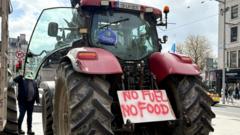
Across Ireland, this scene is repeating in a frantic, stuttering loop. Hundreds of petrol stations have switched off their digital price boards, leaving their forecourts dark and desolate. What began as a localized protest over rising costs and carbon levies has metastasized into a national paralysis. We are discovering, with painful clarity, just how thin the thread is that connects our lives.
The Anatomy of a Standstill
To understand how a few dozen tractors and a handful of picket lines can bring a country to its knees, you have to look at the geography of the Irish heartland. We aren't a nation of subway systems and high-speed rail. We are a nation of boreens, regional roads, and the long, solitary commute.
When the depots at Dublin Port and Shannon were first obstructed, the industry experts spoke in clinical terms. They discussed "logistical bottlenecks" and "inventory depletion." But they didn't talk about the primary school teacher in Roscommon who can’t get to work, or the farmer in Kerry watching a week’s worth of milk spoil because the collection truck is stranded.
The facts are staggering. Current estimates suggest that nearly 30% of the independent retail network is currently "bone dry." The larger chains are fareing slightly better, but only because they’ve implemented rationing—limiting customers to €20 of fuel at a time. It’s a frantic, temporary bandage on a deep wound.
Consider a hypothetical driver named Mary. She manages a small logistics firm in Cork. In a normal week, her biggest headache is a flat tire or a late delivery. Today, her "lived experience" is a frantic spreadsheet of misery. She spends four hours every morning calling every station within a fifty-kilometer radius, trying to secure enough "green diesel" for her fleet just to keep the grocery store shelves from going bare.
The Psychology of the Panic
There is a specific kind of communal anxiety that takes hold when a fundamental utility vanishes. It starts with a rumor. A WhatsApp message in a GAA group mentions a station in Athlone that still has a few thousand liters of unleaded. Within twenty minutes, a queue of sixty cars snakes around the corner, blocking traffic and fraying nerves.
This isn't just about greed or "panic buying." It’s a rational response to an irrational situation. When the government advises the public to "remain calm" and "buy only what you need," it often has the opposite effect. It signals that the end of the supply is a very real possibility.
The protesters argue that their backs are against the wall. They point to the spiraling costs of living, the tax on carbon that feels like a tax on being rural, and the feeling that the corridors of power in Dublin are deaf to the engine-knock of the countryside. Their logic is simple: if they can’t afford to move, nobody moves.
But the collateral damage is human, not political.
I spoke with a taxi driver in Limerick who had spent his last €40 of fuel just searching for more fuel. He ended his shift with a half-empty tank and zero profit, having spent the day chasing ghosts. He spoke about the "invisible stakes"—the missed doctor's appointments, the elderly parents who won't be visited this weekend, the small businesses that simply won't open their doors tomorrow.
The Ripple in the Pond
We often view fuel as a commodity for cars, but it is actually the blood of our economy. When the flow stops, the organs begin to fail in a specific, predictable order.
First, the "just-in-time" delivery model collapses. Your local supermarket doesn't have a warehouse in the back; it has a loading dock that expects a truck every twelve hours. Without fuel, those trucks sit idle. Bread shelves empty first. Milk follows. Then the fresh produce begins to wilt.
Next comes the social isolation. For those living in the "Dublin Bubble," a lack of fuel is an inconvenience—an excuse to work from home or take the Luas. For a person living in a valley in Wicklow, it is a house arrest.
The protesters remain dug in, their high-vis vests glowing under the streetlights at the depot gates. They are waiting for a concession that hasn't come. The government, meanwhile, talks about "security of supply" and "emergency powers," words that sound increasingly hollow to the person staring at a needle resting on the red line.
The Fragility of the Modern World
We have built a world of incredible efficiency and terrifying fragility. We rely on the assumption that the liquid under the ground will always be available at the turn of a key. We have designed our towns, our jobs, and our social lives around the internal combustion engine.
When that engine stalls, the silence is deafening.
It isn't just about the petrol. It’s about the realization that we are all three days away from a different century. Without the ability to move, our modern comforts vanish, leaving us standing on a cold forecourt at midnight, clicking a dry handle over and over again, hoping for a miracle that smells like exhaust.
Sean eventually found a gallon of diesel from a neighbor who kept a small reserve for his lawnmower. It was just enough to reach his daughter. As they drove back through the darkened countryside, passing station after station with their lights extinguished, the conversation wasn't about politics or carbon taxes. It was about the strange, unsettling sight of a country that had forgotten how to walk, suddenly forced to stand still.
The stars were bright over the Irish midlands, unmarred by the usual glow of the petrol station canopies. It was beautiful, in a haunting, desperate way. It was the look of a world that had run out of momentum.