The Tuesday evening rush hour in New England usually sounds like a low, predictable hum. It is the syncopated rhythm of turnpike traffic, the chime of commuter rail doors closing, and the distant, comforting rumble of a regional jet climbing into the dusk. On a crisp autumn evening, millions of people were locked into these identical, unremarkable routines. They were thinking about grocery lists, soccer practices, and the ambient anxiety of the upcoming work week.
Then, the sky tore itself apart.
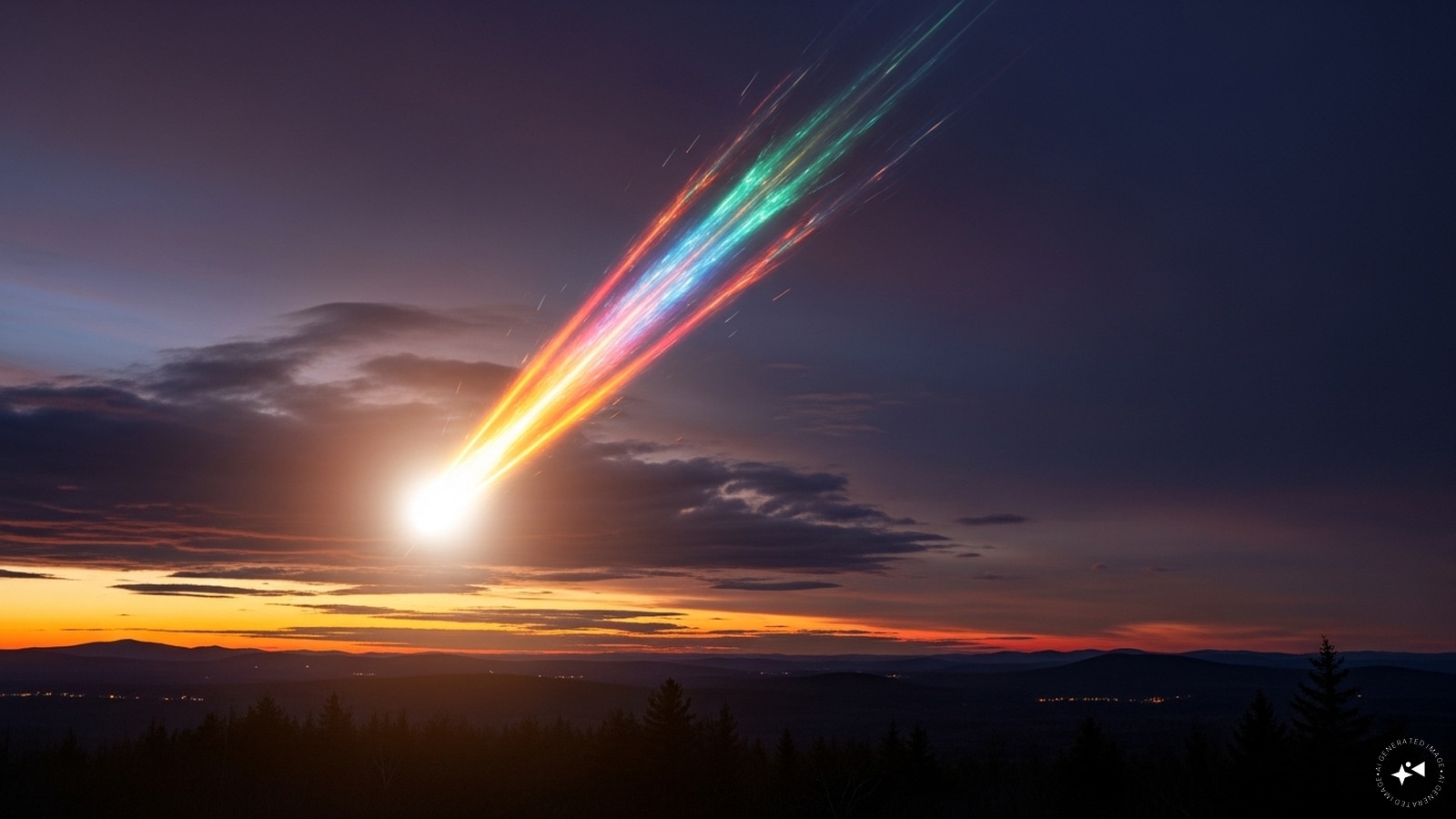
At precisely 5:51 PM, an intruder from the deep solar system crossed the threshold of Earth’s atmosphere. Moving at a blistering velocity that mocks our fastest supersonic technology, a meteor slammed into the upper air directly over Massachusetts.
It did not slip in quietly.
For a fraction of a second, a blinding, electric-blue flash turned a routine commuter twilight into stark, artificial noon. Shadows stretched violently across the pavement from Montreal to Delaware. Dashcams caught the sudden, terrifying blooming of light. Pedestrians froze in their tracks, looking upward with an instinctual, primal fear that human beings haven’t deeply felt since we slept in caves.
But the light was only the prelude.
The Anatomy of a Shockwave
Consider what happens next when an object the size of a boulder meets the dense wall of the Earth's atmosphere. It does not just burn; it compresses the air ahead of it with such extreme force that the air molecules cannot move out of the way fast enough. The temperature spikes to thousands of degrees. The rock experiences a catastrophic structural failure.
It explodes.
Minutes after the flash, the sound hit the ground. It wasn't a distant rumble. It was a physical blow. Residents across central Massachusetts reported a concussive boom that rattled windowpanes in their frames, shook dishes from kitchen counters, and caused basement foundations to vibrate.
To the unsuspecting person sitting on a sofa in Worcester or Framingham, it felt exactly like a gas main explosion next door, or perhaps a localized earthquake. The police departments received an unprecedented deluge of 911 calls. Switchboards lit up with a single, urgent question: What just happened?
The American Meteor Society, a group that tracks these rare, spectacular events, was instantly flooded with hundreds of eyewitness reports. The data points mapped a massive arc of visibility. Someone walking their dog in a suburb of Philadelphia saw the exact same streak of fire as a university student looking out a dorm window in southern Canada.
We live our lives under the illusion of a ceiling. We treat the sky as a harmless backdrop for our architecture and our weather. An event like this shatters that illusion completely. It reminds us, with a violent, beautiful exclamation point, that we are actually riding a fragile blue marble through an active cosmic shooting gallery.
The Human Echo of a Cosmic Event
To understand the true weight of a fireball like this, you have to look away from the satellites and radar screens and look instead at the kitchen tables.
Imagine a hypothetical resident—let's call her Sarah—standing in her kitchen in Fitchburg, Massachusetts. She is stirring a pot of pasta, listening to the evening news on the radio. Suddenly, the kitchen window flashes with a light so intense she thinks a transformer has blown on the pole outside. Before she can even step toward the glass, a deep, resonant thud hits the house. The floorboards vibrate under her slippers. Her dog begins to bark frantically, pacing the hallway.
Sarah’s first thought isn't about space rocks. It is about immediate danger. Is it a terrorist attack? A plane crash? A domestic disaster?
This is the psychological tax of the modern world. When the sky makes a sudden noise, our minds immediately sprint toward our deepest collective anxieties. For nearly an hour, until local news stations and astronomical agencies could verify the radar tracks, thousands of people lived in that tense, suffocating space of the unknown.
The relief that followed was a strange, collective exhale. When the word spread via social media and emergency broadcasts that the culprit was a meteor, the fear dissolved into awe. The event transformed from a terrifying threat into a shared, transcendent moment of wonder. Neighbors who hadn't spoken in months stepped out onto their front porches, looking up into the now-dark sky, talking across lawns about the light they had all just witnessed.
Reading the Cosmic Dust
The science behind these fireballs is a humbling exercise in scale. Most of the shooting stars we wish upon during an annual meteor shower are no larger than a grain of sand or a pebble. They vaporize flawlessly miles above our heads, leaving nothing but a fleeting silvery trail.
A fireball that causes an audible explosion is an entirely different beast.
Scientists estimate that an object capable of producing a boom this loud must weigh hundreds, if not thousands, of pounds before entering the atmosphere. As it plummets downward, the friction transforms the outer layers of rock into molten liquid, which sloughs off in a brilliant trail of glowing plasma.
What we saw over New England was the death rattle of an ancient survivor. This piece of rock had likely spent billions of years drifting through the cold void between Mars and Jupiter, a pristine relic from the formation of our solar system. It outlasted continents. It outlasted eras. Yet, its journey ended in a fraction of a second over an interstate highway during rush hour.
Astronomers are currently using atmospheric data, security camera footage, and Doppler weather radar to calculate the exact trajectory of the space rock. There is a high probability that fragments—known as meteorites—survived the violent disintegration and rained down somewhere in the dense forests of New England.
The hunt is now on. Scientists and amateur collectors are trekking through the woods, hoping to find a black, crusty stone that smells faintly of sulfur. To hold one of those rocks in your hand is to hold a piece of infinity.
The Fragile Shield
We tend to think of our technological supremacy as an absolute shield against the wilderness of the universe. We track storms from orbit, map deep space with advanced telescopes, and build cities that defy the elements.
But a Tuesday evening fireball reveals the gaps in our armor.
This meteor was not detected before it hit. It was too small, too dark, and moving too fast for our near-Earth object surveillance systems to flag. It simply materialized out of the dark, a reminder that the planet is constantly interacting with a dynamic, unpredictable environment.
The atmosphere did its job perfectly. It acted as a shield, absorbing the tremendous kinetic energy of the rock and converting it into harmless light and sound long before it could cause widespread destruction on the ground. We are protected by a thin, invisible layer of gas that we regularly take for granted.
Night fell completely over Massachusetts a few hours after the explosion. The traffic on the turnpike resumed its normal, steady rhythm. The 911 dispatch centers grew quiet. The dinner tables were cleared, and the dishes were put away.
Yet, the air felt subtly changed. Anyone who looked up at the stars that night did so with a slightly different perspective. The sky was no longer just a blank canvas for the moon. It was a doorway to the wild, brilliant, and occasionally deafening unknown.


