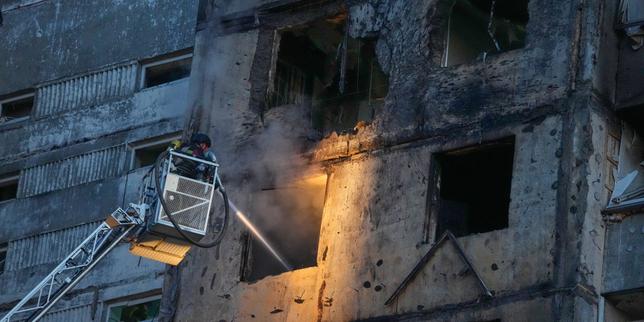
The glass always goes first. Long before the sirens tear through the heavy midnight air, long before the low, angry buzz of a drone engine starts vibrating against your ribs, there is the shattering. It is a sharp, musical sound, like a winter lake cracking open underfoot, repeated a thousand times across a single neighborhood.
For the people of Kyiv, the night does not arrive with the gentle folding of dusk. It arrives with a tremor.
A dozen souls woke up to that tremor earlier today. Not in the clean, sanitized language of a casualty report, but in the chaotic, dust-choked reality of shattered frames, torn drywall, and the copper taste of fear in the back of the throat. Ten injured. Ten names that will likely be reduced to a blip in a morning news ticker, swallowed whole by an international news cycle that has grown callous to the daily rhythm of an air raid.
Listen closely to what happens when the drones come. It is not just an attack on concrete and steel. It is an assault on the very architecture of normal life.
Consider a hypothetical resident—let us call him Oleksandr, though he could just as easily be Maria, or any of the millions who refuse to pack bags they no longer have room for. Oleksandr keeps his boots under the edge of the bed. Not because he is a soldier—he is an accountant who misses the quiet predictability of balancing spreadsheets—but because the floorboards of his sixth-floor apartment are cold, and when the warning sounds at two in the morning, he has exactly ninety seconds to make a choice.
Ninety seconds. Try measuring your life in ninety seconds.
In that frantic window, you do not grab family heirlooms. You grab your phone, a bottle of water, and your cat, who is already vibrating with an animal terror that precedes human comprehension. You run down six flights of concrete stairs where the paint is peeling from damp walls, surrounded by neighbors in mismatched coats, clutching pillows and shaking hands.
The drones overhead are Iranian-designed Shaheds, flying lawnmowers packed with high explosives. They are crude, noisy, and terrifyingly effective at psychological warfare. They buzz through the dark like mechanical hornets, cheap to build, expensive to intercept, and devastatingly persistent. When one hits a residential district, it does not target a military barracks. It targets the kitchen where someone left a half-drunk cup of chamomile tea on the counter. It targets the bedroom where a child’s stuffed rabbit sits propped against a pillow.
Why do they keep coming? The tactical answer is exhaustion. It is a war of attrition fought in the skies, designed to drain air defense reserves, plunge cities into darkness, and grind down the psychological endurance of a population until they cry out for a peace built on submission. Every intercepted drone is a victory, yes. But every piece of shrapnel that punches through a roof is a small, quiet fracture in the collective soul of a city that just wants to sleep.
The human mind is remarkably elastic, until it isn't. You can adapt to the sirens. You can learn to distinguish the crump of an outgoing air defense battery from the sickening whistle of an incoming impact. You can joke about the absurdity of drinking espresso in a subway station while the earth trembles three hundred feet above your head.
Yet, resilience is not a bottomless well. It is a finite resource, measured in sleepless nights, frayed nerves, and the quiet grief of watching your city turn into a battlefield.
When the smoke clears and the municipal workers arrive with brooms and flatbed trucks to sweep away the glass, the raw statistics are logged, counted, and filed away. Ten wounded. Minor to moderate injuries, the reports will say, as if trauma can be neatly categorized on a spreadsheet.
They won't tell you about the silence that follows. Not the peaceful silence of dawn, but the heavy, waiting silence of a city holding its breath, wondering which windowpane will catch the next light, and whether the sky will hold until morning.