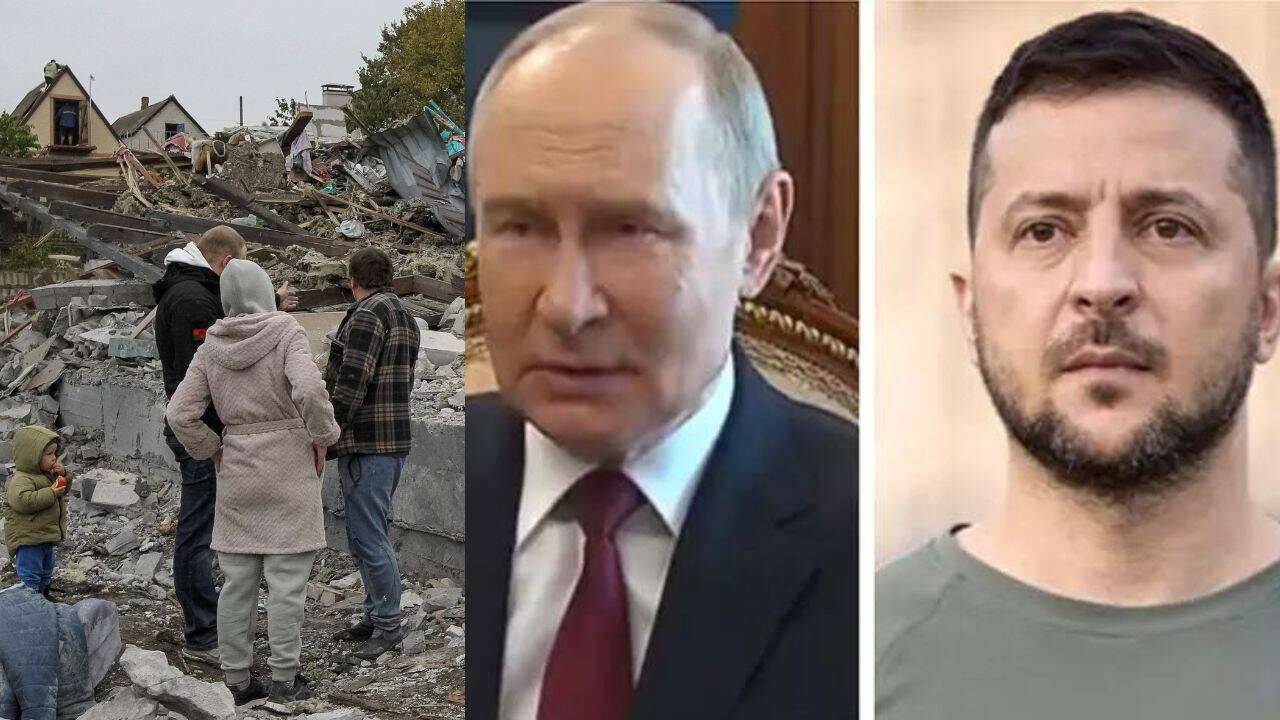
Sirens. Always sirens first.
Before the glass rattles in its frame, before the low, chest-caving thud travels through concrete and soil, there is that rising wail over a city that has learned to sleep in its shoes. Across nine Ukrainian regions, night has stopped being a curtain drawn over a tired day and become a ledger opened in the dark. You can read a headline about nine regions struck and feel almost nothing if you have spent too many months scrolling past tallies. Nine. Just a single digit. Easy to skip over while reaching for coffee.
Wait.
Say the word aloud and watch the map stretch. Nine regions is not a single street corner or one quiet border village. It is sprawling farmland and industrial corridors, riverbanks and apartment blocks, clinics and bakeries scattered across vast distances where ordinary people were trying to live ordinary lives. When reports surface showing a spike in civilian casualties alongside fresh strikes across nine regions, the numbers look tidy on a screen—neat little rows of figures waiting to be quoted, compared, and forgotten by noon.
They are not tidy. Every figure in a casualty report represents a body that was warm twenty minutes earlier, a phone screen that will never light up with a message saying I made it home, a kitchen table where one chair now holds only a folded sweater.
To understand why a surge in civilian harm hits differently when it spans nine regions at once, let us use a hypothetical scenario—strictly a composite illustration built from documented patterns of modern air and missile barrages rather than a real individual's biography. Picture Olena, a district nurse in a mid-sized Ukrainian city far from the trench lines. She is not a soldier. She carries no rifle. Her daily battle is against fever, blood pressure spikes, and exhaustion in a clinic running on backup generators.
When air alerts sound across nine regions simultaneously, air defense networks are stretched thin like fishing net pulled taut over too wide a swell. Think of an air defense grid like a goalkeeper trying to cover nine goalposts at the same time while a dozen strikers fire from different angles. Even when the keeper dives well, even when interceptions succeed, debris falls, shockwaves shear roofs off homes, and a single missile slipping past a gap can turn a quiet morning commute into a triage floor. That is the cold mechanics behind a spike in civilian casualties: broader geographic reach, layered defenses under constant strain, and dense civilian spaces sitting directly beneath flight paths.
I have stood in rooms where the air smells of plaster dust, damp wool, and scorched wire. You remember strange, small things long after the big noises stop. You remember the way a plastic kettle melted into a countertop while a ceramic mug beside it stayed intact. You remember the silence that follows an impact—that heavy, ringing pause before car alarms start crying and neighbors shout across stairwells. Having seen what blast waves do to brick and human tissue alike, I find it nearly impossible to treat a casualty report as mere data. A spike in civilian casualties is not an abstract curve on a chart. It is a sudden crowding of emergency wards, an overload of blood banks, and families sitting on plastic chairs in hallways waiting for a doctor with gray rings under his eyes to walk out and speak plainly.
When Nine Regions Become One Shared Breath
Why do simultaneous strikes across nine regions carry a weight that feels heavier than nine separate incidents spaced weeks apart?
Part of the answer is psychological. War relies heavily on exhaustion. When attacks hit across nine regions in a single wave, almost nobody gets the comfort of thinking, At least we are far from it tonight. Neighbors in one oblast call cousins in another. School principals check on colleagues hundreds of kilometers away. A nation becomes a single nervous system reacting to the same sharp jolt at once.
Consider what happens next when a new report documents a rise in civilian casualties: skepticism creeps in alongside sorrow. People who have survived months or years of sirens ask hard questions. Why are residential neighborhoods and civilian infrastructure still bearing the brunt? How do warnings reach people when power grids flicker or mobile signals drop? Why do civilian casualties climb even when officials promise stronger defenses?
I do not pretend to have every neat answer, and anyone claiming total certainty about every strike's trajectory or every casualty count is selling more confidence than the fog of war allows. Verification takes hours—sometimes days—amid blackouts, rubble, and chaotic evacuations. Sometimes the exact tally shifts as rescue crews clear another stairwell or hospitals receive delayed transfers from outlying towns. Admitting that uncertainty is not weakness; it is honesty. In fast-moving strikes across nine regions, early numbers are often a floor rather than a ceiling.
Still, certain patterns are unmistakable. Civilian harm spikes when high-explosive or ballistic munitions strike urban centers, when falling fragments hit crowded streets, or when repeated waves wear down both physical shelters and human reflexes. Over time, fatigue changes behavior. At the start of a conflict, almost everyone runs to a basement at the first tone. By the hundredth or five-hundredth alert, people calculate odds in their heads. It's three in the morning. The shelter is freezing. Maybe it won't come this way. That very human calculation—wanting just ten more minutes of warmth or sleep—turns deadly when a strike lands close by.
The Anatomy of a Casualty Spike
To see how a report of rising civilian casualties comes together, strip away the jargon and look at what happens on the ground.
First comes the strike itself. Across nine Ukrainian regions, targets and impact zones can range from energy facilities and transport hubs to areas adjacent to homes, markets, and transit stops. Even when a munition is aimed at infrastructure, modern urban geography leaves almost no buffer. A substation sits blocks from apartment blocks. A railway line cuts past houses. Inaccurate guidance, electronic warfare interference, interception debris, or direct strikes near civilian zones all produce the same tragic outcome: civilians killed or wounded.
Second comes the cascade. A strike rarely ends when the smoke clears.
Imagine—again, a hypothetical composite to illustrate the chain reaction—a bakery and a neighborhood clinic near a damaged transformer in one of the nine struck regions. The blast shatters windows across two blocks. Glass slices hands and faces. A passerby is struck by flying metal. Within minutes, the power goes out. Ambulances navigate dark streets where traffic lights are dead and rubble narrows the lane. At the hospital, surgeons work by headlamp or dim generator light while aftershocks or follow-up alerts keep everyone half-crouched.
A casualty spike is rarely just one moment of violence; it is the compound interest of shattered glass, lost power, delayed care, and grief arriving all at once.
Third comes the reporting lag and the human toll that never makes the headline table. A report showing a spike in civilian casualties captures those killed and injured—a grim, vital record of human cost. Yet it cannot easily measure the child who stops speaking after a night in a damp cellar, the elderly man whose heart gives out during a frantic dash down four flights of stairs, or the paramedic whose hands shake so badly between shifts that he can barely hold a teacup.
History shows us a grim consistency in modern conflicts fought from the air and from afar: civilian populations pay steep prices whenever warfare expands in scale or tempo. From twentieth-century city bombings to contemporary missile and drone barrages, civilians rarely choose the timing of escalations, yet they absorb the shockwaves first. Knowing that history does not make the present easier to bear, though it strips away any illusion that strikes across nine regions are "surgical" in human terms. When nine regions are hit, nine sets of communities feel the tremor.
What Survives Beneath the Rubble
If the story stopped at sirens and statistics, it would be accurate—and incomplete.
What keeps striking anyone who watches communities endure waves like this is the stubborn, unglamorous refusal to stop being human. After a night of strikes across nine regions, morning still arrives. Someone sweeps glass from a doorway. Someone boils water on a camping stove and pours it into thermoses for neighbors. Someone opens a basement door to strangers because nobody wants to stand on an exposed landing alone.
That is not romanticism. It is survival stitched together by ordinary people who have no grand speeches left in them, only action. A baker pulls warm loaves from a wood-fired oven despite cracked walls. A teacher posts lessons in a chat group while sitting on a hallway floor. A nurse—like our hypothetical Olena—checks vitals with steady fingers even when her own apartment windows are taped with cardboard.
Why does that human resilience matter when reading about nine struck regions and a spike in civilian casualties? Because distance breeds numbness, and numbness is the quiet ally of indifference. When we reduce nine regions to a line in a brief and treat a casualty spike as just another grim trend, we hollow out the reality of what those words mean. We forget that behind every number is a life interrupted in mid-sentence.
There is no clean resolution to a night when nine regions come under fire and casualty reports climb. No neat bow can be tied around grief. There is only the insistence on looking clearly at what happened, refusing to look away when the numbers rise, and holding onto the truth that every single one of those figures had a name, a voice, and a tomorrow they expected to see.
A child's blue winter boot sits upright on a dusty staircase, waiting for a foot that never came back down.