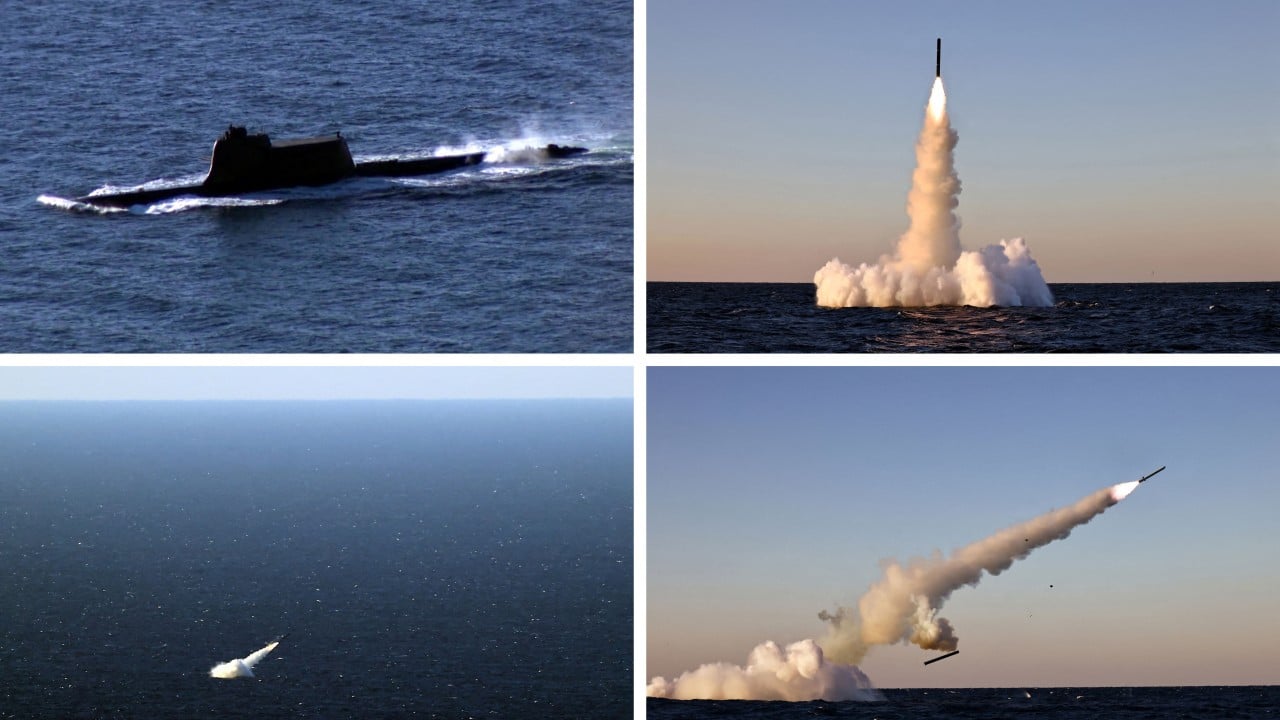
North Korea's submarine-launched cruise missile tests are not mere theatrical stunts designed to rattle South Korea's markets for a week. They are a calculated push to bypass radar detection and ballistic missile interceptors, creating a low-altitude strike option that forces Seoul to watch the sky and the seabed at the same time.
Standard coverage treats every missile launch off the Korean coast as a predictable cycle of provocation and condemnation. That habit misses the mechanical shift underway. A ballistic missile arcs high into space, leaving a predictable trajectory that early-warning radars and interceptors can track. A submarine-launched cruise missile skims close to the water and terrain, hugging the curvature of the earth to stay hidden until late in its flight. Pair that flight profile with a launch platform that hides beneath the waves, and South Korea's air and missile defense planners face a much nastier math problem. Meanwhile, you can find other developments here: The Smog We Inherit Every Autumn.
Over decades of covering defense procurement and intelligence assessments across Northeast Asia, one pattern has stayed consistent. Pyongyang rarely builds weapons for a single dramatic show; it builds them to complicate an adversary's decision tree. When a missile can come from an unknown coastal sector rather than a fixed launch pad, and fly low enough to slip under high-altitude radar beams, every military base, command post, and port in South Korea has to prepare for shorter warning times.
How Cruise Missiles Stress Air Defense
Cruise missiles are essentially small, unmanned aircraft carrying a warhead and a guidance system. Unlike ballistic rockets that burn heavy fuel early and coast along a high arc, a cruise missile uses a turbojet or turbofan engine to sustain powered flight over long distances. North Korea has publicly touted long-range cruise systems—including variants associated with the Pulhwasal-3-31 and Hwasal family—as capable of strategic strikes and potential nuclear delivery. To explore the full picture, we recommend the excellent analysis by NPR.
Height is the enemy of radar. Because the earth curves, land-based radars have a line-of-sight limit against low-flying targets. A missile flying low over sea or uneven terrain can stay masked behind hills, islands, or radar blind spots for much longer than a high-flying ballistic warhead.
Defending against low-altitude cruise missiles is an endurance and sensor problem. A single gap in radar coverage can turn a minutes-long warning into seconds.
Interceptors built to defeat ballistic missiles in their midcourse or terminal descent phases are often the wrong tool for a low-flying cruise missile. Defeating the cruise threat requires dense low-altitude sensor networks, airborne early-warning platforms, short-range air defenses, and fast command-and-control links that can hand off a target without losing track. Even when South Korea fields layered defenses, saturating or confusing those layers with low-flying decoys or varied approach angles remains a core operational risk.
To see why geography matters, consider a hypothetical example. Imagine a submarine slipping out under cover of darkness along an irregular coastline and firing a cruise missile toward a coastal logistics hub. If the missile hugs low terrain features along its path, ground radars stationed inland or behind ridges may detect it only after it clears a rise—leaving air defense batteries and base personnel with a compressed reaction window. That hypothetical scenario captures why military planners treat low-altitude cruise flight as a distinct headache from ballistic missile defense.
The Submarine Factor and Its Limits
Putting a cruise missile on a submarine adds a second layer of uncertainty. A mobile land launcher can be spotted by satellites, drones, or reconnaissance aircraft before it fires. A submerged boat hides under water, where acoustic conditions, salinity layers, and seabed clutter make tracking notoriously difficult.
Yet putting missiles on a submarine does not automatically hand Pyongyang an invincible fleet. North Korea's submarine force has long faced real limitations in noise reduction, battery endurance, and maintenance. Older diesel-electric hulls are louder than modern Western or South Korean submarines, making them more vulnerable to anti-submarine warfare patrols, sonar arrays, and maritime patrol aircraft once detected leaving port.
Analysts watching North Korea's naval program have also pointed to a gap between missile testing and operational fleet readiness. Testing a missile from a boat or test platform proves the launch sequence and flight hardware can work under controlled conditions. Turning that into a dependable, survivable sea-based deterrent requires trained crews, reliable underwater communications, dockyard upkeep, and hulls that can operate safely without giving away their position.
There is also a tension between stealth and survivability. A submarine that stays too close to shallow coastal waters to launch quickly may face tighter anti-submarine coverage and hazardous navigation. A boat that pushes farther out gains sea room, but faces longer transit times and tougher command-and-control links with Pyongyang.
| Capability Factor | Land-Based Ballistic Missile | Submarine-Launched Cruise Missile |
|---|---|---|
| Flight Profile | High arc into upper atmosphere, steep descent | Low-altitude powered flight hugging terrain or sea |
| Radar Visibility | Tracked early by long-range and missile radars | Can be masked by terrain curvature and low altitude |
| Launch Platform | Fixed silos or road-mobile transporter erectors | Submerged submarine operating in contested waters |
| Primary Defense Challenge | High-speed intercept and terminal defense | Low-altitude detection, tracking handoff, and point defense |
Why Seoul Feels the Pressure Now
Tensions between the two Koreas rarely rise in a vacuum. When submarine cruise missile tests occur alongside border friction, sharp rhetoric, and broader regional security strains, they compound existing anxieties in Seoul rather than sitting in isolation.
For South Korean leaders, the concern is not just a single test firing. It is what happens if Pyongyang pairs low-altitude cruise missiles with other asymmetric tools—such as drones, cyber operations, artillery, or ballistic systems—during a crisis. A multi-axis threat forces defenders to divide attention and interceptor stocks across different target types at the exact same time.
Conventional wisdom often assumes Pyongyang launches weapons solely to extract immediate diplomatic concessions or shock domestic audiences. Sometimes that is part of it. Other times, the driver is much more mundane and methodical: validating engineering fixes, drilling crews, collecting telemetry, and normalizing a wider menu of strike options so they look routine rather than extraordinary.
South Korea's response has leaned heavily on strengthening anti-submarine warfare, expanding surveillance and reconnaissance, and reinforcing deterrence with the United States. Still, no defense posture is airtight. Watching vast stretches of ocean and low-altitude airspace around the clock is expensive, manpower-intensive, and unforgiving of human or technical error.
What Analysts Actually Watch Next
Observers who have followed North Korean missile programs for years know better than to judge progress by state media photos alone. Official releases are edited for domestic morale and foreign intimidation, often withholding exact launch locations, flight paths, or technical setbacks.
Serious analysts look for quieter indicators instead:
- Launch Frequency and Variety: Whether tests shift from occasional showcase shots to repeated drills across different sea areas, launch tubes, or missile variants.
- Naval Deployment Patterns: Changes in submarine patrol tempo, shipyard activity, or support vessel movements near naval bases.
- Sensor and Command Integration: Signs that North Korea is practicing target updates or coordinated strikes rather than isolated single-missile flights.
- Alliance Counter-Moves: Adjustments in South Korean and U.S. anti-submarine patrols, coastal radar coverage, and joint readiness drills.
Another overlooked factor is cost asymmetry. A cruise missile is expensive to build compared to a basic rocket, yet it can still force a defender to expend costly air-defense interceptors or scramble aircraft to investigate a low-altitude track. Over time, that cost imbalance strains budgets and readiness even when no shots are fired in anger.
When a low-flying missile can launch from beneath the waves and slip past high-altitude radars, peace on the peninsula stops looking like a static standoff and starts looking like a constant test of nerves.