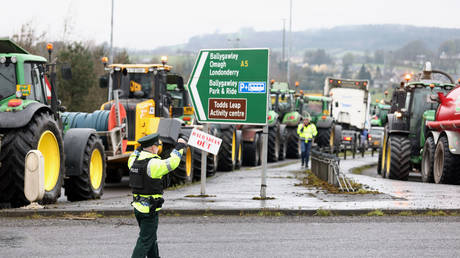
Northern Ireland didn't just wake up angry on Tuesday. The frustration has been simmering for months, but the sight of tractors clogging the Sydenham Bypass and the Westlink proves that the "breaking point" isn't a metaphor anymore. It’s a reality blocking your morning commute.
If you're wondering why farmers and hauliers are risking fines and police cautions to crawl along the M2 at ten miles per hour, the answer is simple. They can't afford to work, and they can't afford to stop. This isn't just about a few extra pence at the pump. It’s about a systemic failure that has left rural Northern Ireland feeling abandoned by both Stormont and Westminster.
The Reality of 180p Diesel
The numbers coming out of the pumps right now are staggering. Road diesel in Northern Ireland has hit roughly 180p per litre, and if you look across the water to parts of Britain, it’s pushing £2. For a haulier running a fleet or a farmer managing hundreds of acres, these aren't just "rising costs." They are business killers.
Perhaps the most heartbreaking image from the recent demonstrations wasn't the wall of steel on the A1. It was Martin Downey, a beef farmer from Dromore, who showed up to the protest on a bicycle. He didn't do it for the exercise or the environment. He did it because he literally couldn't afford the diesel to drive his tractor to the rally. When a food producer can't afford to fuel the machine that feeds the country, the system is broken.
The "perfect storm" cited by the Ulster Farmers’ Union isn't hyperbole. We're looking at:
- Red diesel prices doubling to over £1.20 per litre.
- Fertilizer costs skyrocketing alongside fuel.
- The knock-on effect of the Middle East conflict squeezing global supply.
Why the Republic’s Response Makes NI Feel Ignored
You can't talk about the protests in Belfast, Ballygawley, or Omagh without looking south of the border. Just days ago, the Republic of Ireland saw even more aggressive action—blockades at the Whitegate refinery and fuel depots that left many pumps dry.
The difference? The Irish government blinked.
Dublin rolled out a €505 million (£440m) support package. They cut excise duty on petrol and diesel. They delayed carbon tax increases. In Northern Ireland, protesters are looking at that deal and asking, "Where's ours?"
First Minister Michelle O’Neill has been vocal, pointing the finger directly at Keir Starmer. Her argument is hard to ignore: over half of what you pay at the pump is tax. While the Republic uses its fiscal levers to ease the pain, Northern Ireland is stuck waiting for Westminster to acknowledge that a "cost-of-living crisis" hits differently in a region where public transport is sparse and the car is a necessity, not a luxury.
The Human Cost of Blocked Roads
It’s easy to get angry at the protesters when you’re the one stuck behind a Massey Ferguson while trying to catch a flight at Belfast City Airport. We saw passengers on Tuesday abandoning taxis and dragging suitcases along the hard shoulder of the Sydenham Bypass. It’s messy. It’s inconvenient.
Health Minister Mike Nesbitt warned that these delays could literally cost lives if ambulances get caught in the gridlock. That's a heavy weight for any protester to carry. But the hauliers and farmers I’ve spoken to feel they have no other choice. They feel that if they don't cause a scene, they'll simply disappear quietly into bankruptcy.
What Actually Needs to Happen
If the government wants these convoys to vanish, they need to stop offering "sympathy" and start offering "subsidy." Here is what a meaningful response looks like:
- Immediate Fuel Duty Cut: The UK government needs to slash the tax portion of the pump price. If the Republic can do it, the UK can too.
- Targeted Haulier Support: A rebate system for essential transport providers to keep the supply chain from snapping.
- Emergency Farm Grants: Specific aid for red diesel users who are currently watching their margins evaporate into the soil.
The PSNI has been relatively low-key so far, issuing fixed penalty notices but mostly just managing the flow. But don't mistake that for a lack of tension. If Westminster continues to ignore the specific pressures on Northern Ireland’s rural economy, the "slow-moving convoys" will eventually become "no-moving blockades."
Stop waiting for the markets to "stabilize." They won't. The conflict in the Middle East isn't ending tomorrow, and the Strait of Hormuz remains a volatile choke point. We need local solutions for a global crisis, and we need them before the next round of tractors hits the Westlink.
Check your local traffic apps before heading out tomorrow. Avoid the major hubs like Sprucefield and the Toome bypass if you can. If you see a farmer on a bicycle at a protest, maybe don't honk your horn in anger. He’s probably fighting for your food prices as much as his own livelihood.