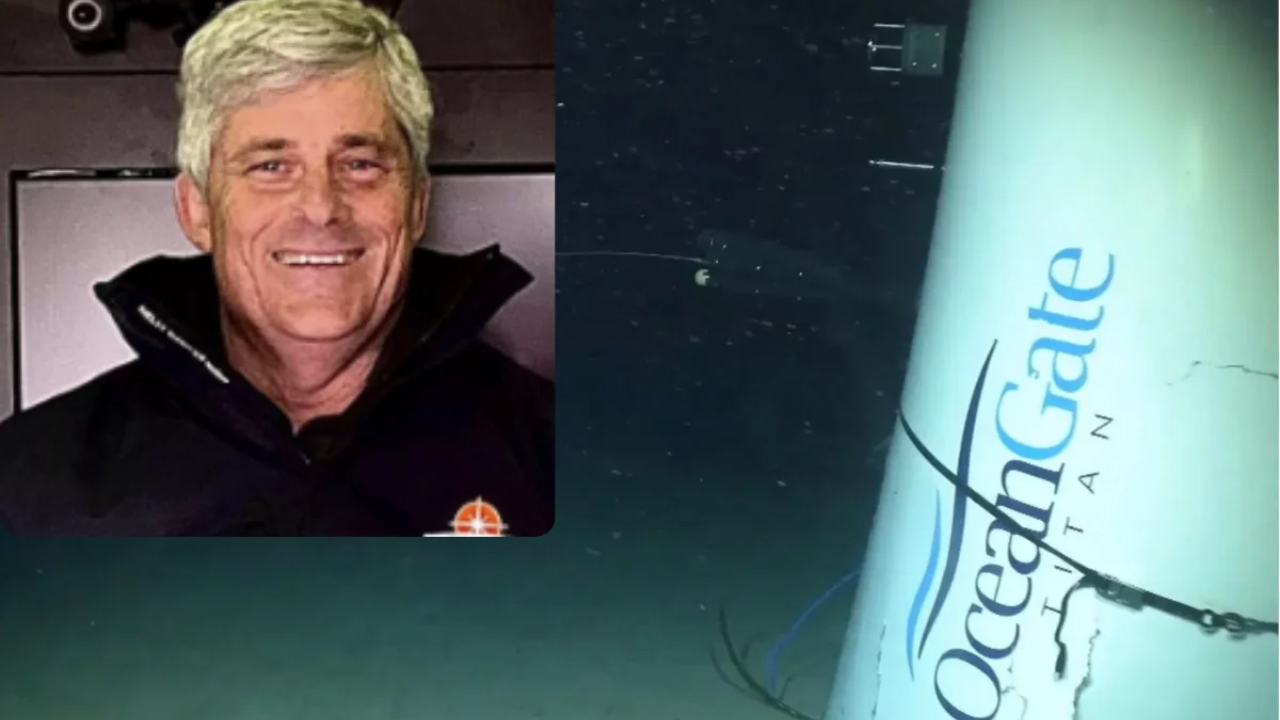
Claims that OceanGate CEO Stockton Rush intentionally engineered a fatal dive to join Titanic lore confuse high-risk organizational negligence with premeditated self-destruction. Official investigations by the U.S. Coast Guard (USCG) and the National Transportation Safety Board (NTSB) establish that the June 18, 2023 implosion of the Titan submersible—which killed all five people aboard at a depth of roughly 3,346 meters—was driven by unverified carbon fiber composite hull construction, flawed real-time monitoring analysis, bypassed third-party classification standards, and a corporate culture that sidelined safety warnings. Separating verified engineering and governance failures from speculative motives explains why the tragedy happened and how ultra-deep commercial ventures fail.
Competitor commentary centered on Karl Stanley’s interviews relies on a narrative of deliberate fatalism: Rush supposedly built a "mousetrap for billionaires" and sought historical immortality alongside paying passengers. That framing treats an extreme failure of risk management as an intentional plot. In high-consequence engineering, attributing catastrophic outcomes to secret suicidal intent rarely holds up better than examining incentive structures, confirmation bias, and institutional blind spots. When an executive repeatedly dives inside a vessel they built and believes they have outsmarted conventional rules, overconfidence and sunk-cost commitment offer a far more consistent explanation than a desire to die.
Deconstructing the Intent Claim vs. Known Facts
Evaluating claims about Rush’s motives requires separating confirmed technical and operational facts from after-the-fact psychological interpretations. Investigative bodies look for physical evidence, operational records, and repeatable failure mechanisms rather than retrospective character judgments.
Verified Facts from Investigations and Records
- Catastrophic Hull Failure: The USCG Marine Board of Investigation and NTSB determined that the Titan suffered a structural failure of its carbon fiber composite pressure hull around 10:47 a.m. on June 18, 2023, in the North Atlantic, exposing occupants to roughly 4,800 to 4,930 psi of external water pressure.
- Prior Acoustic and Structural Warnings: Investigations and prior accounts documented cyclic fatigue and hull anomalies, including delamination after earlier dives and acoustic cracking events that altered strain gauge behavior.
- Absence of Independent Classification: OceanGate declined third-party classification society certification and operated outside established pressure vessel for human occupancy (PVHO) standards, relying instead on its own internal assessments and real-time acoustic monitoring.
- Commercial Economics and Regulatory Gaps: Paying passengers ("mission specialists") were charged up to $250,000 per spot to help fund expeditions, while existing maritime and small passenger vessel regulations lacked specific enforcement mechanisms for novel deep-submergence composite hulls.
Educated Hypotheses and Contested Interpretations
- Psychological Motivation: Claims that Rush planned to die to enter Titanic mythology remain unverified hypotheses. While Rush spoke frequently about legacy, breaking industry conventions, and the cultural prominence of the Titanic, public statements favoring aggressive risk tolerance do not prove an intent to die.
- Legal Characterization: Retrospective commentary about "murder" misapplies criminal law categories. In legal analysis, intentionally risking one's own life alongside paying customers points away from premeditated murder and toward questions of gross negligence or reckless disregard, depending on jurisdiction and prosecutorial standards.
- Internal Employee Knowledge: Suggestions that staff uniformly anticipated an inevitable implosion overstate what can be proven across every employee. Whistleblowers and former personnel raised concrete safety alarms, yet organizational dynamics—hierarchy, authority gradients, and selective interpretation of sensor data—allowed operations to continue.
The Four Pillars of OceanGate's Failure Architecture
Rather than a secret plan for self-destruction, the Titan disaster reflects four interacting structural breakdowns that turned incremental hull degradation into a sudden collapse.
1. Material Physics and Unverified Fatigue
Deep-ocean submersibles operating at 3,800 meters face relentless hydrostatic compression. Traditional deep-diving submersibles have favored metals like titanium or acrylic spheres because their compressive behavior and fatigue characteristics are well understood and predictable. Carbon fiber composites behave differently under repeated high-pressure cycles: microscopic matrix cracking, resin voids, and ply delamination can accumulate without obvious external visual cues until local buckling triggers sudden collapse.
Without rigorous full-scale destructive testing, conservative safety factors, and independent validation, OceanGate lacked a reliable measure of the hull's true remaining strength. Downgrading a stated depth rating after observing fatigue signs acknowledges vulnerability without resolving the underlying structural risk when dives continue into extreme depths.
2. Monitoring Illusion and Data Misinterpretation
OceanGate promoted real-time acoustic and strain monitoring as a substitute for conventional certification. In theory, listening for acoustic emissions can detect micro-fracturing before catastrophic failure. In practice, sensor systems only protect a vessel if thresholds are calibrated accurately and operators are willing to halt operations when readings shift.
Investigators found that OceanGate's analysis of real-time monitoring data was flawed, leaving leadership blind to progressive structural deterioration after earlier dives. When a team believes its custom telemetry makes rule-breaking safe, anomalous signals are easily rationalized as sensor noise rather than treated as stop-work triggers.
3. Governance Breakdown and Normalization of Deviance
Sociologist Diane Vaughan's concept of the normalization of deviance describes how organizations gradually accept abnormal conditions as normal because prior rule violations did not immediately produce a disaster. Each dive that surfaced without an implosion reinforced the illusion that the hull's margins were sufficient.
When dissenting engineers, advisers, or acquaintances warn of structural hazards and are dismissed as overly cautious or uninformed, internal corrective feedback collapses. In safety-critical engineering, authority gradients matter: if the leader controls both technical sign-off and commercial schedules, warning signals get filtered out before they can force a redesign or halt.
4. Market Incentives and Regulatory Blind Spots
High-net-worth adventure tourism creates a distinct economic trap. Ticket prices in the hundreds of thousands of dollars fund capital-intensive operations, support vessels, and research ambitions, creating strong pressure to maintain expedition schedules. At the same time, international waters and specialized submersible categories sit outside routine oversight regimes.
When customers sign extensive waivers acknowledging extreme danger and regulators lack tailored rules for experimental PVHO craft, market discipline weakens. Wealthy participants may mistake high price and charismatic leadership for technical rigor, assuming that bespoke engineering equals proven safety.
Cause-and-Effect Chains the Narrative Misses
Sensational framing often jumps straight from "Rush ignored warnings" to "Rush wanted to die." A tighter causal chain shows how ordinary executive biases compound into catastrophe:
- Unvalidated design choice: Selecting a carbon fiber composite cylinder joined to titanium end caps without established classification standards introduced complex interfacial stress and fatigue uncertainty.
- Repeated cyclic loading: Every descent and ascent subjected the composite structure to extreme pressure cycling, allowing internal damage such as delamination to grow.
- Flawed diagnostic feedback: Misinterpreting monitoring outputs prevented the company from retiring the hull after damage occurred.
- Suppression of dissent: Framing external critics as obstacles preserved schedule momentum and founder autonomy.
- Instantaneous physical failure: Under roughly 4,800 to 4,930 psi, local buckling propagated across the weakened composite hull in milliseconds, leaving no survivable margin.
Notice what this sequence explains that a "death wish" theory cannot: why Rush spent years building a company, courting investors, recruiting partners, and piloting the craft himself. Founders rarely invest a decade building a venture to stage a suicide; they far more commonly fall prey to founder's syndrome, believing their intellect and custom instrumentation supersede decades of hard-won engineering norms.
Operational Lessons for High-Risk Ventures
Anyone building or evaluating hardware in extreme environments—deep sea, aerospace, energy, or autonomous systems—can apply a practical sequence to prevent similar blind spots.
Step-by-Step Risk Control Sequence
- Separate safety authority from commercial leadership. Give a chief safety or engineering authority an independent stop-work veto that cannot be overridden to save a schedule or expedition window.
- Treat sensor telemetry as a leading indicator for halt decisions, not a license to push limits. Define quantitative, pre-agreed abort and retirement thresholds before a vessel enters the water, and enforce them automatically when anomalies appear.
- Require independent peer review and third-party verification for novel materials. When using non-standard composites or unvalidated structures under extreme loads, mandate outside structural analysis and conservative derating rather than relying on internal optimism.
- Audit dissent channels systematically. Track every technical objection raised by staff, contractors, or external specialists, and document the physical proof required to close each concern.
- Align liability waivers with transparent risk disclosure, never as a substitute for engineering margin. Legal disclaimers do not alter material physics; if a system requires passengers to accept unquantified structural failure to operate, the design is not ready for commercial carriage.
Limits of These Controls
No governance process or sensor suite eliminates risk entirely in frontier environments. Even certified submersibles face unforgiving physics at 3,800 meters, and rescue options at extreme ocean depths remain severely constrained. Independent oversight can slow innovation and raise upfront capital costs, which is precisely why founders resist it—yet those added costs exist to catch hidden failure modes before lives are lost. Furthermore, organizational safeguards fail if leadership treats compliance as box-checking rather than genuine engineering humility.
Strategic Recommendation
Investors, expedition operators, and regulators evaluating extreme-environment ventures should treat founder conviction and proprietary monitoring claims as high-risk red flags unless backed by independent structural validation and formal stop-work governance. Before committing capital, partnering, or boarding an experimental craft, stakeholders should demand third-party engineering reviews, explicit hull-retirement criteria tied to objective data, and clear separation between commercial incentives and safety sign-off.