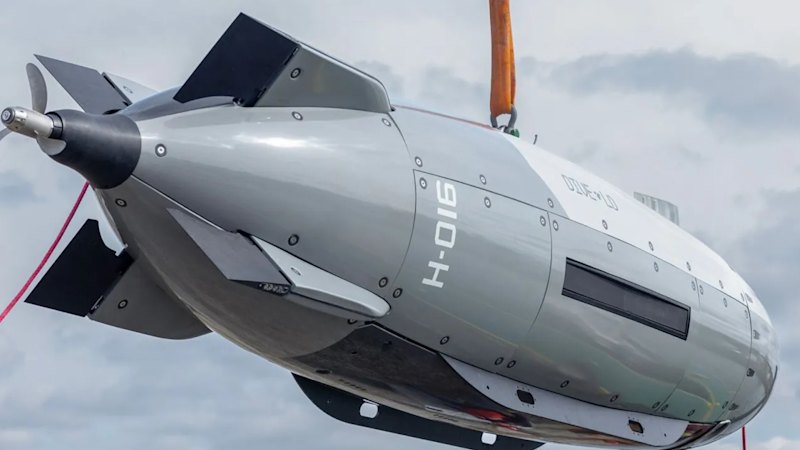
Every desk warrior in the defense media is hyperventilating over the Iranian Revolutionary Guard Corps dragging a piece of gray composite hull out of the Strait of Hormuz. Headlines scream about a major intelligence catastrophe, warning that Tehran has intercepted the crown jewel of American undersea technology.
They call it a high-tech intelligence coup. They are wrong.
The panic relies on a fundamental misunderstanding of what modern autonomous hardware actually is. The panic-peddlers look at a lost Anduril Dive-LD autonomous underwater vehicle and see a classified Pandora's box. The reality on the engineering floor is far more pedestrian and far more brutal for anyone hoping for a grand espionage breakthrough.
The Myth of the Reverse-Engineering Miracle
The lazy consensus claims that handing an uncrewed underwater vehicle to Iran gives their engineers a blueprint to copy Western capabilities. This argument assumes that seeing a finished piece of hardware lets you magically replicate the industrial base, material science, and proprietary software architecture behind it.
It does not.
Reverse-engineering a commercial-off-the-shelf derived autonomous hull is like stealing a Formula 1 steering wheel and expecting to build a championship engine factory in your garage. The value of systems like the Dive-LD is not locked inside a static fiberglass shell. It lives in iterative software loops, acoustic sensor calibration data, and manufacturing tolerances that cannot be copied simply by shining a flashlight down a flooded ballast tank.
If looking at a captured hull were enough to leapfrog decades of defense R&D, every nation with a coastline would possess a peer-level navy by now. Iran has recovered Western aerial and maritime drones before. It has changed the strategic balance of the Gulf by roughly zero percent each time.
Attritable Means Expendable
The Pentagon's response has been treated with cynical eye-rolls, with commentators claiming officials are merely saving face after a humiliating loss. "They would say that," goes the refrain.
This ignores the entire doctrine shift driving modern defense acquisition. Systems like the Dive-LD are explicitly classed as attritable. That is not a corporate PR euphemism. It is a mathematical calculation built into the unit cost and deployment lifecycle.
When you design hardware to operate in high-threat chokepoints like Hormuz while clearing mines or mapping seabeds, you build them with the expectation that some percentage of your fleet will fail, run aground, or get scooped up by adversaries. If losing a two-million-dollar composite tube ruins your operational strategy, your strategy is broken. The United States builds these things by the dozen precisely so that operators can shrug when one goes silent and keep moving files down the queue.
What The Panic Misses About Undersea Warfare
Focusing on the shiny metal object misses the actual war being fought beneath the surface waves. The real story in the Strait of Hormuz is not a floating piece of marine plastic. It is the relentless shift toward volume and persistence over single, exquisite platforms.
Traditional military thinking values rare, heavily defended platforms that cost billions and take decades to procure. Uncrewed systems invert that equation entirely. They trade individual invulnerability for collective saturation. If an adversary spends millions in fuel, manpower, and international posturing to salvage a dead drone that had already dropped its navigation logs and diagnostic faults, the operating economics favor the side that treats the platform as disposable.
Let Tehran parade their prize on evening broadcasts. Let the commentators spin grand yarns about compromised secrets. While they waste cycles tearing apart an empty shell, the deployment schedule for autonomous maritime swarms marches forward unaffected.
Stop treating every lost node in a distributed network as a national security emergency. In modern hardware attrition is just the cost of doing business.