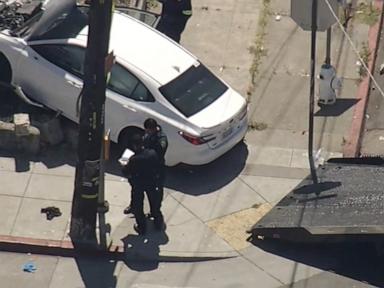
Urban traffic incidents involving underage operators and vulnerable road users expose systemic vulnerabilities within municipal infrastructure, licensing frameworks, and kinetic risk management. When a juvenile driver strikes a pedestrian in a designated crosswalk, the event is rarely an isolated anomaly of individual negligence. Instead, it represents the terminal failure of a multi-layered sociotechnical system. Deconstructing this failure requires examining the mechanical variables, human cognitive constraints, and structural design flaws that converge at pedestrian conflict points.
The Mechanics of Kinetic Energy Transfer
The physics governing vehicle-pedestrian collisions dictate the severity of bodily trauma. Kinetic energy scales quadratically with velocity according to the standard formula:
$$E_k = \frac{1}{2}mv^2$$
Where mass ($m$) is held constant by the vehicle class, increases in velocity ($v$) exponentially amplify the destructive energy delivered upon impact. A light passenger vehicle or SUV traveling at thirty miles per hour generates a force profile that frequently exceeds human biomechanical tolerance thresholds, particularly when blunt-force trauma is compounded by secondary ground strikes.
At designated crosswalks, pedestrian vulnerability is intensified by asymmetrical exposure. Unlike vehicular occupants protected by crumple zones, side-impact beams, structural pillars, and multi-point restraint systems, the pedestrian absorbs the entirety of the kinetic load directly.
When a driver fails to yield, the stopping distance function determines whether a collision occurs. Total stopping distance comprises perception distance, reaction distance, and braking distance. Underage drivers often exhibit elevated reaction times due to delayed neurological maturation in the prefrontal cortex, which governs risk assessment and impulse inhibition. When combined with sub-optimal vehicle control proficiency, the margin for error at urban conflict points narrows significantly.
Environmental and Structural Variables
Municipal street design frequently prioritizes vehicular throughput over pedestrian safety, creating high-risk environments at signalized and unsignalized intersections. Several structural factors contribute to collision probability:
- Sightline Obstructions: Parked vehicles, commercial signage, and unmanaged foliage obscure the visual corridor between approaching motorists and crossing pedestrians, compressing the time window available for evasive maneuvering.
- Lighting Deficits: Nighttime or low-light conditions severely degrade contrast sensitivity, reducing the visibility of pedestrians wearing non-reflective apparel.
- Intersection Geometry: Wide turning radii encourage motorists to execute turns at higher speeds, reducing their visual scanning arc and increasing the likelihood of failing to detect pedestrians within the crosswalk.
Addressing these variables requires shifting from reactive attribution of fault to proactive environmental hardening. Traffic calming mechanisms, such as raised crosswalks, bulb-outs that shorten crossing distances, and leading pedestrian intervals, fundamentally alter the kinetic and behavioral dynamics of the intersection.
Cognitive Load and Operator Competency
Evaluating the role of an underage operator necessitates a rigorous assessment of cognitive processing capacity under operational stress. Driving requires continuous multitasking: tracking dynamic variables, managing spatial boundaries, interpreting traffic signals, and anticipating unpredictable pedestrian movements.
Juvenile operators navigate these demands with less consolidated procedural memory than experienced drivers. When faced with an unexpected hazard—such as a pedestrian entering a crosswalk from a blind spot—cognitive overload can induce behavioral freezing or erratic input adjustments, such as mistaking the accelerator for the brake pedal.
The operational environment inside the cabin further compounds cognitive taxation. Distraction vectors, including digital interfaces and peer passenger dynamics, degrade attention allocation. In jurisdictions where graduated driver licensing systems exist, restrictions on passenger limits and nighttime driving attempt to mitigate these exact cognitive bottlenecks. However, compliance remains variable, leaving structural vulnerabilities exposed.
Systemic Interventions and Risk Mitigation
Mitigating future incidents demands an institutional overhaul of how urban corridors are managed. Relying solely on punitive measures after a critical injury occurs fails to address the root causes of systemic failure. Effective interventions operate across three distinct operational horizons:
- Infrastructure Redesign: Municipalities must eliminate wide multi-lane crossings in high-pedestrian zones, replacing them with protected intersections that physically compel lower vehicular speeds through tight turning geometries.
- Technological Integration: Widespread deployment of automated pedestrian detection systems and autonomous emergency braking technologies can override human cognitive lapses, neutralizing the delayed reaction times typical of inexperienced operators.
- Licensing Rigor: Graduated licensing structures must incorporate mandatory simulator-based stress testing to evaluate an operator's hazard perception and emergency response under high cognitive load before full operational privileges are granted.
Securing pedestrian safety in high-density environments requires abandoning the assumption that human vigilance alone can compensate for flawed design and high-energy mechanics. The elimination of catastrophic intersection failures depends on engineering systems that anticipate operator limitation and prioritize human vulnerability above vehicular velocity.