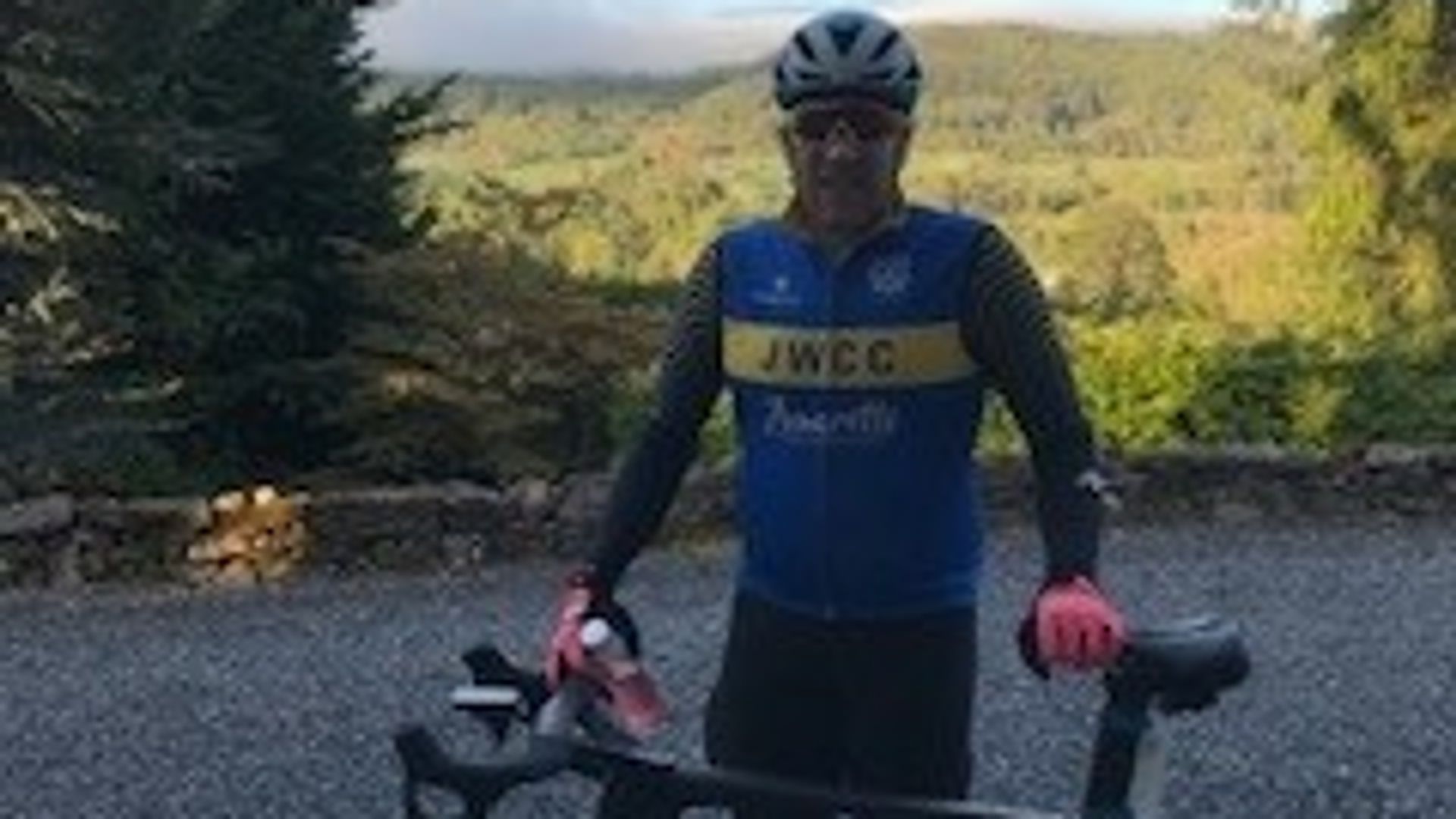
The routine was identical to dozens of previous Tuesday evenings. A tight formation of experienced riders from the Johnstone Wheelers Cycling Club rolled onto the westbound carriageway of the A8 in Inverclyde, locked into a steady paceline. Among them was 46-year-old Iain McTavish, a Glasgow University philosophy graduate, a consistent presence in local track leagues, and a fixture of the Scottish cycling scene. By 7:10 p.m., the pack had been violently broken apart by a collision with a Ford C-Max. McTavish was pronounced dead at the scene, while two of his companions were rushed to the hospital with severe injuries.
Standard news cycles process events like this through a predictable, sorrowful lens. Flowers are laid, grieving family members issue statements through police press offices, clubs post black-and-white photographs on social media, and authorities issue standard appeals for dashcam footage. Then, the road reopens. Traffic resumes its relentless flow, and the systemic vulnerabilities that turned a strip of asphalt into a lethal hazard fade back into the background. But cataloging grief is not the same as diagnosing a crisis. Every time a peloton is struck on an open arterial road, society treats the outcome as an isolated tragedy rather than the predictable mathematical result of shared infrastructure that violently prioritizes velocity over life.
The Anatomy of Arterial Risk
Roadways like the A8 are engineered for movement, not coexistence. High-speed multi-lane stretches create an environment where the kinetic energy of a modern passenger vehicle leaves zero margin for error. When a driver misjudges distance, suffers a momentary distraction, or fails to account for closing speeds against a group of cyclists, the physics are entirely one-sided.
In McTavish’s case, the collision occurred on an arterial stretch between Langbank and Woodhead, areas designed to keep regional traffic flowing at high velocity. Cyclists using these routes are entirely exposed, relying on scraps of asphalt or the precarious discipline of single-file positioning. Statistics from transport authorities across the United Kingdom consistently show that rural and semi-urban arterial roads carry a disproportionate fatality rate for non-motorized users. A driver operating a vehicle weighing upwards of 1.5 tons at 60 miles per hour occupies a space where human error is insulated by steel cages and airbags. A cyclist possesses only spandex and polystyrene.
Yet the official response remains locked in a loop of procedural reaction. Police Scotland launched an immediate appeal, urging witnesses with dashcam data to step forward. Sergeant Jack Swindells offered the requisite condolences to the family, noting that inquiries remain ongoing to establish the full circumstances. These investigations are necessary, but they routinely frame crashes as micro-events—attributing blame solely to the individual choices made in a split second by a specific driver or rider. They rarely interrogate the macro-failure: why high-speed traffic and vulnerable human bodies are permitted to occupy the exact same physical space without absolute physical separation.
The Cultural Friction on Open Roads
There is a deeper, uglier layer to cycling safety that transport analysts often whisper about but rarely address in official reports. Public hostility toward cyclists on open roads has curdled into something dangerously permissive. On any given weekend across Britain, riders training in bunches face aggressive close passes, deliberate engine revving, and shouted obscenities from motorists who view the presence of bicycles on major routes as an existential personal insult.
This hostility does not exist in a vacuum. It is fueled by cultural narratives that frame road space as an exclusive commodity paid for by motor vehicle taxation—a persistent legal and economic myth. When media outlets and politicians treat active transit as an inconvenience rather than a fundamental right, it creates a psychological license for driver negligence.
A motorist who views cyclists as illegal interlopers on "their" road is fundamentally less likely to grant them the mandatory three-foot buffer required for safe passing. While investigators have not suggested malice in the Inverclyde crash, the broader ecosystem of road use is defined by an underlying impatience. Drivers are rushed, distracted by dashboard interfaces, and conditioned to expect absolute, unhindered movement. When a group of disciplined, highly visible athletes riding in a tight formation like the Johnstone Wheelers still ends up struck from behind, it shatters the comforting illusion that high-visibility jerseys and flashing rear lights are enough to guarantee survival.
Beyond the Post-Accident Ritual
The aftermath of McTavish's death follows a well-worn script. Tributes pour in from Scottish Cycling, detailing his dedication to Georgetown time trials and his role as a rider representative on local committees. Friends remember a man who could be relied upon to turn up for a rainy training ride, a sharp intellect shaped by his philosophy studies, and a steady wheel in the local bunch.
These remembrances matter because they preserve the humanity of a person reduced to a police incident number. However, they risk masking the systemic policy failure underneath. Memorials do not alter asphalt. Condolences do not install physical barriers.
True reform requires abandoning the fantasy that painted white lines on high-speed roads constitute infrastructure. Countries that have successfully driven cyclist fatalities down to near-zero did not do so by running public awareness campaigns asking drivers to be nicer. They engineered the problem out of existence through mandatory protected cycle lanes, separated grade crossings, and strict strictures on urban and semi-urban speed limits.
Until transport departments treat the separation of cars and bikes with the same urgency as railway signaling, the local bunch will remain exposed to lethal hazards every time they roll out for a Tuesday evening training session. The flowers left on the A8 will eventually wither, but the underlying danger will wait patiently for the next ride.


