Every June, your social media feed probably fills up with inspirational quotes from Helen Keller. Well-meaning organizations post graphics about overcoming adversity, and politicians release boilerplate statements about inclusion. We call it Deafblind Awareness Month, but honestly, most of the public awareness it generates misses the point entirely.
People look at deafblindness and see a tragedy to pity or an impossible barrier to marvel at. They treat it like a rare, isolating medical anomaly. That view is wrong. It ignores a vibrant, highly organized community that is actively rewriting how humans communicate, navigate, and connect.
True awareness is not about feeling inspired by disabled people surviving in a world built for the sighted and hearing. It is about recognizing that deafblind people have built their own distinct culture, languages, and spaces. If you want to understand what Deafblind Awareness Month actually signifies, you have to look past the surface level charity drives and look at the real, lived experiences of the community today.
The Reality of Living Between Two Worlds
Deafblindness exists on a massive spectrum. A common misconception is that every deafblind person lives in total darkness and absolute silence. In reality, the vast majority of people within this community have varying degrees of residual vision, residual hearing, or both.
Some individuals are born deaf and lose their vision later in life due to genetic conditions like Usher syndrome. Others lose both senses over time due to illness, trauma, or the natural aging process. Because the combinations of sight and hearing loss are unique to each person, there is no single cookie-cutter way to navigate life as a deafblind individual.
Navigating public spaces presents a constant logistical challenge. Think about how much information you process passively. The chime of a subway doors closing. The flashing walk signal at a crosswalk. The overhead announcement at an airport. When you lack reliable access to those auditory and visual cues, the world becomes a place of forced dependency unless intentional accessibility systems are in place.
The community faces massive systemic barriers in employment and education. Data from the National Center on Deaf-Blindness reveals that thousands of children in the United States require specialized academic support that many school districts struggle to provide. Without trained interveners—professionals who act as the eyes and ears for a deafblind child—these students are left adrift in classrooms that cannot accommodate them. The story changes very little in adulthood. Unemployment rates remain stubbornly high because employers assume accommodating a deafblind worker is too difficult or too expensive. It is a failure of imagination, not a failure of capability.
Moving Past the Ghost of Helen Keller
You cannot talk about deafblindness without talking about Helen Keller. Born on June 27, 1880, her birthday is the exact reason why the United States celebrates Deafblind Awareness Month in June, a tradition officially kicked off by President Ronald Reagan in 1984.
Keller was a brilliant author, political activist, and lecturer. Yet, modern media has flattened her legacy into a simple cartoon. We are taught about the breakthrough at the water pump where she learned the word for water, and then the story basically stops. She is frozen in time as a grateful child who was "saved" by her teacher, Anne Sullivan.
This hyper-focus on Keller as a singular historical miracle does a disservice to the modern deafblind movement. It creates an impossible standard. When a single historical figure represents an entire disability group, society expects every deafblind person to be a world-renowned academic or a quiet, compliant symbol of inspiration.
The modern community wants autonomy, not sainthood. They are advocates, artists, parents, software engineers, and community organizers. They deal with mundane struggles like fighting with health insurance companies for equipment or dealing with broken braille displays. By keeping the conversation stuck in 1880, we avoid dealing with the systemic failures of 2026.
The Evolution of Tactile Language and Protactile Culture
Communication is where the deafblind community shows its true ingenuity. When you cannot rely on sight or hearing, touch becomes the primary vehicle for language.
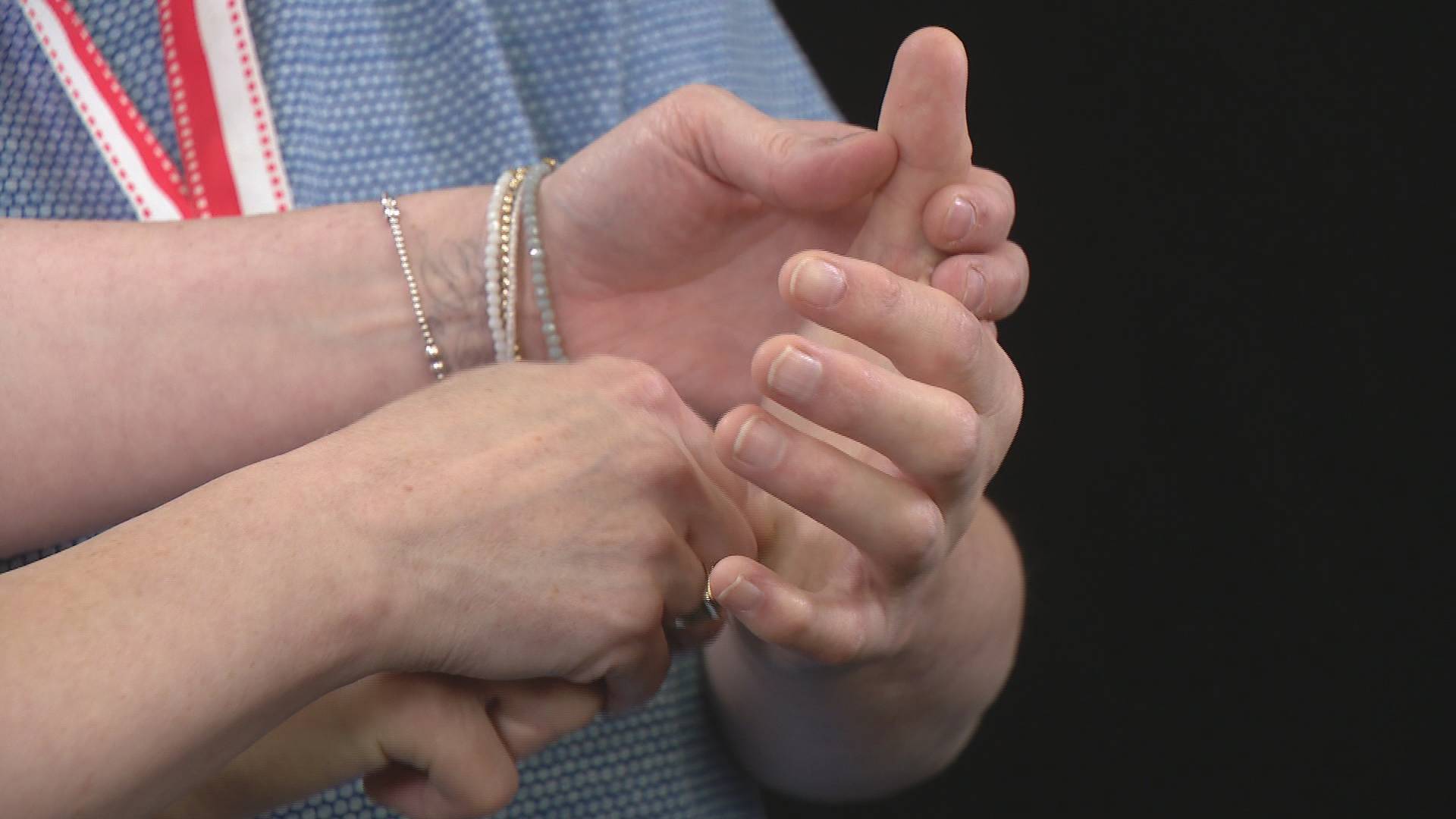
For decades, many deafblind individuals used tactile American Sign Language (ASL). This involves a deafblind person placing their hands lightly over the hands of a signer to feel the shape, movement, and location of the signs. It works well, but it historically relied on a visual language being adapted for touch. It kept the deafblind person in a somewhat passive role, constantly trying to visualize what a sighted signer was doing.
That dynamic changed radically with the birth of Protactile.
Originating in the early 2010s through the work of deafblind leaders like Jelica Nuccio and John Lee Clark, Protactile is a language built entirely by and for deafblind people. It does not rely on visual imagery or translation from a spoken language. It is a purely tactile language that uses the receiver's body—their hands, arms, shoulders, and back—as the space where language happens.
Visual ASL vs. Protactile Communication
-----------------------------------------------------------------
Visual ASL: Requires line of sight, facial expressions, and spatial tracking.
Tactile ASL: One-way hand-over-hand tracking of visual signs.
Protactile: Multi-directional touch, real-time feedback on the body, entirely non-visual.
In a Protactile conversation, feedback is instantaneous. If you are listening to someone tell a story in Protactile, you do not wait for them to finish signing to respond. You tap on their thigh or arm to signal agreement, laughter, or confusion while they sign. It eliminates the isolation of waiting for a translation. It makes communication a deeply shared, reciprocal experience. The rise of Protactile has triggered a cultural shift, proving that touch is a sophisticated, complete medium for human thought.
Technology is a Lifeline with a Massive Price Tag
Technology has drastically altered what is possible for deafblind autonomy. Refreshable braille displays connect to smartphones and computers via Bluetooth, translating digital text into raised pins in real time. Screen readers convert text into highly amplified audio or feed it directly into compatible hearing aids. Optical character recognition software allows a smartphone camera to scan a printed document and instantly convert it to braille.
These tools are life-changing. They are also astronomically expensive.
A high-quality refreshable braille display can easily cost thousands of dollars. Specialized software licenses run into the hundreds. For an individual living on a fixed disability income or struggling to find steady work, these tools are completely out of reach.
Government assistance programs and vocational rehabilitation services exist, but navigating the bureaucracy to get these devices funded takes months, sometimes years. If your device breaks down, the repair costs can leave you disconnected from the digital world for weeks. Technology can bridge the gap between isolation and independence, but only if you can afford to cross that bridge.
The Unsung Heroes of Autonomy
Independence does not mean doing everything entirely alone. For the deafblind community, true independence often requires working alongside Support Service Providers (SSPs) or Co-Navigators.
These professionals act as a human bridge to the environment. They do not make decisions for the deafblind individual, and they do not act as traditional caretakers. Instead, they provide objective visual and environmental information.
If a deafblind person goes to the grocery store, a Co-Navigator will describe the layout, read product labels, note prices, and point out where the checkout line begins. If they attend a public meeting, the Co-Navigator will sign or write out who is speaking, describe the room's layout, and convey the emotional energy or facial expressions of the crowd.
Funding for these services is incredibly fragile. There is no comprehensive federal program in the United States that guarantees SSP or Co-Navigator services for every deafblind person. Funding is a patchwork of state grants, local non-profits, and volunteer networks. When budgets get cut, these services are often the first to go, trapping individuals in their homes and cutting them off from their communities.
How to Move Beyond Passive Awareness
Awareness without action is just performance. If you want to celebrate Deafblind Awareness Month in a way that actually matters, you need to change how you interact with the world and advocate for structural change.
Start by auditing the spaces you control. If you run a business, manage a website, or organize public events, look at your accessibility features through a non-visual, non-auditory lens.
- Make sure your digital content is fully compatible with screen readers and braille displays by writing clear alt text for images and avoiding messy, unlabelled buttons.
- Advocate for stable, permanent funding for state Co-Navigator programs so deafblind individuals do not have to ration their hours of community access.
- Support businesses and organizations that actively hire deafblind professionals and invest in tactile access.
- Educate yourself by reading work written by deafblind authors and advocates rather than relying on stories told about them by sighted and hearing creators.
Stop treating deafblindness like a tragedy that requires your pity. Start treating it as a distinct human experience that requires your respect, your structural accommodation, and your political solidarity.

:max_bytes(150000):strip_icc()/parts-of-a-swamp-cooler-2718628-a477e6f0787b4f8bb62ddf2def31d495.png)