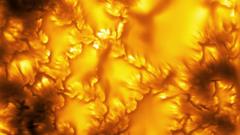
You have never seen our home star quite like this. Astronomers just published the sharpest, most detailed images of the sun’s visible surface ever captured, revealing chaotic and beautiful structures that change everything we thought we knew about stellar physics.
Forget what you remember from old textbook diagrams. The sun's photosphere isn't a smooth, uniform golden disk. It is a violent, churning soup of plasma, and scientists are finally peering down at features as small as 12 miles across. To put that clarity into perspective, it is equivalent to spotting a single coin or a tiny fruit from over seventy miles away.
Inside the Inouye Solar Telescope Breakthrough
The secret behind these jaw-dropping visuals is the National Science Foundation's Daniel K. Inouye Solar Telescope, perched high on a volcanic summit in Maui, Hawaii. With a massive four-meter primary mirror, it collects a staggering amount of light, cutting through atmospheric distortion with specialized techniques developed by an international team of researchers.
When lead authors like astronomer David Kuridze first reviewed the processed data, the findings blew them away. Instead of standard convection cells, the high-resolution frames exposed ultra-fine dark striations and spiraling, wave-like vortices. These swirling patterns aren't just visually striking. They provide the first empirical confirmation of a long-theorized physical process on our star.
Solving the Kelvin Helmholtz Mystery
For decades, physicists debated whether a specific fluid dynamic known as the Kelvin-Helmholtz instability could happen right on the sun. On Earth, you see these types of rolling, wave-like billows in ocean currents or cloud formations. Proving they exist on a star fueled by raging plasma was another story entirely.
These new observations confirm that fast-moving plasma sliding past slower fluid creates these exact cascading disruptions. The crests resemble curling waves or textured brush strokes, marking a massive win for fluid dynamicists and solar researchers alike.
Why should you care about plasma swirls millions of miles away? Because they directly answer some of the most frustrating questions in modern astrophysics.
Cracking Open the Corona Puzzle
For a long time, science faced a glaring contradiction. The sun’s surface sits at a balmy 10,000 degrees Fahrenheit, but its outer atmosphere—the corona—reaches millions of degrees. Logic dictates that moving away from a heat source should lower the temperature, yet the opposite happens in space.
These newly captured surface vortices offer a clean explanation. As these tiny whirlpools break down energy flows, they inject extra magnetic energy upward into the corona. They also act as the missing link for flux braiding, where magnetic field lines wrap around each other like twisted hair until they snap and release explosive power.
When those magnetic lines break, they drive solar flares and coronal mass ejections. Understanding how these micro-scale features trigger macro-scale solar weather helps protect our planet's power grids, satellites, and GPS networks from sudden disruptions.
Grab a clear look at the published research in the journal Nature if you want to dive into the technical math. Otherwise, just appreciate that our understanding of the sky above us just got a whole lot sharper.