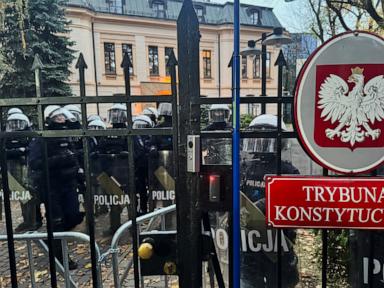
Three protesters ended up in handcuffs outside a Warsaw courthouse while the Polish president publicly defended a suspended judge. Most international headlines treated this like just another localized street scuffle in Central Europe. They missed the entire point.
If you're trying to understand why police detained protesters during a rally as the Polish president backed a suspended judge, you can't look at the arrests in isolation. Those three detentions are a symptom of a decade-long constitutional tug-of-war over who actually controls Poland's courts. When the head of state steps into the middle of a disciplinary battle over a single judge, it isn't just political theater. It's a deliberate stress test of the country's democratic guardrails.
I've followed Central European judicial politics closely for years, and the biggest mistake outsiders make is viewing these rallies through a simple left-versus-right lens. It's much messier than that.
Why a Single Suspended Judge Sparked Street Arrests
You might wonder why a disciplinary ruling against one judge brings crowds into the streets and forces riot police to intervene. In Poland, individual judges have become walking symbols of the rule of law.
Under the former Law and Justice (PiS) government, sweeping judicial overhauls created new disciplinary chambers and changed how judges are appointed. Critics—including the European Court of Justice—argued these changes stripped courts of their independence. Judges who pushed back or applied European Union law over domestic political decrees suddenly found themselves suspended, stripped of immunity, or transferred to dead-end posts.
When a new coalition government took power in late 2023 under Prime Minister Donald Tusk, millions of voters expected an immediate reset. It didn't happen.
The roadblock? The presidency.
Poland operates under a semi-presidential system where the president holds veto power over legislation and appoints judges upon the recommendation of the National Council of the Judiciary. When a Polish president backs a suspended judge—or defends judges appointed under the disputed post-2017 system—it directly collides with the sitting government's efforts to undo those reforms.
Street rallies erupt because citizens feel trapped between two competing legal realities. One side sees the suspended judge as a victim of political retaliation. The other side views the disciplinary action as a necessary cleanup of an illegitimate system.
What Actually Happens When Police Detain Protesters at Polish Rallies
Let's clear up a common misconception about crowd control in Warsaw. When news breaks that police detained three protesters during a rally, people abroad often picture massive, violent riots.
Usually, that's not what's happening on the ground.
Polish police operate under strict public assembly laws that give officers wide latitude to remove individuals who block court entrances, ignore dispersal orders, or refuse to show identification. In tense judicial protests, demonstrators frequently sit on courthouse steps or form human chains to block vehicles carrying judges or disciplinary officials.
Detentions in these scenarios typically follow a predictable pattern:
- Physical obstruction of public buildings or official motorcades triggers immediate police warnings.
- Refusal to clear an access route leads to officers physically carrying protesters away from the perimeter.
- Identity checks and misdemeanor charges follow at a local precinct, where detainees are usually held for several hours before being released with a court summons.
Three arrests out of a crowd of hundreds or thousands actually signals restraint rather than a sweeping crackdown. Yet those three handcuffs dominate the news cycle because they provide dramatic visuals for a deeply polarized media environment. State-aligned outlets frame the detainees as aggressive lawbreakers disrupting public order. Opposition outlets paint them as peaceful defenders of constitutional democracy.
Both narratives ignore the legal gray zone that put those protesters on the pavement in the first place.
The Constitutional Deadlock Nobody Wants to Admit
Here's the uncomfortable truth about Poland's judicial crisis. Right now, two parallel legal systems exist inside the same country.
Think about what that means for an ordinary person going to court over a divorce, a business dispute, or a property claim. Depending on which judge hears your case, the losing side can argue the verdict doesn't legally exist because the judge was appointed by a contested council.
This isn't a theoretical problem for law professors. It's a practical nightmare.
- Disputed appointments mean thousands of rulings sit under a cloud of potential invalidation by European courts.
- Presidential vetoes prevent the parliament from passing clean legislative fixes without the president's signature.
- Disciplinary standoffs leave suspended judges in limbo, sometimes still drawing partial pay while barred from hearing cases, or continuing to issue rulings that ministry officials refuse to recognize.
When the Polish president publicly backs a suspended judge, he's reinforcing his interpretation of the constitution—one that insists presidential prerogatives over judicial appointments are absolute and cannot be questioned by parliament or other courts.
To critics, that stance looks like obstruction. To supporters, it's the only thing stopping the government from purging the judiciary of conservative voices.
How Media Framing Distorts the Polish Judicial Crisis
If you only read quick wire summaries about police detaining protesters during a rally while the president backs a suspended judge, you get whiplash. The headlines sound almost identical whether the rally happened in 2021, 2023, or 2026.
That repetition creates fatigue. Readers tune out because the story seems frozen in time.
Look closer at the details, though, and the dynamics have shifted dramatically. Years ago, street protests outside the Supreme Court and the Constitutional Tribunal drew tens of thousands of people holding candles and copies of the constitution. Today, the crowds are smaller, sharper, and often organized by hardcore activist networks or rival political factions rather than broad grassroots movements.
Why did the crowd sizes shrink while the political temperature stayed sky-high?
Exhaustion plays a huge role. People have watched politicians trade accusations of "constitutional coups" for over a decade without delivering a stable compromise. Another factor is complexity. Explaining the difference between an "old judge" and a "neo-judge" appointed after 2018 takes ten minutes of legal background. Nobody puts a ten-minute legal lecture on a protest banner.
Instead, the conflict gets boiled down to personalities. One suspended judge becomes the focal point. One presidential statement sets off a press conference war. Three protesters get detained trying to breach a police cordon, and the entire systemic crisis gets reduced to a 30-second video clip.
The European Union's Quiet Role in the Background
You can't separate domestic Polish court battles from Brussels. Every time a judge is suspended or reinstated in Warsaw, lawyers in Luxembourg and Brussels take notes.
The European Commission tied billions of euros in recovery funds to specific judicial milestones—specifically, dismantling contested disciplinary mechanisms and restoring the right of judges to question the status of their peers without facing punishment. While major tranches of EU money were unlocked after Poland presented an action plan to restore the rule of law, the underlying structural problems haven't disappeared.
The European Court of Human Rights in Strasbourg continues to issue rulings against Poland over violations of the right to an independent tribunal established by law. Each ruling costs Polish taxpayers money in compensation awards and adds diplomatic pressure on Warsaw.
Yet external pressure has limits. Brussels can freeze funds or levy daily fines, as it did during the height of the dispute over the Turow coal mine and the Supreme Court Disciplinary Chamber. What Brussels cannot do is force a Polish president and a Polish prime minister to agree on how to rewrite domestic statutes.
That stalemate leaves judges caught in the crossfire. If a judge follows EU case law, they risk domestic disciplinary backlash from allies of the presidency. If they ignore EU rulings, their decisions risk being overturned at the European level.
Why Presidential Backing Matters More Than Street Rallies
Street protests grab cameras, but presidential backing changes the legal math.
In Poland, the president isn't a purely ceremonial figurehead like in Germany or Italy. Beyond vetoing bills, the president can refer laws to the Constitutional Tribunal before or after signing them, issue pardons, and refuse to administer oaths of office to judicial candidates.
When the president steps forward to defend a suspended judge, he sends three clear signals:
- To the judiciary: Judges aligned with the president's legal view know they have political cover from the highest office in the land.
- To the government: Any attempt to remove or discipline judges without presidential sign-off will face an immediate constitutional challenge.
- To the public: The presidency intends to remain an active participant—not a neutral referee—in defining what counts as legal authority in Poland.
This dynamic explains why peaceful rallies outside courthouses escalate so quickly. Protesters aren't just yelling at a building; they're reacting to the realization that standard parliamentary elections haven't resolved who holds the gavel. When voters feel the ballot box didn't settle the argument, some of them take their frustration to the barricades.
How to Follow Polish Political News Without Getting Misled
If you want to track developments around Poland's courts, protests, and executive standoffs accurately, stop relying on single-paragraph breaking news alerts. They strip away the exact context you need to tell a routine political squabble apart from a genuine constitutional rupture.
Check three specific details whenever a story like this crosses your feed:
- Identify which court or chamber is involved. A dispute inside a regional administrative court carries very different weight than a standoff inside the Supreme Court or the Constitutional Tribunal.
- Look at the legal mechanism behind the suspension. Was the judge suspended by a court president, a disciplinary officer appointed by the Justice Ministry, or a judicial body? The answer tells you which side initiated the move.
- Watch the legislative calendar, not just the protest crowd. Real shifts in Poland's rule-of-law crisis happen when bills pass parliament without a presidential veto, or when high courts issue binding resolutions—not when three people get ticketed outside a courthouse gate.
Pay attention to how both Warsaw and Brussels react over the next 48 hours following any detention or presidential statement; that's where the real political leverage shows up.


