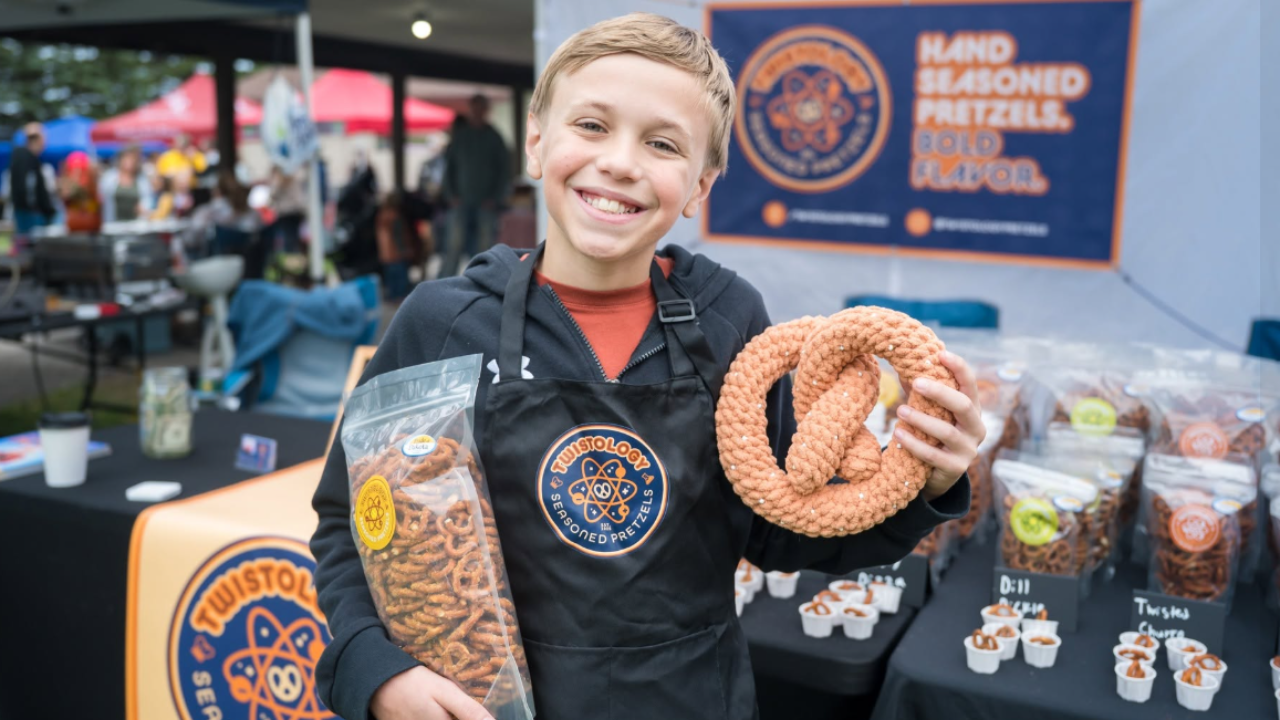
Two dollars sounds like pocket change. Most aspiring entrepreneurs wouldn't bother bending down to pick up a two-dollar bill, let alone build an entire company around a $2 price tag.
Yet a 13-year-old proved that low-ticket, high-volume food sales can outpace complicated tech startups before a kid even gets a driver's license. When you look closely at how a 13-year-old built a homemade pretzel business selling bags for $2, you realize the magic wasn't in a secret family recipe. It was in friction-free pricing, smart unit economics, and understanding human impulse buying better than most MBA graduates. For an alternative perspective, check out: this related article.
If you're a parent looking to teach your kid real business skills—or an adult trying to launch a low-cost side hustle from your kitchen—you probably overcomplicate the first step. You worry about logos, websites, and LLC filings before you've sold a single bag of snacks. Stop doing that. Here's how a simple $2 pretzel model actually works in the real world, why it succeeds where fancier ideas fail, and how you can replicate the mechanics legally and profitably.
The Psychology Behind the $2 Price Point
Price tags create friction. The higher the number, the longer a buyer pauses to calculate value. Further insight on this trend has been provided by MarketWatch.
When a customer sees a $7 gourmet pastry at a local market, they hesitate. They check their wallet, think about their budget, and often walk away. When they see a warm, salty bag of homemade pretzels for $2, the brain skips the math entirely. Two dollars sits right inside the "impulse zone"—an amount so small that saying yes feels effortless.
In behavioral economics, researchers often point to the "pain of paying," a concept popularized by Carnegie Mellon professor George Loewenstein. Every time we hand over money, the brain registers a mild discomfort. Cash hurts more than credit, and odd, higher prices trigger scrutiny. A flat $2 price eliminates coin-counting hassle and lowers the pain of paying to near zero.
Consider an illustrative example of how this plays out at a Saturday youth soccer tournament. Imagine setting up near the bleachers with a basket of warm pretzel bites. A parent holding two kids and a folding chair doesn't want a $12 artisanal box. They have a few crumpled singles in their pocket. Selling 50 bags at $2 takes less than an hour because nobody has to think twice. You make $100 in gross revenue before halftime, and half your buyers immediately ask if you'll be back next weekend.
Low prices also invite repeat purchases on the spot. Someone buys one bag for themselves, takes two bites while walking away, realizes how good fresh baked dough tastes, and turns around to buy three more for their family. You can't get that kind of velocity with a $15 product.
Breaking Down the Real Unit Economics of Homemade Pretzels
People assume you can't make real profit selling food for $2. Those people haven't looked at the wholesale cost of flour, yeast, and salt.
Bread-based snacks boast some of the highest gross margins in the entire food industry. Unlike meat, dairy-heavy pastries, or fresh berries, pretzel dough relies on shelf-stable commodities that cost pennies per serving. Let's look at the actual numbers using standard US grocery and bulk warehouse pricing so you can see how the math holds up.
An illustrative batch of homemade soft pretzels or pretzel bites requires basic ingredients:
- All-purpose or bread flour: A 25-pound bag at a warehouse club like Costco or Sam's Club costs roughly $10 to $13. That breaks down to about $0.45 per pound. One pound of flour yields roughly three to four generous snack bags of pretzels, putting your flour cost around $0.12 to $0.15 per bag.
- Active dry yeast: Buying yeast in a one-pound vacuum-sealed brick costs around $6 to $8. Since a batch only needs a tablespoon or two, your yeast cost sits around $0.03 per bag.
- Baking soda, salt, and brown sugar: Baking soda is essential for that classic chewy, browned pretzel crust (most home bakers boil dough in a baking soda bath rather than handling food-grade lye). Coarse pretzel salt, water, and a touch of brown sugar or butter add another $0.10 to $0.15 per bag.
- Packaging: Clear food-safe cello bags or brown kraft paper snack bags bought in bulk packs of 500 run roughly $0.04 to $0.06 each.
Add that up. Your total Cost of Goods Sold (COGS) sits right around $0.35 to $0.40 per bag.
Sell that bag for $2.00, and you keep $1.60 in gross profit on every single unit. That's an 80% gross margin. Even if you factor in electricity for the oven, parchment paper, and a small bottle of mustard or cheese dip on the side, you're still clearing well over $1.25 per bag.
Compare that to a classic lemonade stand, where fresh lemons, ice, cups, and sugar often eat up 50% to 60% of revenue—and where melted ice ruins unsold inventory. Pretzels hold up at room temperature for hours, travel easily in insulated totes, and deliver restaurant-level margins out of a standard residential kitchen.
Why a 13-Year-Old Has an Unfair Advantage
Adults fail at micro-businesses because we get embarrassed. Teenagers don't carry that baggage yet.
When a 13-year-old walks up to neighbors, coaches, or local shop owners with a basket of freshly baked pretzels, people actually want to engage. Kids get doors opened that stay slammed shut for adults. Customers love supporting young hustle, especially when the product genuinely tastes good and doesn't feel like a charity handout.
A teenager also operates with near-zero overhead. There's no commercial rent, no payroll tax, and no debt service eating into daily sales. Every dollar earned goes straight into ingredient restocks, better baking trays, or a savings account. That creates an immediate feedback loop: bake on Friday night, sell on Saturday morning, count cash on Saturday afternoon.
The biggest mistake parents make when their kid shows interest in a business like this is taking over the hard parts. Don't handle the cash. Don't pitch the customers. Let your kid figure out what happens when they burn a tray of dough or miscalculate how much salt goes into the boiling water. Those tiny, low-stakes failures teach operational discipline way faster than any textbook ever could.
What Most Home Bakers Get Wrong About Cottage Food Laws
Before you fire up your oven and start bagging pretzels for the neighborhood, we need to talk about the legal reality. You can't just sell homemade food anywhere you want without checking state rules first.
In the United States, homemade food businesses operate under Cottage Food Laws. Every single state has its own version of these rules, and they vary wildly. Organizations like the Institute for Justice track cottage food regulations nationwide, and their research shows just how much state lines matter.
Here's what trips people up:
- Non-potentially hazardous foods only: Most states allow you to bake and sell shelf-stable foods from a home kitchen without a commercial health inspection. Plain, salted, or cinnamon-sugar pretzels almost always qualify because baked bread doesn't require refrigeration. The moment you add cream cheese filling, cheddar cheese sauce, or meat toppings, you cross into "potentially hazardous" territory, which usually requires a licensed commercial kitchen.
- Where you can sell: Some states—like Texas, California, and Florida—allow direct-to-consumer sales at farmers markets, roadside stands, and from your front porch. Other states restrict sales to specific venues or cap your annual gross revenue (caps range from $15,000 in some states up to $50,000 or more, while states like Wyoming and North Dakota have removed revenue caps altogether under food freedom laws).
- Labeling requirements: Even at a $2 price point, cottage food rules almost always require a printed label on each bag. You typically need to list the product name, your name and home address (or registered kitchen number), a full list of ingredients in descending order by weight, major allergens (wheat, milk, soy), and a disclaimer stating the food was made in a home kitchen not inspected by the state health department.
Printing basic address labels at home costs less than two cents per bag and keeps your operation completely above board. Check your state Department of Agriculture website before selling outside your immediate circle of friends and family.
How to Nail the Product So People Come Back
A $2 price tag gets someone to buy once. Quality is the only thing that gets them to buy next week.
If you hand someone a dense, dry hockey puck of dough, they won't care that it only cost two bucks. Soft pretzels rely on a specific chemical reaction to achieve that dark brown, chewy exterior and fluffy interior.
Traditional Bavarian pretzels get dipped in a food-grade lye solution before baking. For a 13-year-old working in a home kitchen, lye is dangerous—it's caustic and can cause chemical burns if splashed. Skip it. Instead, use a boiled baking soda bath (roughly half a cup of baking soda dissolved in 8 to 10 cups of boiling water). Dropping the shaped dough into boiling alkaline water for 20 to 30 seconds gelatinizes the starches on the outside of the dough. When it hits the hot oven, the Maillard reaction kicks into overdrive, giving you that unmistakable pretzel flavor and mahogany color safely.
Bite-sized pieces beat full-sized twisted pretzels for a $2 bag model every single time. Here's why:
- Portion control is effortless. Rolling dough into long ropes and cutting one-inch nuggets lets you weigh out exact 4-ounce or 5-ounce portions per bag. With full-sized pretzels, one misshapen twist looks noticeably smaller than the next, making customers picky.
- Faster baking times. Small bites bake in 8 to 10 minutes instead of 15 to 18, letting a single standard home oven crank out dozens of servings per hour.
- Easier street eating. Customers walking around a craft fair, sporting event, or neighborhood block party can pop pretzel bites straight from the bag without needing a plate, napkins, or two free hands.
Offer just two flavors to start: classic coarse sea salt and cinnamon sugar. Too many options slow down production and confuse buyers at the point of sale. Keep the menu tight, master the bake, and focus on speed.
Where to Sell $2 Pretzel Bags Without Paying Expensive Booth Fees
If you spend $150 on a vendor booth at a city festival, you have to sell 75 bags of pretzels just to break even on rent. That's a terrible way to start a micro-business.
Instead, go where hungry crowds already gather without charging steep vendor fees:
- Youth sports complexes and local parks: Weekend baseball, soccer, and basketball tournaments pack hundreds of hungry parents and kids into one area for hours. Always ask the tournament director or park manager for permission first—offering them a free warm bag while you ask works wonders.
- Neighborhood pre-orders: Post a simple photo of fresh-out-of-the-oven pretzel bags in your neighborhood Facebook group or Nextdoor feed on Thursday evening. Take pre-orders for Friday afternoon porch pickup or local bike delivery. Zero wasted inventory.
- Local car washes, barber shops, and auto repair waiting rooms: Partner with small neighborhood businesses on busy Saturday mornings. People stuck waiting 45 minutes for an oil change or a haircut love a cheap, warm snack.
- School events and booster club fundraisers: High school band competitions, theater nights, and track meets always need concessions. A teen entrepreneur can either sell independently with permission or split profits 70/30 with a school club in exchange for prime foot traffic.
Scaling Beyond the Kitchen Counter
Once you consistently sell out 50 to 100 bags a weekend, you'll hit a production bottleneck. One standard residential oven can only hold two half-sheet baking pans at a time.
Don't rush out to rent a commercial storefront. That's how promising small food businesses go broke. Instead, upgrade your workflow in small, cash-funded steps:
First, buy heavy-duty commercial aluminum half-sheet pans and pre-cut parchment paper sheets. Having six pans prepped and loaded lets you rotate trays in and out of the oven without wasting ten minutes scrubbing pans between batches.
Second, introduce a simple upsell at checkout. Keep the core pretzel bag at $2—never raise that anchor price if you don't have to—but offer a sealed 2-ounce cup of shelf-stable honey mustard or caramel dip for $1, or a cold bottle of water for $1. Suddenly, a $2 customer turns into a $4 customer without feeling squeezed.
Third, track every single batch in a basic spiral notebook or spreadsheet. Write down how much flour you bought, how many bags you baked, how many you sold, and how much cash came home. Knowing your exact numbers separates a real business owner from a kid just playing shop.
Start this weekend with $15 worth of ingredients, bake 30 bags of pretzel bites, print basic ingredient labels, and go sell them out of a basket at a local community event. Once you hand over your first warm bag and pocket two crisp dollar bills, you'll never look at small-ticket business ideas the same way again.