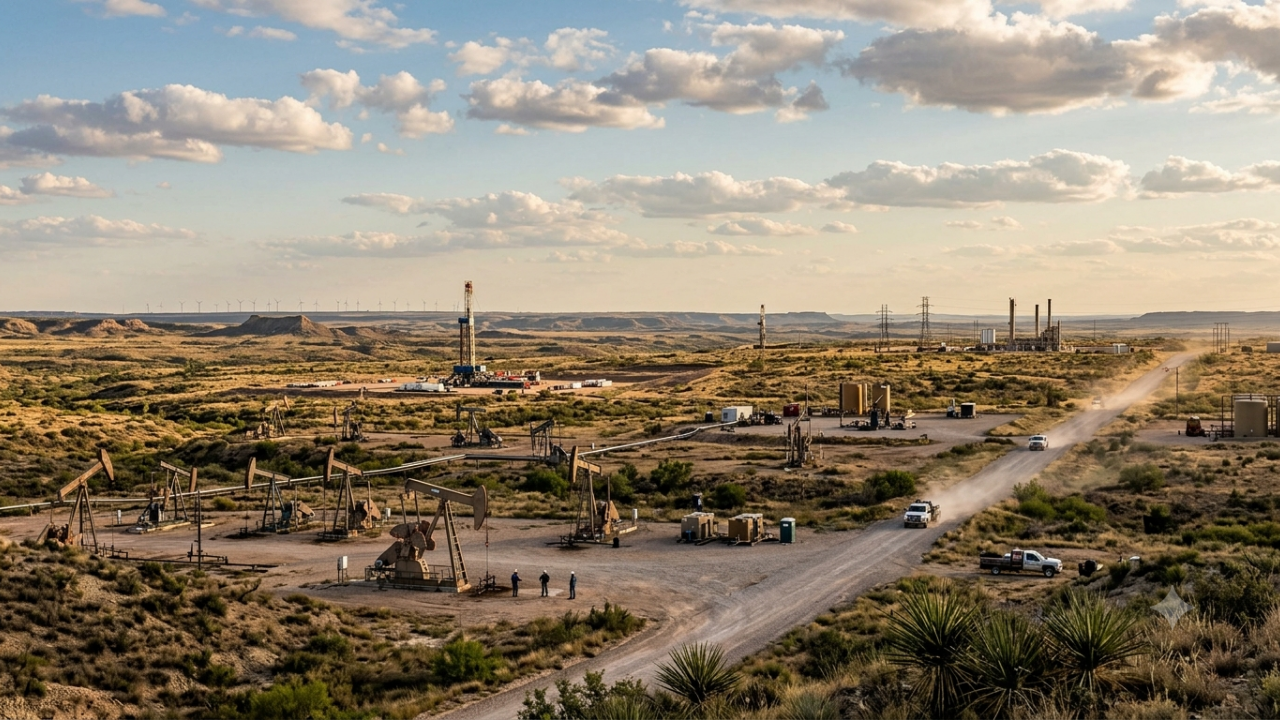
A century ago, corporate wildcatters and weary geologists wrote off West Texas as a dry, unforgiving wasteland. They called it a graveyard for dry holes and broken financial dreams. Nobody wanted to sink capital into dirt that refused to yield.
Times change. Today, that exact stretch of arid earth powers an economic engine supporting 853,924 jobs nationwide.
If you still think the Permian Basin is just a collection of rusty nodding donkey pumps and mud-caked boots, you are missing the entire picture of modern American energy and commerce. According to data compiled by the Permian Basin Petroleum Association, operations here pull in billions of dollars and generate roughly $18.2 billion in state tax revenues for Texas and New Mexico alone.
How a Dust Bowl Became an Economic Heavyweight
Let's look at the actual footprint. The basin occupies a relatively small sliver of the population base across Texas and New Mexico, yet its economic gravity bends entire state budgets. In New Mexico, the region accounts for 25.9 percent of the private-sector gross domestic product while representing only 9.2 percent of the state's population. Down in Texas, it punches just as hard, driving 8.1 percent of private-sector GDP despite housing a mere 1.6 percent of the state's residents.
Numbers on a spreadsheet don't capture the daily grind on the ground. When active rigs ramp up, the shockwaves hit suppliers in Houston, logistics hubs in Chicago, and software startups in Austin.
You aren't just looking at roughnecks on drilling floors. You are looking at an interconnected web of:
- Heavy-duty equipment manufacturers and mechanical overhaul shops
- Local road crews building out highway capacity to handle semi-truck volume
- Specialized environmental compliance officers and software engineers
- Hospitals, schools, and civic infrastructure straining to keep pace with rapid regional growth
The Scale of Underground Riches
Why does this specific basin matter so much? Geology dealt the region an extraordinary hand. Current estimates put recoverable reserves in the Permian at roughly 92.7 billion barrels of oil and over 211 trillion cubic feet of natural gas.
That sheer volume shifts global market equations. Projections indicate the region could supply nearly half of all domestic US oil production before the decade closes.
Critics often assume this massive fossil fuel footprint exists in total isolation from newer energy tech. That assumption falls apart when you visit the region today. Solar arrays and wind developments are scaling up alongside traditional extraction sites. New Mexico and Texas have seen explosive multi-percentage surges in renewable energy capacity additions right alongside the oil fields. Energy companies are diversifying because powering extraction requires reliable, redundant local grids.
Facing the Real Bottlenecks
Growth at this velocity creates severe operational friction. If you plan to build a business or invest in the region, you have to navigate severe infrastructure strains. Housing costs in hub cities like Midland and Odessa swing wildly based on crude prices. Finding skilled labor remains a constant headache for operators who need specialized instrumentation technicians and safety supervisors.
Water management is another massive hurdle. Fracking requires millions of gallons of fluid, forcing companies to engineer sophisticated recycling networks and disposal systems to protect local water tables. Ignoring these logistical constraints is how projects fail.
Looking further down the timeline, groups like the Permian Strategic Partnership estimate the basin could drive $350 billion in gross product and underpin roughly 1.2 million jobs nationwide by 2050. Hitting those milestones depends entirely on regulatory stability, pipeline buildouts, and continuous technological upgrades.
Stop viewing West Texas as a boom-and-bust relic of the past. It's a complex, high-stakes industrial ecosystem that dictates the financial health of entire communities across America.