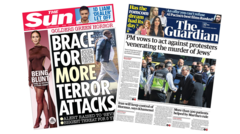
Fear sells papers and buys votes. It is the most reliable currency in the modern political economy. When headlines scream about prime ministers vowing to act or warning us to brace for more terror, they aren't reporting on a strategy. They are reporting on a ritual.
The media and the state have entered a co-dependent loop where "action" is measured by the volume of a speech rather than the efficacy of a policy. We are told to prepare for the worst while being promised that the government has everything under control. Logic dictates that both cannot be true simultaneously. If the state is truly acting with decisive force, the threat should diminish. If the threat is inevitable, the "vow to act" is a performance.
The High Cost of the Security Theater
Most people think security is a binary state: you are either safe or you are not. In reality, security is an optimization problem involving diminishing returns. I have watched governments burn through billions in taxpayer capital to fund "preventative" measures that do nothing more than slow down commuters and create the illusion of vigilance.
Consider the standard response to a security crisis: more boots on the ground, more surveillance, and more rhetoric. In the private sector, if a project failed to deliver results after a massive capital injection, the CEO would be fired. In politics, failure is used as a justification for a bigger budget.
The "vow to act" usually translates to one of three things:
- Legislative Bloat: Passing new laws that sound tough but are legally redundant.
- Increased Friction: Implementing security measures that target the 99.9% of law-abiding citizens to prove the government is "doing something."
- Optical Deployment: Moving armed officers to high-traffic areas where they are visible but often tactically irrelevant.
The Intelligence Paradox
The public wants a guarantee of zero risk. This is a mathematical impossibility. By demanding that leaders "stop" all attacks, we force them into a defensive crouch that actually makes us more vulnerable.
When a leader says we must "brace" for attacks, they are engaging in liability shifting. It is a psychological hedge. If nothing happens, they are the shield that protected us. If something does happen, they told us it was coming. It is the ultimate "heads I win, tails you lose" scenario for a politician.
True intelligence work is quiet. It is boring. It happens in windowless rooms and involves data patterns, not podiums. The moment a threat becomes a headline, the intelligence has already failed or the threat is being utilized as a tool for social cohesion.
The Economy of Attention
Why does the press play along? Because "PM Vows to Act" is a perfect headline. It suggests a narrative arc with a hero, a villain, and a looming conflict. It keeps you refreshing the feed.
The reality of modern risk is far more mundane. You are statistically more likely to die from a poorly maintained road or a preventable medical error than a headline-grabbing terror attack. Yet, we don't see prime ministers standing at podiums vowing to "act" against potholes with the same theatrical intensity.
We have a distorted perception of risk because we prioritize the spectacular over the significant. A single event that kills ten people gets more coverage than a systemic failure that kills ten thousand over a year. Leaders know this. They prioritize the spectacular because it is the only thing that moves the needle on their approval ratings.
Stop Bracing and Start Calculating
The advice to "brace" for impact is functionally useless. What does it actually mean for a citizen to brace? It means living in a state of low-level anxiety that reduces economic activity, social trust, and mental health.
If we want to actually address the root of these issues, we have to stop rewarding the rhetoric. We should be asking for the cost-benefit analysis of every new security measure. We should be demanding to know what specific, measurable metrics will determine if the "vow to act" was successful.
The Problem With Radical Transparency
The downside to my approach is that it is cold. Most people don't want to hear that a certain level of risk is acceptable. They want to be lied to. They want to be told that the big, strong government can make the bad things go away forever.
Admitting that we cannot stop every threat would require a level of political honesty that would likely result in an immediate loss of power. So, the cycle continues. The headline is written, the speech is given, the budget is increased, and the fundamental risk remains unchanged.
The Architecture of Response
The "PM vows to act" trope is a symptom of a deeper malaise in leadership: the inability to distinguish between motion and progress.
- Motion: Sending 1,000 extra officers to patrol a city center.
- Progress: Disrupting a financial network that funds extremism.
One is visible and useless. The other is invisible and vital. As long as we continue to judge our leaders by what we can see on the evening news, we will continue to get the theater we deserve.
The next time you see a headline telling you to brace for impact, don't look at the threat. Look at the person telling you to be afraid. Ask yourself what they are trying to sell you. Usually, it's their own necessity.
Stop falling for the ritual. Demand data, not drama.
Turn off the news and go for a walk. You’re more likely to trip on the sidewalk than be a victim of the "impending" attack the PM is vowing to stop. If you want to change the world, start by ignoring the people who profit from your fear.