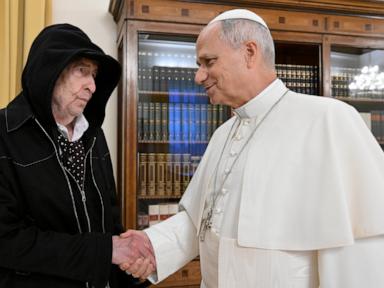
Pope Leo XIV welcomed Bob Dylan to the Vatican in a rare, private audience that signals a deliberate shift in how the Holy See engages with secular art, American cultural history, and moral philosophy. Far from a routine celebrity photo opportunity, the meeting between the first American-born pontiff and the 85-year-old Nobel laureate represents a calculated effort by the new papacy to bridge the gap between institutional Catholicism and the prophetic traditions of modern folk and rock music.
The optics alone were striking. For decades, Dylan has operated as an elusive, fiercely private figure who routinely skips major award ceremonies and avoids institutional endorsements. Yet here he was, stepping past the Swiss Guard into the Apostolic Palace at the invitation of Pope Leo XIV, the former Cardinal Robert Francis Prevost of Chicago. For a different look, check out: this related article.
To understand why this happened now, you have to look past the novelty of a rock icon shaking hands with the Bishop of Rome. You have to examine the specific cultural calculus of a young papacy trying to establish its intellectual and spiritual identity on the world stage.
The Chicago Connection and a Shared American Lexicon
Pope Leo XIV is not a European prelate viewing American counterculture through a distant, academic lens. Raised on the South Side of Chicago before spending decades as a missionary and bishop in Peru, Prevost came of age during the exact era when Dylan rewrote the rules of popular music. Similar reporting on this trend has been shared by USA Today.
When a 14-year-old Robert Prevost was growing up in Illinois in the late 1960s, Dylan’s songs were not museum pieces. They were the ambient soundtrack of a country tearing itself apart over civil rights, the Vietnam War, and economic inequality. That shared generational frequency matters. Previous popes approached popular musicians with polite, sometimes awkward formality. Pope John Paul II famously listened to Dylan perform "Knockin' on Heaven's Door" in Bologna in 1997, offering a theological reflection on the song's lyrics afterward, though the two men occupied entirely different cultural universes.
Leo XIV speaks Dylan’s native tongue—literally and figuratively. Both men are products of the American Midwest, shaped by an obsession with the gap between national ideals and gritty reality. By bringing Dylan to Rome, the Pope is signaling that his pontificate will not retreat into insular clericalism. Instead, he is claiming the moral urgency of mid-century American protest art as a legitimate dialogue partner for Catholic social teaching.
A History of Vatican Soft Power
The Vatican never does anything by accident. Every audience granted by a sitting pope is an exercise in cultural diplomacy, a centuries-old mechanism the Holy See uses to project influence without an army or a massive economy.
Historically, the Church’s relationship with modern artists has been fraught. After centuries of serving as the primary patron of Western art—commissioning Michelangelo, Raphael, and Bernini—the Vatican spent much of the 19th and 20th centuries on the defensive against secular modernity. It was Pope Paul VI who began reversing that trend in the 1960s and 1970s, establishing the Collection of Modern Religious Art in the Vatican Museums to prove the Church could still converse with contemporary creators.
Pope Francis accelerated this strategy, hosting massive gatherings of comedians, visual artists, and filmmakers in the Sistine Chapel. Yet Francis often kept rock and pop musicians at arm's length, preferring classical composers or socially conscious filmmakers like Martin Scorsese.
Leo XIV is expanding that playbook. Inviting Dylan accomplishes three immediate strategic goals for the Holy See:
- Legitimizing the "Prophetic" Outsider: Dylan has spent sixty years critiquing warmongers, corrupt judges, and hypocritical institutions. By welcoming him, the Vatican implicitly validates the role of the secular artist as a moral truth-teller, even when that artist refuses to toe an orthodox doctrinal line.
- Reaching an Aging, Disaffected Demographic: Across North America and Western Europe, millions of Baby Boomers and Gen Xers left organized religion behind decades ago, often citing institutional rigidity. Many of those same people treat Dylan’s catalog as a form of secular scripture. A meeting with Dylan builds an instant, non-preachy bridge to an audience that otherwise ignores papal encyclicals.
- Reclaiming the Narrative on Peace and Justice: With global conflicts escalating and economic anxiety deepening, the Vatican wants to position itself as the premier moral voice against militarism. Few living artists carry as much anti-war credibility as the man who wrote "Masters of War" and "A Hard Rain's A-Gonna Fall."
Dylan’s Complicated Dance with the Sacred
If the Vatican’s motives are strategic, Dylan’s decision to accept the invitation is equally revealing. This is a man who famously boycotted the 2016 Nobel Prize ceremony in Stockholm, sending Patti Smith to perform in his stead while he stayed away from the press. He does not do vanity tours.
To grasp why Dylan showed up in Rome, you have to understand his lifelong, turbulent relationship with Christian theology.
In the late 1970s, Dylan stunned the music industry by converting to evangelical Christianity, releasing a trilogy of overtly religious albums—Slow Train Coming, Saved, and Shot of Love—and preaching from the stage between songs. Critics savaged him. Fans walked out. By the mid-1980s, Dylan had drifted away from fundamentalist rhetoric, returning to a more ambiguous, symbol-heavy style of songwriting.
Many casual observers assumed his Christian phase was a temporary aberration. It wasn't. If you actually listen to Dylan’s later masterpieces—Time Out of Mind (1997), Love and Theft (2001), or Rough and Rowdy Ways (2020)—the biblical imagery never left. It simply went underground, fusing with Greek mythology, blues traditions, and the King James Bible into a dense, apocalyptic worldview.
Dylan’s late-career work is obsessed with mortality, judgment, grace, and the decay of Western civilization. Those are fundamentally Augustinian themes. And Pope Leo XIV happens to be a member of the Order of Saint Augustine, having served as the Prior General of the Augustinians for twelve years before becoming a bishop.
St. Augustine of Hippo spent his life wrestling with the tension between the "City of God" and the "City of Man"—the eternal spiritual realm versus the corrupt, violent reality of earthly empires. That exact tension is the engine driving almost every song Dylan has written since 1997. A conversation between an Augustinian pope and the author of "Not Dark Yet" isn't a publicity stunt. It is a meeting of two minds obsessed with the same existential questions.
The Risk of Institutionalizing a Rebel
Not everyone views this rapprochement as an unalloyed triumph. There is a distinct friction whenever an ancient, hierarchical institution embraces a countercultural icon, and the risks cut both ways.
For the Vatican, aligning too closely with a secular artist carries the danger of theological dilution. Dylan is not a Catholic apologist. His worldview is deeply fatalistic, steeped in Old Testament wrath and blues-infused existentialism rather than neat catechism answers. Traditionalist critics within the Church frequently argue that when popes court secular celebrities, they trade away doctrinal clarity for fleeting media applause. They contend that the Church should be elevating explicitly Catholic artists rather than chasing validation from mainstream cultural figures.
For Dylan, the risk is the exact opposite. His entire artistic mythos rests on radical independence. From the moment he plugged in an electric guitar at the Newport Folk Festival in 1965, Dylan has built his career on refusing to belong to anyone’s movement, church, or political party. Stepping into the gilded halls of the Vatican risks softening his edges, turning a dangerous, unpredictable poet into a safe, elder-statesman mascot for institutional respectability.
Yet Dylan has always been savvy about how his image is deployed. He understands that at 85, his legacy is already carved in stone. Meeting with Leo XIV does not tame his music; if anything, it forces listeners to take the spiritual and philosophical weight of his lyrics more seriously.
What Happens When Popes and Poets Collide
History shows that when the papacy engages with major cultural figures, the effects ripple outward slowly rather than producing overnight policy shifts.
When Pope John Paul II met with Dylan in Bologna in 1997, the event was initially dismissed by music journalists as a bizarre footnote. Yet that single appearance helped spark a broader academic and theological reassessment of Dylan’s catalog, leading to seminary courses, scholarly books, and a recognition that rock music could carry genuine metaphysical weight.
Leo XIV’s audience with Dylan goes a step further because it happens behind closed doors, stripped of stadium lights and concert staging. It signals that this papacy views artistic intuition as an essential counterweight to technocratic politics and algorithmic culture. In an era dominated by artificial intelligence, polarized social media feeds, and disposable entertainment, both men represent stubbornly analog, deeply human modes of communication.
Dylan famously sang in "It's Alright, Ma (I'm Only Bleeding)" that "he not busy being born is busy dying." By stepping across the threshold of the Apostolic Palace to meet a fellow son of the American Midwest, Dylan proved he is still willing to surprise the world—and Pope Leo XIV proved he knows exactly how to make the world listen.


