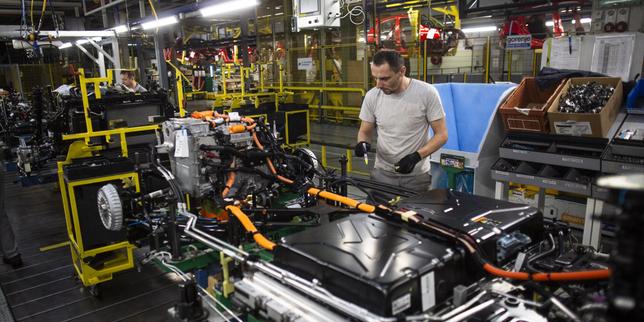
The floor of the assembly hall vibrates. It is a steady, low-frequency thrum that gets into the marrow of your bones before you even walk through the heavy steel doors. Inside, the air smells of warm cutting oil, ozone, and hot steel. Sparks cascade in brilliant, brief arcs from the tip of a robotic welding arm, illuminating the grease-stained face of a technician who has not looked up from his terminal in twenty minutes.
This machine is breathing. It is alive. Or at least, it was meant to be ours.
Step outside the perimeter fence, past the concrete guard booths and the rows of empty employee parking slots, and the geography shifts. The factory floor sits in a region that has spent decades watching its industrial pulse grow faint. Every crane arm swinging overhead and every roll of sheet metal fed into a stamping press represents a fragile defiance against an old, quiet decay. People here remember when things were built locally. They remember the sound of shift changes echoing down residential streets at four in the afternoon. They also remember the morning the lights went out for good down the road, when the corporate logos were unbolted from the brick facades and shipped across oceans to places where labor was cheaper, regulations softer, and questions fewer.
Now, a new kind of quiet threatens the workshops that remain. It is not the silence of abandonment. It is the insidious quiet of subsidizing our own replacement.
Consider the arithmetic of the modern economy. For years, massive blocks of public capital—taxpayer euros pooled from Berlin to Lisbon—have been funneled into industrial programs designed to secure sovereignty, protect jobs, and keep the continent anchored in high-value manufacturing. The intent is noble. The execution, historically, is a masterclass in self-sabotage.
Imagine a transnational corporation headquartered in a sleek glass tower three countries away. They write a brilliant, compliant proposal. They check every bureaucratic box. They promise green transitions, regional development, and high-tech output. Millions in public funds flow into their corporate accounts. On paper, the metrics look pristine. A spreadsheet glows with green checkmarks.
Then look at what actually happens on the ground.
The heavy components for the new clean-energy grid are not cast in the local foundry down the road. They are imported as raw or semi-finished shells from overseas mega-factories, assembled with foreign sub-components, and merely stamped with a European label at the very end of the line. The public coin—harvested from the wages of local bakers, nurses, and machinists—pays for the assembly, while the intellectual property, the heavy metallurgical supply chains, and the core industrial capacity remain anchored elsewhere.
Stéphane Séjourné looked at this structural absurdity and called it out with rare, unfiltered bluntness. Public money, he argued, must serve European production. Not foreign assembly lines. Not corporate accounting arbitrage.
It sounds obvious. It is revolutionary.
For too long, European industrial policy has suffered from a naive devotion to free-market orthodoxy that treats all capital as nationality-blind. The theory was simple: let the market optimize, let goods flow from wherever they are cheapest, and let consumers reap the rewards of globalized efficiency. But efficiency without resilience is just vulnerability wearing a cheap suit. We learned that lesson during the supply chain crunches, when pharmaceutical precursors vanished from pharmacy shelves and specialized microchips ground automotive lines to a halt. We learned it when energy shocks exposed how deeply dependent our heavy industries had become on external lifelines.
Yet, policy changes slowly. Bureaucracy moves at the speed of committees.
Walk through a vocational school in an industrial rust belt town, and you will see the human cost of this sluggish adaptation. Young men and women in stiff canvas aprons lean over CNC milling machines, learning the tolerances of aerospace-grade aluminum. They are sharp, focused, and hungry for a future that stays put. They want to build things that last. When you ask them where they plan to work after graduation, they point vaguely toward multinational branch plants that might pack up and relocate the moment a foreign tax credit flickers on the horizon.
They are training for a ghost economy.
When public subsidies are distributed without stringent, unbreakable local content requirements, we are essentially financing our own economic disarmament. Every euro of taxpayer money that flows out of the regional ecosystem to pad the profit margins of a firm that outsources its core manufacturing is a euro stolen from the future of our own workforce.
To fix this requires more than protectionist rhetoric. It requires a fundamental rewiring of how governments view economic support.
First, conditionality must become absolute. If public funds touch a balance sheet, the physical manifestation of that capital—the steel, the silicon, the machinery—must trace its lineage back to local soil. If a company wants European subsidies to build the infrastructure of tomorrow, they must use the hands, the brains, and the factories of the people paying for it. No loopholes. No shell companies registered in tax havens to launder the origin of components.
Second, we must stop treating manufacturing as a dirty relic of the twentieth century. The future of Europe will not be built on software alone. You cannot code a wind turbine blade, and you cannot digitize a high-strength steel chassis. The digital economy floats on a physical infrastructure. Lose the ability to shape metal, cast alloy, and wire power grids, and you lose the sovereignty to make any decisions at all.
The technician back on the factory floor wipes a smudge of grease from his forehead and adjusts the feed rate on the laser cutter. The metal screams softly as it parts.
Outside, the sun dips below the horizon, casting long, sharp shadows across the concrete yard where shipping containers sit stacked, waiting for transport. Those containers could be filled with things we made, things that prove we still have the capability, the discipline, and the collective will to stand on our own feet. Or they could be filled with the quiet realization that we paid for everything, and built nothing.