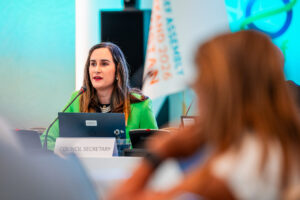
The air inside the plenary hall always smells faintly of stale coffee and expensive air conditioning. For six days, thousands of people in sharp suits have been arguing over punctuation marks. A comma can cost a million dollars. A misplaced "furthermore" can stall a watershed protection project for three years. To the outside world, this is the Global Environment Facility (GEF) assembly—a massive financial engine that has quieted the anxieties of the developed world by pouring billions into planetary rescue.
On paper, the victory lamps are burning bright. The data screens rolling across the main stage show undeniable triumphs. Millions of hectares of land saved. Carbon emissions slashed by figures that require too many zeros to easily comprehend. Biodiversity corridors established across continents. The delegates clap. It is a polite, rhythmic sound that echoes off the polished concrete walls.
But step away from the microphone. Walk past the security perimeters, past the digital displays showing real-time deforestation tracking, and consider a different reality.
Consider Maria. She is a hypothetical composite of three different women I spoke with last year in the high-altitude wetlands of the Andes, but her reality is entirely concrete. Maria does not know what the acronym GEF stands for. She has never read a 400-page framework document on climate resilience. What she does know is that two years ago, a massive conservation initiative drew a digital line around the forest her family has gathered firewood from for four generations. Suddenly, her traditional life became an environmental violation. The project met its biodiversity quota on a spreadsheet in Washington, D.C. Maria’s children skipped two meals a week because gathering fuel now required a six-mile detour around a newly minted ecological sanctuary.
This is the friction point of modern environmentalism. The milestones are real, but so is the isolation. As the institutional machinery celebrates crossing major environmental thresholds, a growing chorus of delegates and community leaders is starting to push back against the podiums. They are asking a question that makes the room uncomfortable: Who actually pays the price for our global successes?
The Illusion of the Bird’s-Eye View
From ten thousand feet in the air, a degraded forest looks like a math problem. It is a grid of coordinates requiring a specific injection of capital, a tree-planting initiative, and a strict enforcement mechanism to ensure the saplings survive. This is the technocratic gaze. It relies heavily on satellite imaging, predictive algorithms, and economic modeling to determine where funds should flow.
It is an incredibly efficient way to manage money. It is a terrible way to understand a ecosystem.
When we treat the planet as a massive engineering project, we treat the people living on the land as variables rather than stewards. For decades, the dominant paradigm in global conservation operated on a fortress model. To save nature, you had to protect it from humanity. Build a fence. Hire rangers. Push the indigenous populations to the periphery.
The data now shows this approach is fundamentally flawed. Studies consistently reveal that lands managed by indigenous communities experience significantly lower rates of deforestation than state-protected areas. Yet, historically, only a fraction of global climate finance filters down to these local groups. The money gets trapped in the upper strata of international consulting firms, governmental ministries, and administrative overhead.
The delegates raising their voices at recent summits are pointing out this structural bottleneck. They are not arguing against the milestones; they are arguing against the math used to celebrate them. If an international fund spends fifty million dollars to protect a marine ecosystem but leaves the local fishing village completely destitute, that project is not a success. It is a displacement.
The High Cost of Heavy Bureaucracy
To understand why the system struggles to connect with the ground, you have to look at the paperwork. To apply for a major environmental grant, a community organization often needs to navigate a multi-stage vetting process that takes years. The application guidelines alone can span hundreds of pages, written in dense, specialized jargon.
Imagine a small farming cooperative in sub-Saharan Africa trying to secure funding to restore soil quality. They know the land intimately. They understand which native crops can withstand the shifting rainfall patterns. But they do not employ a team of professional grant writers. They do not have the resources to conduct a comprehensive five-year risk assessment matrix that aligns with the specific reporting requirements of a multi-lateral trust fund.
The result is a profound gatekeeping effect. The groups best equipped to heal the land are systematically locked out of the financial resources meant for them, simply because they lack the administrative vocabulary. The money goes instead to large, centralized NGOs that know how to fill out the forms perfectly, even if their staff spends more time in capital cities than in the mud.
This administrative divide creates a dangerous disconnect. When projects are designed from afar, they often fail to account for the complex social realities of the target regions. A well-funded irrigation network might break down within six months because nobody trained the local youth on how to repair the specific solar pumps imported from overseas. A reforestation project might plant millions of trees that are promptly eaten by local livestock because the community was never consulted about grazing patterns.
Accountability cannot just face upward toward the donors. It must face downward toward the people whose lives are being altered by these interventions.
Redefining What Counts as Progress
The pressure inside the international environmental community is shifting the conversation toward radical inclusion. This is not about being polite or checking a diversity box. It is a matter of survival for these projects.
True inclusion means changing who sits at the design table from day one. It means moving past tokenistic consultation sessions—where local leaders are invited to a hotel ballroom to nod at a pre-written plan—and moving toward actual co-management. It requires the institutional humility to admit that an elder who has observed the local weather patterns for sixty years might possess insights that a satellite data set cannot capture.
It also requires a restructuring of financial accountability. Funds must become more agile, offering smaller, direct-access grants to grassroots organizations without requiring them to transform into corporate entities overnight. We need to measure success not just by the total number of dollars disbursed or hectares fenced off, but by the stability of the communities safeguarding those areas.
The tension in the plenary halls is a sign of progress, even if it feels uncomfortable. It is the sound of a system realizing that it cannot save the planet by ignoring the people who live on it.
The evening session closes. The delegates filter out into the humid night air, their badges swaying from their necks. The digital screens blink off, leaving the stage in darkness. The milestones achieved are monumental, historical, and necessary. But they are merely the framework of a house that is still empty. The real work is not happening under the fluorescent lights of a convention center. It is happening in the dirt, in the quiet corners of the world where people are trying to balance the survival of their children with the survival of the forest. If we want to build a future that lasts, we have to stop treating their lives as an afterthought to our statistics.