The asphalt in Austin doesn’t care about politics, but it does care about maintenance. On a Tuesday morning, a city worker named Elias—a man who has spent twenty years ensuring the sewage lines don't back up into your favorite downtown bistro—watches a crack in the pavement. To you, it’s a minor nuisance. To Elias, it’s a symptom. He knows that the machinery required to fix it, the overtime for his crew, and the very chemicals used to treat the water flowing beneath the street are tied to a ledger that is currently bleeding red ink.
Elias isn't a politician. He’s a stabilizer. Yet, his ability to do his job is now a chip in a high-stakes poker game played three hundred miles away in a climate-controlled room in the State Capitol.
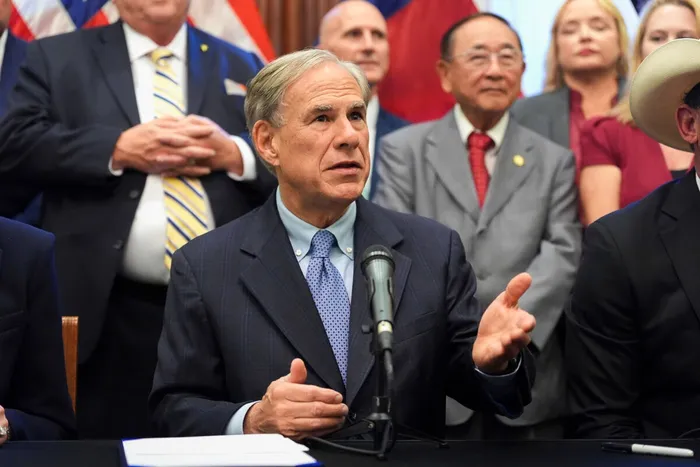
Governor Greg Abbott recently sharpened his pen and drew a line through $200 million. That money wasn't just "funding." It was the lifeblood for Texas’s largest urban hubs: Houston, Dallas, San Antonio, and Austin. The reason? A bitter, escalating dispute over how local law enforcement interacts with Immigration and Customs Enforcement (ICE). The Governor demands total cooperation with federal detainer requests; the cities, citing overextended resources and a need to maintain trust within their own communities, have hesitated.
So, the tap is being turned off.
The Invisible Ledger
When a state government halts $200 million in funding, the impact doesn't manifest as a sudden, dramatic explosion. It’s a slow, grinding erosion. Imagine a local community center in a neighborhood where the sun sets a little too early and the streetlights stay dark a little too long. That center provides after-school programs that keep kids off the corner. It offers job training for a father who just lost his shift at the warehouse.
That center operates on a grant. That grant is part of the $200 million.
When the funding vanishes, the doors don't just lock overnight. First, the snacks for the kids disappear. Then, the Saturday hours are cut. Finally, a "Temporarily Closed" sign is taped to the glass with shaking hands. The "ICE policies" being debated in press releases feel like abstract legal jargon until you realize they are being traded for the safety of a ten-year-old walking home in the dark.
This is the hidden cost of the political leverage. It is a tax on the vulnerable, paid in the currency of public safety and municipal stability.
Texas is a titan of industry, a "miracle" of economic growth that prides itself on being a beacon for business. But businesses don't move to cities where the police departments are cannibalizing their own budgets to cover the shortfall of state grants. They don't move to places where the infrastructure is allowed to crumble as a punitive measure. By targeting the economic engines of the state—the big cities that generate the lion's share of Texas's GDP—the administration is essentially keying its own car to prove a point to the passengers.
A Conflict of Two Oaths
Consider the perspective of a police chief in a major Texas metro. On one hand, she has a mandate from the state to enforce every federal detainer request without question. On the other, she has a city council and a community that she must protect.
If her officers are seen as de facto immigration agents, the "silent witnesses" in her city go deaf. A woman who sees a burglary won't call 911 if she fears her status—or her neighbor's status—will lead to a one-way trip to a detention center. Crimes go unreported. Predatory criminals remain on the street because their victims are too terrified to speak.
The chief is caught in a vice. If she follows the city’s lead to prioritize local trust, she loses the millions needed for body cameras, mental health crisis teams, and specialized gang units. If she follows the state’s lead, she loses the very community cooperation required to solve murders and stop domestic violence.
It is a choice between a hollowed-out budget and a hollowed-out community.
Logically, the math is brutal. The $200 million in question covers a vast array of services that have nothing to do with the border. We are talking about justice assistance grants, crime victim funds, and specialized trauma care for hospitals. These are not "luxury" items. They are the stitches that hold the fabric of a civil society together after it has been torn by violence or poverty.
The Ripple Effect on the Sidewalk
Let’s go back to the sidewalk.
Elias knows that if the budget for his department is slashed to cover the gaps left by the state's withdrawal, he won't be hiring a replacement for the guy who retired last month. The work will take longer. The cracks will get wider.
But it goes deeper than concrete. Think of a small business owner in San Antonio, someone who saved for a decade to open a hardware store. He relies on a stable environment. He relies on the fact that if there’s a fire, the department has the latest equipment. He relies on the idea that the city and state are working in a "synergy"—though that word is too sterile for what is actually a sacred pact between the governed and the governors.
When that pact breaks, uncertainty moves in. Uncertainty is the poison of the Texas miracle.
The Governor’s move is framed as a matter of "Rule of Law." It is a powerful phrase, one designed to end arguments. But the law is not a blunt instrument meant to be swung at one’s own citizens to compel behavior. It is supposed to be a shield. When $200 million is pulled from the people, the shield is lowered.
The irony is thick enough to choke on. The state argues that these cuts are necessary to ensure the safety of Texans by enforcing federal immigration holds. Yet, the immediate result is a decrease in funding for the very police departments tasked with keeping those same Texans safe from every other threat.
The Cost of Being "Right"
Is being "right" worth the price of a deactivated victim advocacy program in Dallas? Is a political victory worth the shuttering of a drug court in Houston that was finally starting to see success rates climb?
We often talk about government spending in the trillions or billions, numbers so large they lose their meaning. They become stars in a distant galaxy—visible, but cold. But $200 million is different. It’s local. It’s tangible. It is the difference between a city that breathes and a city that gasps for air.
There is a psychological weight to this kind of governance. It sends a message to every resident of these four cities: Your daily safety is a secondary concern to your compliance with a specific ideological directive. It creates a Texas where the zip code you live in determines whether the state views you as a citizen to be served or a rebel to be disciplined. This isn't just about ICE. It isn't just about Greg Abbott. It is about the fundamental definition of what a state owes its people.
If the state can withdraw its support for the most basic functions of a city because of a policy disagreement, then no funding is ever truly secure. Every bridge, every school, every clinic becomes a hostage.
The debate will continue in courtrooms and on debate stages. Lawyers will argue over the fine print of Senate Bill 4 and the limits of executive authority. They will use large words and cite precedents from the 19th century.
But while they argue, the clock is ticking for the people on the ground.
Elias eventually finishes his shift. He packs up his tools, wipes the sweat from his brow, and drives home. He passes a park where the grass is a little longer than it should be because the mowing contract was the first thing to be "reviewed" in the wake of the funding threat. He sees a police cruiser idling at a light and wonders if the officer inside knows that their department’s future is being traded like a commodity.
The lights of the city flicker on as the sun dips below the horizon. They look beautiful from a distance. Up close, you can see the filaments straining.
The $200 million isn't just a number on a balance sheet. It is the sound of a door closing on a kid who needed a place to go after school. It is the silence of a victim who is too afraid to call for help. It is the slow, steady widening of the crack in the pavement that no one is coming to fix.
Texas has always prided itself on being "big." Big dreams, big business, big sky. But right now, the focus has become incredibly small, narrowed down to a single point of contention that threatens to overshadow the needs of millions.
Politics is often described as the art of the possible. In this case, it looks more like the art of the ultimatum. And as any resident of a major city knows, an ultimatum is rarely the start of a productive conversation. It is usually the end of one.
The asphalt remains. The heat remains. The people remain.
But the trust? That is getting harder to find than a cool breeze in August.
Elias turns his key in the front door of his home. He hopes the water runs when he turns the faucet. He hopes the street stays quiet tonight. He hopes that eventually, the people in the big white building under the dome remember that the state isn't made of policies or detainer requests.
It’s made of people who just want to make sure the cracks don't swallow the street whole.