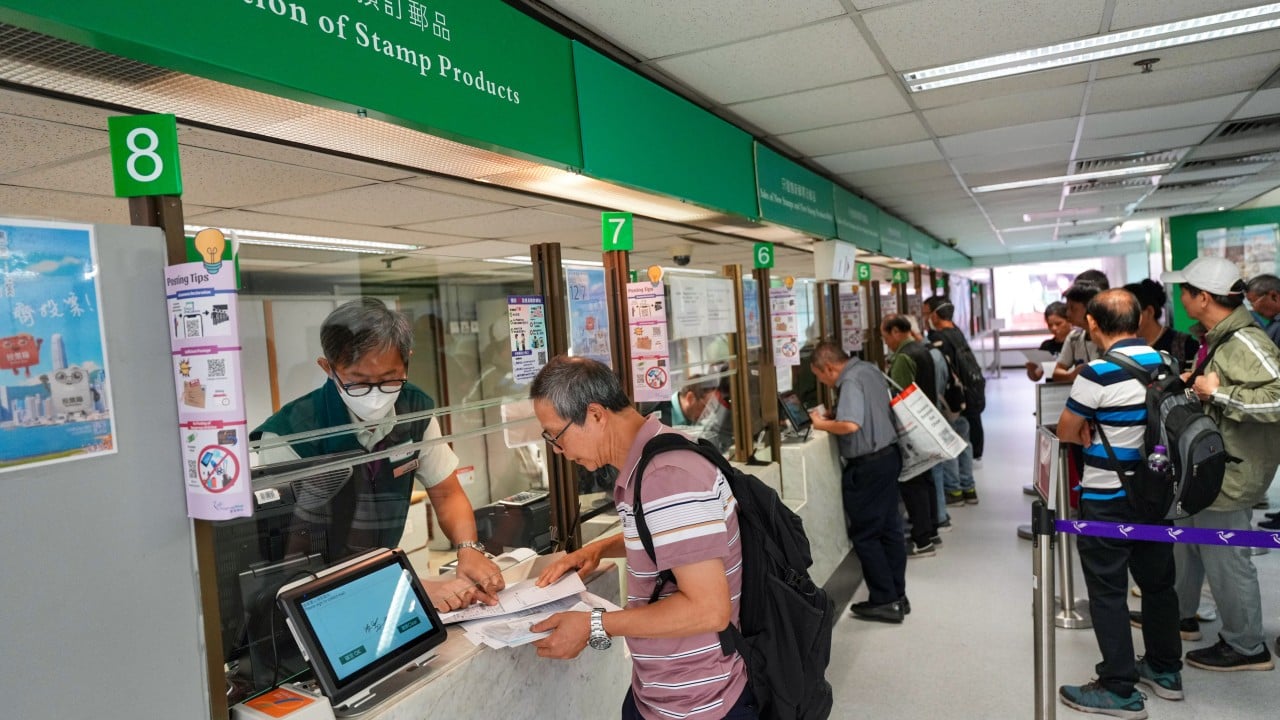
The rain in Hong Kong has a way of blurring the edges of the skyscrapers, turning the neon signs of Central into bleeding streaks of red and blue. Down at the street level, the world moves at a frantic, breathless clip. Millions of taps on glass screens. Billions of bytes of data flashing through undersea fiber-optic cables. We live in a city that prides itself on lightning-fast transactions, where wealth is digital and instantaneous.
Yet, if you walk past the grand, imposing facade of the General Post Office in Connaught Place, you might catch the faint, rhythmic sound of a physical world still spinning. Thud. Thud. Thud. The heavy ink stamp hitting paper.
It is easy to forget that beneath our hyper-connected, cashless reality lies an older, quieter infrastructure. It is the network that carries the legal notices, the medicine refills for the elderly living in estate blocks, the handwritten letters from children studying overseas, and the small, low-margin parcels sent by home-grown entrepreneurs trying to survive an unforgiving retail market.
Now, that infrastructure is quietly bleeding.
Hongkong Post, a institution that has survived wars, handovers, and typhoons for nearly two centuries, is facing a fiscal cliff so steep that it threatens to snap the vital thread connecting millions of citizens. The government is seeking a HK$4.6 billion lifeline from the Legislative Council. To the spreadsheet watchers in government offices, it is a line item. A massive, staggering number, yes, but ultimately just data.
To understand what is actually at stake, you have to look past the dollar signs. You have to look at the people who still rely on the mail to feel seen, and the structural trap that brought a beloved public service to its knees.
The Weight of the Unseen Parcel
Consider a hypothetical citizen named Mr. Chan. He is seventy-two years old, living alone in a public housing estate in Kwun Tong. He does not own a smartphone. The digital revolution did not include him; it bypassed him. Every month, his connection to the broader world arrives in a green uniform. The local postal carrier knows Mr. Chan’s knees are failing, so he waits an extra thirty seconds after knocking.
That interaction cannot be optimized by an algorithm. It cannot be streamlined by a tech startup.
For decades, Hongkong Post operated under a trading fund model. Established in 1995, this mechanism meant the department had to manage its own finances, paying for its operations out of its own revenues rather than relying directly on the tax coffers. For a long time, it worked. The booming economy of the late nineties and early two-thousands provided a steady stream of corporate mail and international shipping fees.
Then, the world shifted.
The rise of email killed the lucrative business letter market. The explosion of private courier companies chipped away at local delivery profits, leaving the post office with the most expensive, least profitable task: delivering to the farthest reaches of the territory, from the remote villages of Lantau Island to the highest floors of walk-up buildings in Sham Shui Po, where private couriers refuse to go because there is no profit in it.
The numbers tell a brutal story. Hongkong Post has recorded multi-million dollar deficits for years. The trading fund model, once hailed as an efficient way to run a public service like a business, became a financial noose. When a public utility is forced to chase profits while bound by a statutory duty to serve every single citizen regardless of cost, failure is not a possibility—it is a mathematical certainty.
The Illusion of Efficiency
We have been conditioned to believe that private enterprise always does things better. If a service loses money, the common refrain is to cut costs, automate, or raise prices.
But imagine the fallout if Hongkong Post raised stamp prices to match the true cost of delivering a letter to a remote fishing village. A single letter might cost HK$30 or HK$40. The wealthy wouldn't notice. They don't use stamps anyway. The burden would fall entirely on the vulnerable, the small businesses, and the elderly who still communicate via paper.
This is the hidden trap of modern public management. When we view a public service purely through the lens of a balance sheet, we misdiagnose the illness.
The HK$4.6 billion funding request currently being debated in the legislature is not a handout. It is an acknowledgment that some things are too important to be left to the whims of the market. The money is intended to restructure the post office, upgrade its aging sorting technology, and transition it away from the outdated trading fund model that has crippled its ability to innovate.
If you talk to the workers on the sorting floor at the Central Mail Centre in Kowloon Bay, the anxiety is palpable. These are people who have dedicated thirty years to the service. They remember when the mailbags were heavy with the weight of a booming manufacturing city. Today, the bags are filled with different things—mostly cheap e-commerce goods from overseas and official government communications.
The work has become harder, the margins thinner, and the public appreciation scarcer.
"We are invisible until something goes wrong," one veteran clerk told me, speaking on the condition of anonymity because he wasn't authorized to talk to the press. "When a letter arrives on time, no one thinks about the ten people who handled it. But if it's a day late, the world ends. Now they tell us we are losing money. We aren't losing money; we are performing a service that costs money."
The Global Chokehold
The crisis in Hong Kong is not unique. Around the world, national postal services are suffocating under the same pressures. The United States Postal Service has required massive federal interventions. The UK's Royal Mail has faced turbulent privatization battles that left consumers frustrated and workers on strike.
The core issue is that global supply chains have transformed. The Universal Postal Union—the international body that governs how much postal administrations charge each other to deliver international mail—has historically favored developing nations, allowing them to ship goods into developed hubs at fraction of the local cost. For years, this meant Hong Kong was flooded with inbound parcels from mainland China and other parts of Asia, handling the heavy lifting of local delivery while receiving only a pittance in terminal dues from the originating countries.
Hongkong Post was essentially subsidizing the global e-commerce boom out of its own pocket, watching its reserves dwindle while foreign retailers profited.
The proposed HK$4.6 billion injection is a desperate attempt to reset the scales. It is an investment in automated sorting systems that can handle the massive volume of small e-commerce parcels more efficiently. It is a plan to retool the post office so it can compete with private logistics giants on equal footing, without abandoning its core mission to the public.
What is Left Behind
If the funding fails, or if it is tied to austerity measures that force the closure of neighborhood post offices, the loss will not just be measured in dollars. It will be measured in the erosion of civic life.
The neighborhood post office is often the anchor of a local community. In older districts like Western or Yau Ma Tei, it is a place where neighbors meet, where elderly residents get help filling out forms, and where small-scale independent publishers mail out their magazines. It is a physical manifestation of the social contract—the promise that no matter where you live, or how much money you have, you are part of the city, and the city will find a way to reach you.
When we lose these spaces, we replace them with smart lockers and automated drop boxes. Cold, grey metal structures tucked into the corners of subway stations. They are efficient, certainly. But they are empty. They do not say hello. They do not notice if you look frail today.
The Value of the Unprofitable
The debate over the HK$4.6 billion lifeline is ultimately a debate about what kind of city we want to live in. Do we want a Hong Kong that operates solely as a hyper-efficient, cold financial engine, discarding any piece of infrastructure that cannot turn a profit on its own? Or do we recognize that a city's greatness is measured by how it maintains the threads that bind its people together?
The money will likely be approved. The government cannot afford the chaos of a collapsing postal system. But the true test will come afterward. It will lie in whether the leadership understands that the post office cannot be fixed simply by turning it into another logistics corporation.
As the evening rush hour peaks in Central, the rain finally stops. The lights of the office towers reflect off the wet asphalt. A postal carrier pushes a heavy green trolley through the crowd, maneuvering past shoppers carrying luxury bags and bankers talking loudly into wireless earbuds.
Most people step out of his way without looking at him. He keeps his head down, moving steadily toward the next delivery box, carrying a load of paper promises through a world made of glass.