The friction between individual expression and collective property management stems from a fundamental mismatch in contractual expectations. Homeowners Association (HOA) disputes regarding commemorative displays are not merely emotional confrontations; they are the result of rigid aesthetic governance colliding with the perceived absolute rights of private ownership. To understand why a veteran’s front-yard display becomes a target for litigation, one must analyze the structural architecture of Covenants, Conditions, and Restrictions (CC&Rs), the economic incentives for uniform property values, and the legal thresholds of selective enforcement.
The Architecture of Private Governance
An HOA operates as a quasi-governmental entity within a strictly defined legal framework. When a property owner buys into a deed-restricted community, they are not just purchasing real estate; they are entering into a servitude—a legal obligation that "runs with the land." This contract shifts the locus of control from the individual to the collective body.
The Tripartite Framework of Compliance
HOA enforcement mechanisms generally rely on three pillars:
- Aesthetic Uniformity: The premise that property values correlate directly with visual consistency across the neighborhood. Any deviation—regardless of its merit, such as military or firefighting service commemoration—is viewed as a potential "broken window" that signals a decline in standards.
- Architectural Review Boards (ARB): The gatekeeping mechanism. The ARB holds discretionary power to approve or deny modifications based on subjective criteria like "harmony of design" or "compatibility with the community."
- Fines and Liens: The enforcement engine. Financial penalties serve as the primary tool for coercion, ultimately backed by the power to foreclose on the property to satisfy unpaid assessments or fines.
Quantifying the Threshold of Selective Enforcement
The most common defense in these disputes is the claim of selective enforcement. Legally, an HOA cannot ignore violations for some residents while penalizing others for the same infraction. However, the burden of proof rests heavily on the homeowner.
The "Business Judgment Rule" provides a shield for HOA boards. This legal doctrine presumes that boards act in good faith and in the best interests of the corporation. For a homeowner to successfully challenge a citation for a patriotic or career-based display, they must demonstrate that the board's decision was arbitrary, capricious, or discriminatory.
The Variancy Variable
In cases involving veteran commemorations, the conflict often centers on the definition of "signage" versus "statuary" or "temporary display." Most CC&Rs have strict prohibitions against signs but are more ambiguous regarding yard art. This ambiguity creates a zone of friction where board members use personal bias to determine what constitutes a violation. If a board allows holiday decorations but bans a permanent tribute to a firefighting career, they risk a "Waiver of Enforcement" defense, where the homeowner argues the board has effectively abandoned that specific covenant.
The Economic Logic of Aesthetic Control
The primary driver of HOA rigidity is the preservation of the "Comps" (comparable sales). Real estate valuation is highly sensitive to external factors. The HOA’s strategy is built on the risk-mitigation principle: individual expression is a variable that introduces uncertainty.
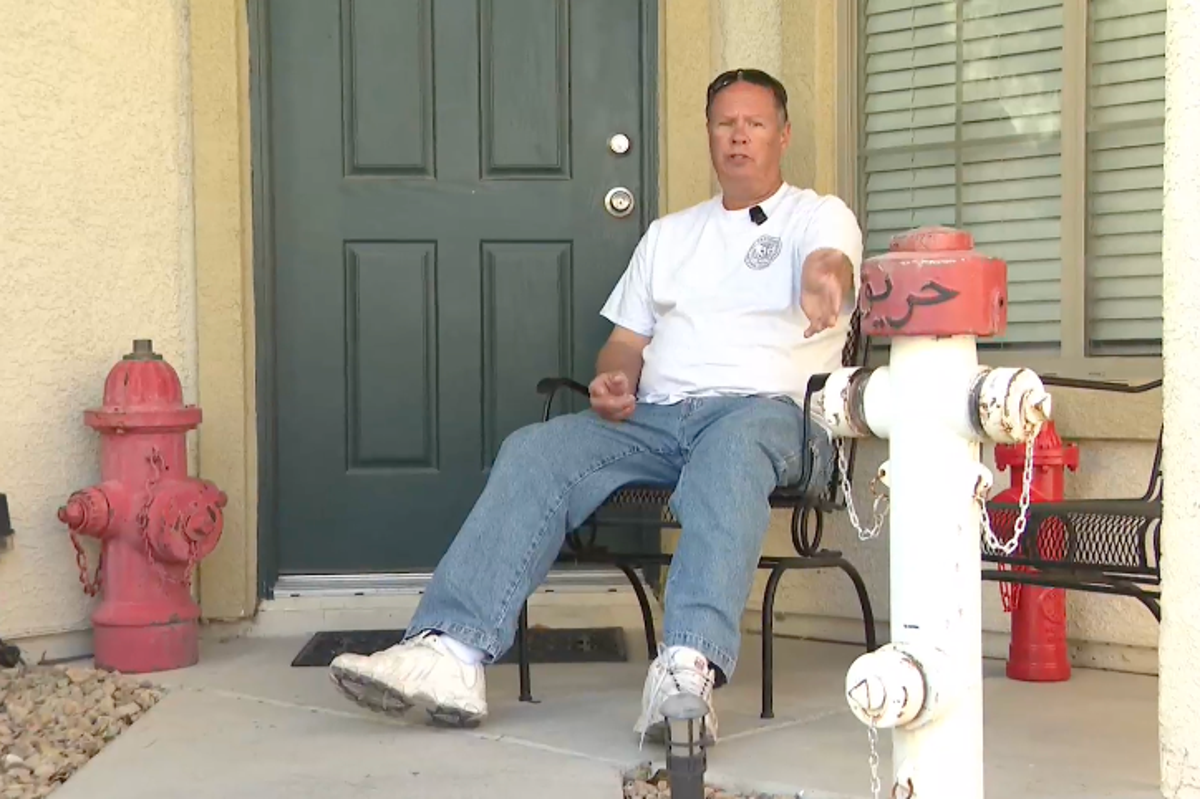
- Risk of Precedent: If the board allows one veteran to display a decommissioned fire hydrant or a large military crest, they lose the legal standing to prevent a neighbor from displaying something deemed objectively offensive.
- Market Liquidity: The theory suggests that a uniform aesthetic appeals to the widest possible buyer pool. Specialized displays, no matter how noble the intent, personalize the property in a way that can extend the "days on market" during a sale.
Legal Limitations on Restricted Speech
While HOAs are private entities and not technically bound by the First Amendment in the same way as government bodies, federal and state laws have begun to carve out protections for specific types of expression.
The Freedom to Display the American Flag Act of 2005
This federal law prohibits HOAs from banning the display of the U.S. flag. However, it allows for "reasonable restrictions" regarding the time, place, and manner of the display. This is where the conflict intensifies. A veteran may view a 20-foot flagpole as a necessary tribute, while the HOA defines a "reasonable" display as a small flag attached to the house.
The legal battleground usually shifts from the content of the display to the physical attributes of the installation:
- Height and Scale: Does the structure obstruct sightlines or violate height ordinances?
- Permanence: Is the display a temporary tribute or a permanent structural change?
- Noise and Light: Does the display involve lighting (e.g., spotlights for flags) that constitutes a nuisance to neighbors?
Operational Friction and the Escalation Cycle
Disputes rarely start with a lawsuit. They follow a predictable escalation cycle that often bypasses rational negotiation.
- The Courtesy Notice: A low-level communication flagging the violation.
- The Formal Notice of Violation (NOV): A legal document initiating the fining process.
- The Hearing Phase: The homeowner appears before a fine committee. This stage is often performative, as the committee is composed of other residents who may have a vested interest in maintaining the board's authority.
- Litigation: Once fines accumulate to a specific threshold, the HOA may turn the matter over to legal counsel, at which point the costs to the homeowner often exceed the value of the property modification.
The Cost-Benefit Imbalance
The veteran or firefighter in these scenarios is often operating on a "Principle of Honor," whereas the HOA is operating on a "Principle of Policy." This creates an asymmetrical conflict. The homeowner is willing to spend personal capital to defend their identity; the HOA is spending community funds (assessments) to defend the integrity of their governing documents.
Strategic Mitigation for the Homeowner
The path to a resolution does not lie in emotional appeals or public shaming of the board, as these tactics often entrench the board's position to avoid looking "weak" to other residents.
Structural Negotiation Tactics
- Audit the CC&Rs: Identify every other instance of non-compliance in the neighborhood. Documenting 10 other violations that have gone unpunished creates a "Selective Enforcement" ledger that can be used as leverage in a hearing.
- Define the Display as Non-Structural: If the display can be categorized as a "temporary landscape feature" rather than a "permanent improvement," it may fall outside the purview of the Architectural Review Board.
- Proposed Compromise: Offer a scaled-down version of the display that adheres to the spirit of the commemoration while minimizing the "Visual Mass" that the HOA perceives as a threat to property values.
Legislative Recourse
Increasingly, state legislatures are intervening to protect veteran-specific displays. For example, some states have passed laws specifically protecting the display of "Service Stars" or military branch flags. The strategy here involves moving the dispute from a contract law issue to a statutory compliance issue, where state law supersedes the HOA’s private bylaws.
[Image showing the hierarchy of law: Federal > State > HOA CC&Rs]
The Long-Term Forecast for HOA Governance
The trend toward "identity-based property use" is forcing a re-evaluation of HOA powers. As the veteran population and other service-oriented demographics seek to integrate their professional legacies into their living environments, the "Blank Slate" aesthetic of the 1990s-era HOA is becoming obsolete.
We are moving toward a "Tiered Governance" model. In this framework, HOAs maintain strict control over essential structural integrity (roofs, paint colors, landscaping) but are forced to yield on "Personal Expression Zones"—typically defined areas on a porch or near a front door where residents have higher autonomy.
The survival of the HOA model depends on shifting from a "Command and Control" philosophy to one of "Impact Management." If a display does not create a quantifiable negative externality (noise, light pollution, safety hazard), the legal and social cost of suppression is becoming too high for communities to bear.
The most effective strategy for an individual facing an HOA citation is to force a quantification of the "harm" caused. By demanding that the board provide data-driven evidence that a commemorative display has negatively impacted neighborhood home values, the homeowner shifts the burden from an emotional defense to an evidentiary one. This often reveals the board's position to be based on subjective preference rather than fiduciary duty, providing the necessary leverage for a settlement or a successful legal challenge.