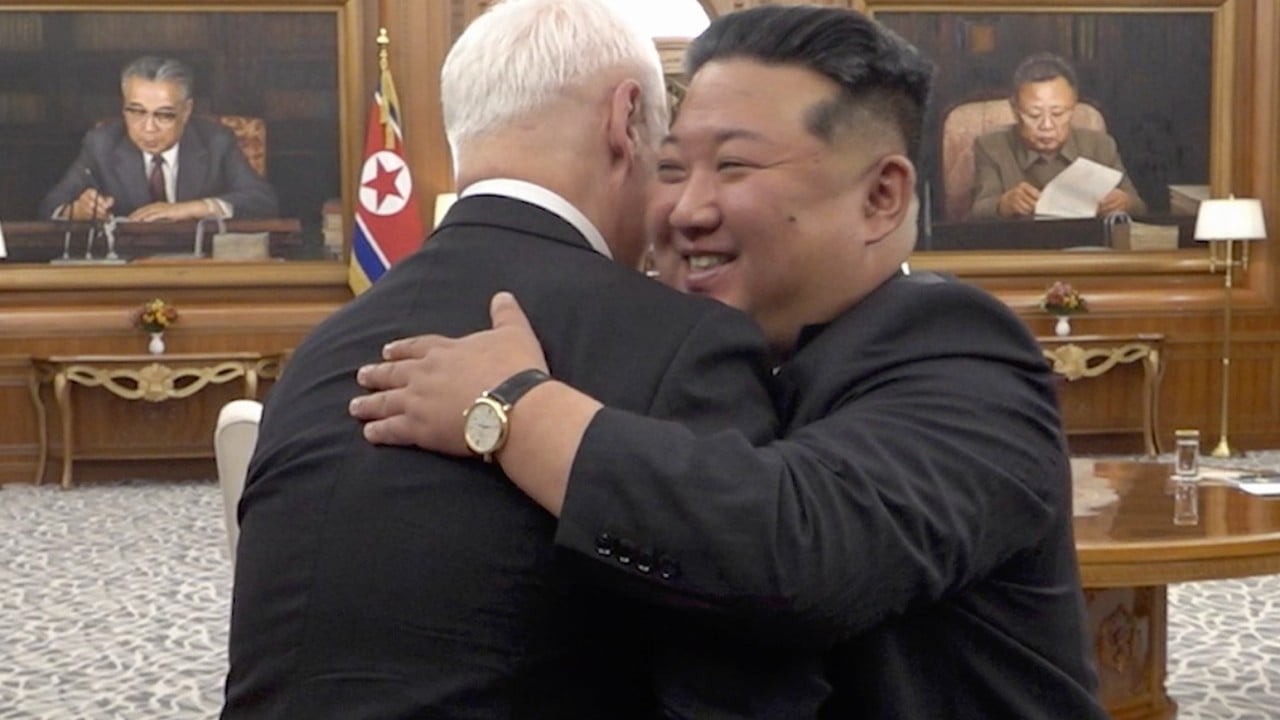
Western media treats Kim Jong Un’s visits to Russian war memorials as a scripted performance of Cold War nostalgia. They see two desperate dictators hugging in a storm. They are wrong. This isn’t a "partnership of pariahs." It is a high-speed integration of two complementary military-industrial complexes that the G7 is too bloated and bureaucratic to stop.
While Washington pundits debate the "morality" of North Korean shells landing in Ukraine, they miss the cold, hard engineering reality. Pyongyang isn't just sending "support." It is using the Ukrainian theater as the world's most aggressive R&D lab for tactical ballistic missiles and heavy artillery.
The Myth of the "Desperate" Dictator
The consensus narrative is that Kim is "desperate" for food and fuel. That’s a lazy, 1990s-era take. Kim isn't trading shells for bags of rice anymore. He is trading raw kinetic mass for high-end aerospace telemetry and nuclear submarine quietening technology.
I have watched analysts underestimate North Korean procurement for a decade. They laughed at the "obsolete" tractors in parades while ignoring the KN-23 and KN-24 quasi-ballistic missiles hiding in the background. These aren't Soviet leftovers. They are sophisticated, solid-fuel systems designed to bypass Aegis and Patriot missile defenses.
By aligning with Moscow at these memorials, Kim is signaling the birth of a Just-In-Time (JIT) Munitions Supply Chain.
- Russia provides: Combat-proven data on Western interceptor performance.
- North Korea provides: The industrial capacity to out-produce the entire European Union in 152mm shells.
- The Result: A feedback loop that corrects missile guidance systems in weeks, not years.
Stop Asking if North Korea is "Stable"
The wrong question is: "Will the Kim regime collapse?" The right question is: "How many Western defense contractors are currently panicking because North Korea’s manufacturing cost-per-kill is 1/100th of theirs?"
Western defense is trapped in a cost-plus-award-fee nightmare. A single Patriot interceptor costs roughly $4 million. A North Korean KN-25 rocket costs a fraction of that. When Kim vows "continued support," he is essentially announcing a hostile takeover of the global attrition warfare market.
Logistics as a Weapon of Mass Destruction
We love to talk about cyber warfare and AI-driven drones. But the war in Ukraine proved that steel and sulfur still rule the earth. Russia ran low on shells. North Korea has millions. The Trans-Siberian Railway has become the most important artery of the 21st century, and it doesn't care about SWIFT sanctions or maritime blockades.
The "memorial" events are cover for high-level logistics summits. When Kim honors "fallen troops," he is sitting in rooms with Russian logistics officers discussing rail gauge compatibility and propellant stability in sub-zero temperatures.
The Accuracy Fallacy
"But North Korean shells are duds!"
I’ve heard this from every armchair general from London to D.C. Let’s look at the math. If North Korea sends 3 million shells and 20% are duds (an exaggeration), Russia still has 2.4 million functional rounds. That is more than the combined production of the U.S. and Europe for the same period.
In a war of attrition, quantity has a quality of its own. The West prioritizes "exquisite" systems—hyper-accurate, hyper-expensive, and impossible to replace. Pyongyang and Moscow are betting on "good enough" systems delivered in overwhelming volume.
The Real Price Tag: What Russia is Giving Back
This is where it gets dangerous. Russia is the world leader in hypersonic glide vehicles and satellite delivery systems. North Korea’s "support" is the down payment on the following:
- Multiple Independently Targetable Reentry Vehicles (MIRVs): If North Korea masters this, the U.S. Ground-based Midcourse Defense (GMD) system becomes mathematically obsolete.
- Nuclear-Powered Submarine Propulsion: This allows Pyongyang to park a second-strike capability off the coast of California indefinitely.
- Advanced Thermal Shielding: The missing piece for North Korean ICBMs to survive reentry.
Every time Kim bows at a Russian memorial, he is likely receiving a hard drive containing the telemetry data from a Russian hypersonic test. This is not a "brotherhood of arms." It is a tech-for-mass trade that bypasses thirty years of UN sanctions in a single afternoon.
Why Sanctions are the Best Thing that Happened to Pyongyang
Counter-intuitive? Yes. True? Absolutely.
Sanctions forced North Korea to build a completely decoupled, autarkic industrial base. They don't rely on global supply chains. They don't need chips from Taiwan or neon from Ukraine. They have spent 70 years preparing for exactly the type of isolated, high-intensity conflict we see today.
Russia, meanwhile, is being "North-Koreanized." By cutting Russia off from the West, we pushed the world’s largest nuclear power into the arms of the world’s most aggressive manufacturer of "illegal" weaponry.
The Failure of "Strategic Patience"
The U.S. policy of "Strategic Patience" assumed that if we ignored North Korea long enough, they would either starve or give up their nukes. Instead, they built an arsenal and found a desperate buyer with a permanent seat on the UN Security Council.
The "memorial" Kim attended isn't about the past. It’s a funeral for the Western-led liberal order. The rules-based international system relies on the ability to punish outliers. But when two outliers link their rail lines and their factories, the punishment becomes irrelevant.
The Industrial Reality Check
Let’s talk about the Shell-to-GDP Ratio.
Russia and North Korea are proving that a nation’s ability to wage war is not measured by its nominal GDP in dollars. It is measured by its ability to convert raw iron and explosives into kinetic energy.
- Russia/NK Strategy: Vertical integration. Government-owned factories. Zero competition for labor.
- Western Strategy: Outsourced components. Just-in-time delivery. Labor shortages in skilled manufacturing.
If you think Kim is the "junior partner" here, you aren't paying attention. Russia needs North Korea more than North Korea needs Russia right now. That shift in leverage is the most significant geopolitical event of the decade, and it happened while we were distracted by social media bans and interest rate hikes.
Stop Watching the Handshake, Watch the Freight Trains
The next time you see a headline about Kim Jong Un "vowing support," don't look at his suit or the flowers he’s laying. Look at the satellite imagery of the Tumangang rail terminal.
Look at the expansion of the Rajin port.
Look at the increased frequency of Il-76 cargo flights between Vladivostok and Pyongyang.
These are the metrics of a new, hardened, and incredibly efficient military axis. It is an axis built on the realization that the West's greatest weakness is not a lack of technology, but a lack of industrial stamina.
The era of "isolating" North Korea is over. They have successfully integrated into the Russian war machine, and in doing so, they have gained a superpower protector that will veto every sanction and provide every technical blueprint they need.
The memorial wasn't a tribute to dead soldiers. It was a celebration of the fact that for the first time in history, North Korea has become a vital, irreplaceable player in a global conflict.
The West didn't just fail to stop Kim; it inadvertently created the perfect conditions for his expansion.
Buy more ammunition. The audit has just begun.