Silence.
That is the first thing you notice when a credential stops working—not the bark of a security guard, not the flash of a camera, just the sudden, pneumatic hiss of a heavy oak door closing in your face while the hum of a hundred nervous translators dies on the other side.
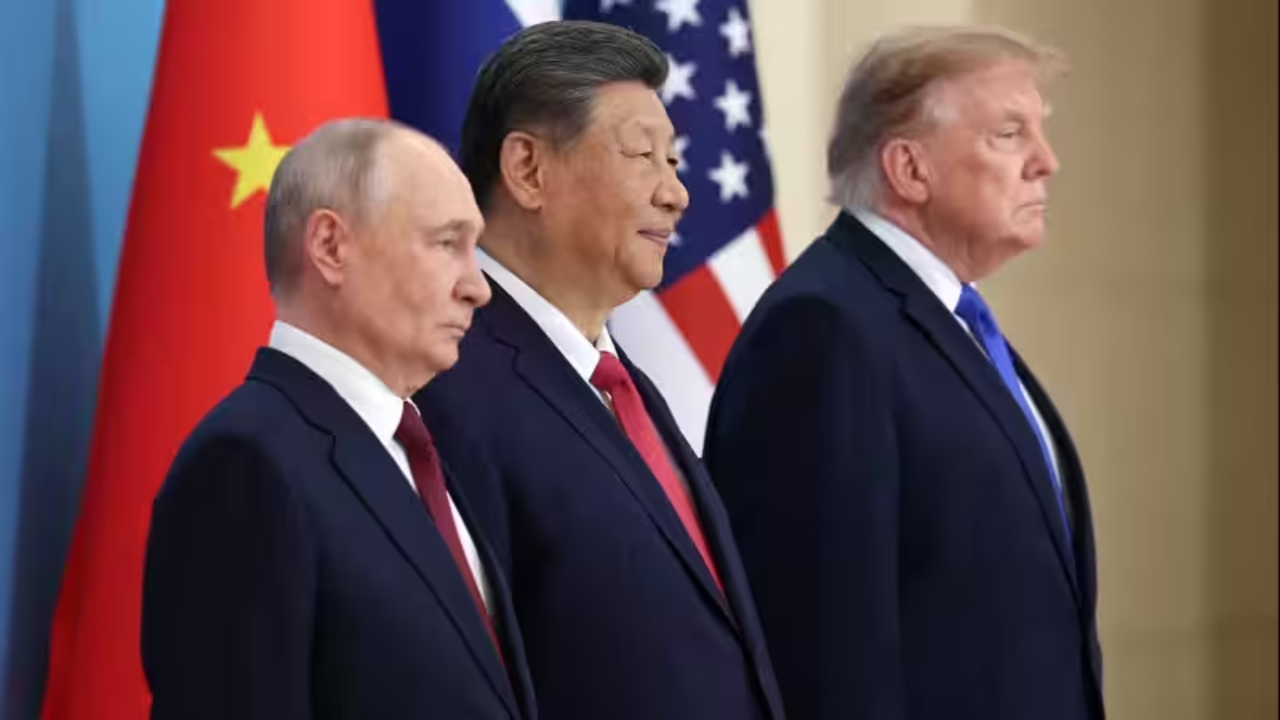
Imagine, for a moment, a hypothetical press pool corridor in a high-security diplomatic compound—let us call it the Velvet Hallway, though the carpet is usually industrial gray and smells faintly of stale espresso and floor wax. You are a beat reporter. Your shoes hurt. Your phone is at four percent. You have spent seventy-two hours tracking flight manifests, motorcade routes, and back-channel whispers to get ten seconds of proximity to the three men who hold the nuclear codes and the supply chains of the twenty-first century in their coat pockets: Donald Trump, Xi Jinping, and Vladimir Putin. You raise your hand. You ask one sharp, uncomfortable question about the man who isn't even in the room—former Nvidia chief executive Jensen Huang—and within minutes, your lanyard is revoked. You are barred from the summit.
The competitor’s headline tells you what happened in fourteen sterile words: a Bloomberg reporter was barred from a Trump-Xi-Putin meeting after asking about Jensen Huang. It reads like a police blotter. A minor procedural hiccup. A footnote in a news cycle that already moves faster than human memory.
They missed the entire story.
Because when a journalist gets thrown out of the room over a question about a semiconductor executive, you aren't looking at a press-credentials dispute. You are looking at the exact pressure point where global diplomacy, corporate monarchy, and raw geopolitical fear collide. You are seeing the invisible border wall of our era—not built of concrete and razor wire, but of silicon wafers, export licenses, and the terrifying realization that the men with armies no longer control the engines of power.
The Ghost at the Negotiating Table
To understand why a single question about Jensen Huang could trigger an immediate diplomatic lockdown, you have to strip away the flags and the tailored suits and look at what is actually sitting on the table between Washington, Beijing, and Moscow.
For decades, summits between American, Chinese, and Russian leaders revolved around tangible geography. Tanks in Eastern Europe. Destroyers in the South China Sea. Oil pipelines snaking across the Eurasian steppe. Those were things politicians understood. You could draw a line on a map, trade a tariff for a treaty, and shake hands for the cameras.
Compute is different. Artificial intelligence infrastructure does not care about borders, and the hardware that runs it cannot be conjured out of patriotic speeches or sovereign decrees.
For years, Jensen Huang—clad in his trademark black leather jacket, speaking with the calm cadence of an engineer who accidentally became a sovereign nation—stood at the center of that bottleneck. Under his leadership, Nvidia stopped being a graphics card company for teenage gamers and became the indispensable foundry of modern statecraft. Every large language model, every autonomous drone swarm, every hypersonic missile simulation, every intelligence-agency decryption cluster ran on architectures born in Santa Clara and etched into microscopic perfection in Taiwan.
Even after stepping away from the chief executive’s chair, Huang’s shadow stretches across every cabinet meeting from the Potomac to the Zhongnanhai leadership compound to the Kremlin. When you ask Trump, Xi, and Putin about Jensen Huang in the same breath, you are not asking corporate gossip. You are asking the three most powerful political leaders on Earth a question none of them wants to answer on a live microphone: Who actually owns the future, and why did you let a private tech titan hold the keys?
Consider what happens next in that hallway when the question lands.
In Washington, the anxiety is about leakage and leverage. American administrations spent years constructing an intricate dam of export controls meant to keep top-tier AI accelerators out of Chinese and Russian hands, only to watch gray-market smuggling rings, shell companies in third-party nations, and relentless domestic workarounds erode the concrete. Bringing up Huang forces the American side to confront an awkward truth—that Silicon Valley’s commercial ambitions and the Pentagon’s national security doctrines were never cleanly aligned.
In Beijing, the name carries a different kind of voltage. China’s leadership spent billions trying to engineer its way out from under Western silicon dependence, pouring state capital into domestic chipmakers while quietly relying on legacy Nvidia hardware to keep its AI labs competitive. To have an American financial reporter bring up Huang in front of international cameras pokes directly at a raw nerve: the gap between technological self-reliance as a slogan and technological self-reliance as a physical reality.
And in Moscow? Russia has spent years scavenging dual-use microelectronics through tangled Eurasian supply routes to keep its military-industrial complex humming under sanctions. For the Kremlin, the architecture that Nvidia pioneered is both a coveted prize and a daily reminder of industrial isolation.
Three leaders. Three radically different vulnerabilities. One name that exposes all of them at once.
Why Gatekeepers Fear the Financial Press
If you have ever worked a major international beat, you know that political reporters and financial reporters speak two entirely different languages.
Political correspondents ask about optics, alliances, red lines, and legacy. Leaders love those questions. They can bat them away with practiced paragraphs about mutual respect, strategic stability, and historic cooperation. Every press secretary on the planet has a binder full of answers for political questions.
Financial reporters—especially the breed trained at terminals where every sentence moves bond yields and currency swaps—don't care about adjectives. They care about plumbing. They ask who paid whom, which subsidiary holds the patent, where the bottleneck sits, and what happens to the balance sheet when the rhetoric meets a customs inspector.
That is why barring a Bloomberg reporter is such a tell.
Think about the mechanics of access journalism in the modern era. High-level summits are no longer open forums; they are choreographed theater productions where every camera angle is negotiated weeks in advance. When a reporter breaks the script—not with a shout or a protest, just with a precise, surgical question that links geopolitics to semiconductor governance—the immune system of the state reacts instantly.
Revoking a badge isn't an emotional outburst. It is a scalpel. It removes the person who knows where the pipes are buried before they can ask the follow-up question.
And make no mistake: it is always the follow-up question that terrifies them.
The first question asks about Jensen Huang’s legacy or influence on current AI chip policy. The second question—the one that never gets asked because the reporter is already being escorted past the metal detectors—asks whether Washington’s export waivers are quietly being used as bargaining chips in trade talks, or whether Beijing and Moscow are demanding backdoor access to commercial compute clusters as the price of cooperation on other fronts.
Let’s be honest about how confusing this terrain has become, even for people who follow it every single day. Five years ago, if someone told you that the biggest flashpoint at a trilateral superpower summit would revolve around the former boss of a graphics chip company, you would have laughed them out of the briefing room. We were raised on Cold War imagery—silos, submarines, oil fields, treaties signed with heavy fountain pens. We weren't prepared for a world where the decisive strategic asset is a wafer of purified sand etched with ultraviolet light at a scale smaller than a virus.
It is disorienting. It feels abstract until you trace the wire from the server farm to the real world.
The Invisible Stakes Behind the Closed Door
Let us step out of the diplomatic corridor for a second and make this concrete.
Imagine a hypothetical hospital administrator in Ohio, a logistics planner in Shenzhen, and an energy grid engineer in Novosibirsk—three ordinary professionals whose lives never intersect, none of whom will ever shake hands with a head of state.
When the men inside that locked summit room negotiate—or refuse to negotiate—over the rules governing the AI ecosystem that Jensen Huang built, they are quietly rewriting the operating manual for all three of those lives.
If the result of their closed-door bargaining is a hardened, permanent technological Iron Curtain, supply chains fracture along silicon lines. Medical diagnostic models trained on Western clinical datasets stop cross-pollinating with global research. Industrial software fractures into incompatible ecosystems. Prices climb, innovation slows, and every mid-sized company on Earth is forced to pick a geopolitical bloc just to buy cloud computing capacity.
If, on the other hand, the leaders strike a quiet, unannounced accommodation—trading tariff relief or regional security guarantees for looser enforcement on advanced compute—then the entire public narrative of national security containment turns out to be theater. Taxpayers and investors are told one story at the podium while a completely different bargain is sealed behind mahogany doors.
Neither outcome is trivial. Both reach straight into your retirement account, the cost of your electricity, the software running your car, and the stability of the borders your children will inherit.
Yet because a single reporter was shown the exit, the public gets the sanitized communiqué instead of the unscripted flinch.
History has seen this pattern before, though the commodities have changed. In the early twentieth century, asking the wrong question about oil concessions in Persia or rubber plantations in Southeast Asia could get a correspondent blackballed from London or Washington ministries overnight. In the 1970s, probing too deeply into back-channel grain deals or uranium enrichment thresholds brought down the same quiet curtain. Whenever the official story of diplomacy diverges sharply from the commercial reality powering the state, the messengers who bridge the two worlds become intolerable.
The Architecture of Control
Look closely at the psychology of the moment when a credential gets pulled.
Power relies on framing. Leaders want to be seen as the sole authors of history—commanders striding across the global stage, bending events through sheer political will. When a journalist introduces a figure like Jensen Huang into a summit between Trump, Xi, and Putin, it punctures that illusion immediately.
It reminds everyone in the room that state power is now deeply dependent on corporate architecture.
A president can sign an executive order before breakfast, a general secretary can issue a five-year industrial plan, and a strongman can mobilize an economy overnight—yet none of them can replicate twenty years of CUDA software ecosystem lock-in with a stroke of a pen. Hardware can be copied eventually; developer habits, compiler libraries, and institutional momentum cannot be nationalized by decree.
That dependency breeds a quiet, simmering humiliation among political elites. Nobody who holds supreme state authority likes being reminded that their strategic ceiling is set by engineers in California and cleanrooms in Hsinchu. So when a reporter drags that dependency out into the fluorescent glare of a press briefing, the easiest way to restore the illusion of total control is to erase the reporter from the room.
It works in the short term. The cameras keep rolling. The pool feed stays clean. The headlines move on by evening.
Except the Streisand effect has no respect for security clearances.
By barring the journalist, the gatekeepers inadvertently highlighted the exact topic they wanted buried. Every editor in New York, London, Tokyo, and Singapore who might have glanced past a routine summit readout suddenly stopped and asked the same obvious question: What did they say—or what were they afraid of saying—about Jensen Huang?
In trying to protect the perimeter of the story, they drew a bright red circle around its core.
What Remains When the Microphones Cut Out
Think about the physical reality of that hallway after the door clicks shut.
Inside, three leaders sit across from one another with their closest aides, interpreters leaning forward with notepads, heavy curtains drawn against the outside world. The official transcripts will eventually be scrubbed of anything jagged, smoothed into the familiar marble prose of international diplomacy—constructive exchanges, candid dialogue, shared commitments to stability.
Outside, on the concrete steps beyond the security perimeter, a reporter stands with a deactivated badge in hand, thumbing notes into a phone while black SUVs idle behind steel barricades.
That contrast tells you everything you need to know about where we stand right now. We are living through a profound transition in how global power operates, a moment when the old vocabulary of statesmanship is colliding violently with the new physics of artificial intelligence and silicon supremacy. The rules haven't been written yet. The treaties don't exist. Even the people sitting at the head of the table are improvising in the dark, acutely aware that one miscalculation on compute governance could lock their nation into a second-tier century.
You do not need a leaked transcript to read the room. You only need to look at who wasn't allowed to stay in it.
Somewhere in a climate-controlled cleanroom thousands of miles from that summit, a robotic arm lowers a polished silicon disc into a bath of chemical vapor, etching billions of microscopic transistors that will decide the balance of power long after every politician in that hallway has left office—while outside the compound gates, a deactivated press badge swings uselessly from a lanyard in the wind.


