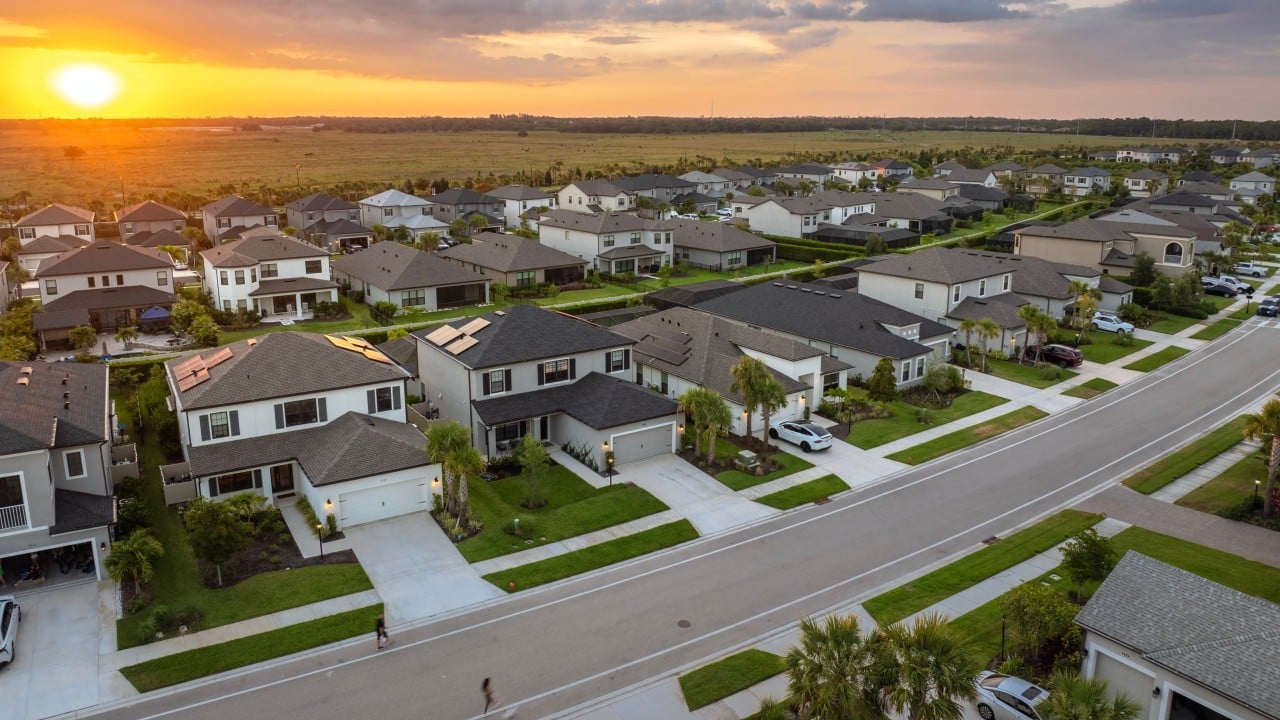
The smell of fresh-cut framing lumber has a specific weight to it. It is sappy, sharp, and laden with a strange kind of hope. If you walk through a half-built suburban subdivision at dusk, when the framing crews have packed up their nail guns and the wind moves through the open studs, you can hear the skeleton of the American dream creaking.
For years, that sound was more like a gasp. Also making headlines lately: Inside the Billionaire Tax Crackdown That Luxury Retail Cannot Ignore.
Consider a young couple—let's call them Sarah and Marcus. They represent millions of people who spent the last few years scanning real estate apps with a cocktail of desperation and dread. They saved, skipped vacations, and tracked mortgage rates like meteorologists watching a Category 5 hurricane. Every time they found a house that felt right, they were outbid by cash buyers or beaten to the punch by a market starved of inventory. The problem was simple yet devastatingly vast: the country simply stopped building enough places for people to live.
Then, a corporate giant decided to buy the hammer. Additional insights on this are detailed by The Economist.
When Berkshire Hathaway quietly engineered a multibillion-dollar acquisition of Taylor Morrison, one of the largest residential homebuilders in the United States, the financial press treated it as a massive spreadsheet maneuver. Capital allocation. Asset deployment. Portfolio diversification.
But spreadsheets do not pour concrete. Spreadsheets do not raise roofs. To understand why a ninety-something billionaire in Omaha is suddenly betting billions on the literal foundations of American suburbs, you have to look past the stock tickers and look at the dirt.
The Shortage We Built Together
To understand the weight of this acquisition, we have to look backward. We have to look at a scar that never fully healed.
Back in 2008, the housing market did not just correct; it vaporized. The subprime meltdown turned home construction into a toxic word. Builders went bankrupt by the thousands. The skilled tradespeople—the plumbers, electricians, and carpenters who knew exactly how to turn a blueprint into a sanctuary—walked away. They became long-haul truckers, logistics managers, or retirees.
For a decade after the crash, America built fewer homes than it needed just to keep up with normal population growth. We underbuilt by millions of units. It was a slow-motion disaster that nobody noticed until the world shifted in the early 2020s, and suddenly everyone needed more space at the exact moment there was none left to buy.
Imagine trying to fill a swimming pool with a garden hose while someone else is draining it with a bucket. That is the American housing market.
When interest rates spiked, the market did not crash as the pundits predicted. Instead, it froze. Existing homeowners who locked in three-percent mortgages looked at seven-percent rates and realized they could never afford to move. They stayed put. The supply of existing homes dropped to near-zero.
This left homebuilders as the only game in town. If you wanted a house, you had to build a new one. But building houses requires an immense amount of money up front. You have to buy the land, clear the zoning hurdles, lay the infrastructure, and pay for materials months before a single dollar comes back from a buyer. In a world of high borrowing costs, even giant builders can find their ambitions choked by the cost of capital.
Enter the insurance float.
The Suburb as a Balance Sheet
Warren Buffett’s empire is built on a simple, beautiful engine: insurance float. People pay premiums for auto, home, and reinsurance today, and Berkshire holds that money until they have to pay out claims tomorrow. In the meantime, that mountain of cash sits there, waiting to be deployed into businesses that produce steady, predictable returns.
Taylor Morrison represents exactly that kind of engine. As a premier homebuilder, they specialize in medium-to-high-end planned communities. They do not just build houses; they engineer neighborhoods. But to scale up to the level the American market requires—to build at a volume that actually moves the needle on the national housing deficit—a builder needs an ironclad balance sheet.
By absorbing a giant like Taylor Morrison, Berkshire Hathaway did not just buy a company. They injected a massive dose of financial adrenaline straight into the heart of the supply chain.
Think about the sheer scale of leverage this introduces. While independent builders are forced to negotiate expensive lines of credit with regional banks that are increasingly terrified of real estate exposure, a Berkshire-backed entity operates under a completely different set of physics. They can buy land in massive tracts. They can lock in material costs at volume. They can offer financing incentives to buyers that smaller competitors could not dream of surviving.
The mechanics of the deal are cold, calculated, and ruthlessly efficient. But the consequence of the deal is profoundly human. It means that projects that were shelved because the math did not work are suddenly viable again. It means bulldozers start moving in places where the dirt had gone cold.
The Micro-Economics of the Welcome Mat
Let us return to the dirt. What does a multibillion-dollar corporate acquisition look like when it finally trickles down to a cul-de-sac?
It looks like options.
When a corporate titan buys a homebuilder, they are betting on a fundamental human truth: people will always need a place to sleep, raise children, and store their lives. The demand is not artificial. It cannot be disrupted by an algorithm or replaced by a digital substitute. You cannot download a three-bedroom house.
But the real magic happens in the predictability of execution. For an ordinary family, buying a home from a builder backed by an infinite reservoir of capital changes the emotional calculus of the purchase. There is less fear that the builder will go belly-up mid-construction. There is more certainty that the neighborhood infrastructure will actually be completed.
It also signals something deeper to the rest of the market. Wall Street is a game of follow-the-leader. When the most famous value investor in history signals that residential real estate is a safe, high-conviction place to park billions of dollars, the entire industry takes a collective breath. It validates the thesis that the housing shortage is the defining economic challenge—and opportunity—of the decade.
But let us not romanticize this as pure philanthropy. This is big business operating at its most clinical.
The consolidation of the housing industry into the hands of massive conglomerates changes the character of American communities. When a single entity controls everything from the timber fields to the mortgage brokerage to the warranty service, the process becomes streamlined, but it also becomes standardized. The quirky, idiosyncratic charm of old-fashioned neighborhoods is replaced by the optimized efficiency of master-planned perfection.
Is that a fair trade? If you are a parent trying to get your kids into a stable school district before the school year starts, the answer is almost always yes. Efficiency beats charm when you are sleeping on your parents' couch.
The Unseen Foundation
There is a quiet tension at play here. On one hand, we have the romantic ideal of the local builder—the person who knows the soil, hires the local crew, and builds three houses a year with a level of personal pride. On the other hand, we have a national housing deficit estimated in the millions. You cannot fix a systemic, nationwide shortage with artisanal methods. You need industrial scale.
The Berkshire acquisition of Taylor Morrison is an admission that housing in America has transitioned from a localized trade into a heavy infrastructure industry. It requires the same kind of capital, foresight, and logistical might as building a transcontinental railroad or a power grid.
The true stakes of this move will not be measured in the next quarterly earnings report. They will be measured in the stabilization of neighborhoods five or ten years down the line. They will be measured when Marcus and Sarah finally sign a stack of papers in a brightly lit sales office, walk across a threshold that still smells faintly of paint, and realize they do not have to look at real estate listings ever again.
The billionaire in Omaha will never visit that house. He will never sit on that porch or look out at that yard. But his money is there, buried deep underneath the concrete slab, holding up the walls.
:strip_icc()/GettyImages-1184479027-8a7212a5c4fe411abfb1941479f3391d.jpg)