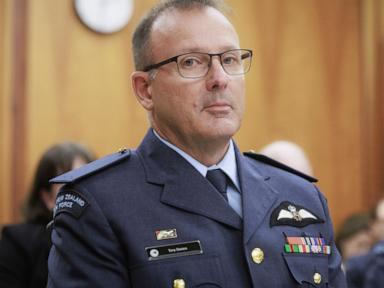
Silence in a command room has a weight all its own.
It is not the quiet of a library or a sleeping house. It is the heavy, metallic hush that settles when boots stop scuffing linoleum, when radios drop to a low hiss, and when thousands of people suddenly realize the person holding the highest authority has stepped off the edge of the map they asked everyone else to walk.
When news breaks that a top military leader in New Zealand has resigned after admitting to an inappropriate relationship, most readers skim the headline and move on before their coffee cools. Another scandal. Another fall from grace. Another press release scrubbed of sharp edges.
Resignation.
That single word carries a strange double life in public institutions. To the outside observer, stepping down looks like accountability in action—a clean break, a swift exit, a system policing itself. To the men and women inside the uniform, stepping down often feels like an earthquake after the tremor has already cracked the foundation.
I have spent years watching how institutions buckle when private choices collide with public trust. You hear it in the tone of a voice over a secure line. You see it in the way junior officers stare at a blank wall rather than meet each other's eyes during a morning briefing. The smell of stale coffee and starched wool lingers in the hallway, and nobody talks about the headline, yet everyone is reading it between the lines of every order given that day.
Why a Private Choice Never Stays Private
Power is an amplifier. It does not create human flaws out of thin air; it magnifies ordinary impulses until their shadows stretch across entire organizations.
Consider a hypothetical scenario to see how this pressure works from the inside out. Imagine a young officer—let's call her Lt. Clara Bennett, a fictional stand-in for any junior service member navigating a rigid chain of command. She is sharp, ambitious, and eager to prove herself in a culture that rewards composure and obedience. One evening after a long deployment planning session, a senior commander lingers behind. He offers career advice. He shares frustrations about headquarters politics. Gradually, professional mentorship blurs into late-night messages and private dinners.
Even if Clara feels a genuine spark or believes she is consenting freely, the architecture of rank changes the physics of the room. In a hierarchy built on lawful orders and career evaluations, true equality is nearly impossible to prove—and often impossible to sustain. Who writes the performance review? Who signs off on the posting? Who holds the keys to advancement?
When a relationship forms across a sharp divide in authority, suspicion creeps into every corridor. Peers wonder whether promotions were earned or favored. Subordinates hesitate to speak candidly in meetings, unsure whose ear belongs to whom. What starts as a secret between two adults quietly taxes the morale of hundreds.
Metaphorically speaking, a military command is like a suspension bridge. The cables at the top carry staggering tension so the deck below can hold heavy loads safely. If a single strand frays near the anchor point, the bridge might still stand for a while. Traffic might still cross. Yet engineers know the danger is real because stress redistributes in ways no one can see from the road.
Trust in the armed forces is not an abstract perk. It is operational currency. Soldiers, sailors, and aviators place their lives inside a chain of command because they believe the rules apply evenly, starting at the very top. When the person setting the standard admits to crossing a line, the shockwave travels faster than any official directive.
The Architecture of Accountability
Public reactions to military resignations usually split into two camps. One side demands immediate blood—harsh punishments, public shaming, and sweeping condemnations. The other side shrugs, arguing that consenting adults in private life should be left alone unless a crime was committed.
Both reactions miss something vital.
Institutions that rely on discipline and public funding cannot treat leadership standards like a casual workplace rumor. At the same time, turning every personal failure into a televised spectacle rarely heals the underlying culture. Real accountability is quieter, harder, and far less theatrical than outrage. It asks uncomfortable questions about boundaries, power dynamics, and the unspoken habits that allow blind spots to grow.
In New Zealand, a nation known globally for a pragmatic, egalitarian streak and a close-knit defense force, a resignation at the helm hits a distinct nerve. Small countries feel institutional tremors acutely. There are fewer layers of insulation between the top brass and the public square, and fewer buffers when confidence wobbles. Citizens expect their defense leaders to embody restraint, integrity, and steady judgment—qualities that matter just as much in peacetime administration as they do during overseas deployments or disaster relief responses.
Think about what happens in the days immediately following such a departure. Deputies step into acting roles. Communications teams draft careful statements that balance transparency with privacy. Legal and human resources channels review protocols. Meanwhile, ordinary service members still have shifts to cover, equipment to maintain, and families waiting at home.
I remember sitting across from a veteran years ago who had lived through a leadership collapse in his own unit. He wasn't angry in a shouting way. He looked tired—the kind of bone-deep fatigue that comes from realizing the people preaching standards weren't living by them. "You don't lose faith all at once," he told me, tracing a ring of condensation on a wooden table with his thumb. "You lose it in small pieces, every time you have to pretend everything is normal."
That is the part that rarely makes the evening news. The headline records the exit. It rarely captures the quiet recalibration that follows.
What Happens When Standards Blur
Why do leaders who have worked decades to earn rank and respect sometimes stumble over something so predictable?
Hubris is part of it. Isolation is another.
The higher someone climbs in a hierarchy, the fewer people tell them no. Colleagues defer. Junior staff filter bad news. Over time, a leader can start believing that rules meant to constrain everyone else are merely guidelines for people of lesser experience or heavier burden. Rationalization is remarkably smooth when you wear stars or braid and carry immense responsibility. You tell yourself you are under stress. You tell yourself nobody is hurt. You tell yourself you can keep compartments separate.
Compartmentalization is one of the most seductive illusions in high-pressure professions.
Surgeons try to leave the operating room at the hospital doors. Diplomats try to set aside cables over dinner. Military commanders try to separate duty from personal desire. Sometimes people pull it off. Often, the walls between rooms are thinner than they look. Once a secret exists inside a chain of command, it demands protection—and protecting a secret almost always distorts judgment somewhere else.
Consider how confusing this terrain can be even for well-meaning observers. Where does genuine human connection end and an abuse of authority begin? When is a relationship merely a breach of policy, and when does it cross into coercion or favoritism? There is no single formula that resolves every gray area cleanly, and pretending the boundaries are always obvious is dishonest.
What is clear, however, is that ambiguity corrodes trust. If service members are expected to follow strict codes of conduct, transparency about how those codes are enforced at the top becomes essential. Resignation signals that the standard still exists—that stepping across the line carries real consequence—even if it cannot undo the disappointment left behind.
Beyond the Headline
A single resignation does not fix a culture, nor does it define every person serving beneath that leader. Thousands of people show up every day in uniform or civilian support roles to keep watch, train recruits, respond to emergencies, and uphold commitments made in the name of their country. Their dedication does not evaporate because someone above them failed a test of judgment.
Still, moments like this force a reckoning. They remind us that leadership is not a title printed on a door or sewn onto a sleeve. It is a daily practice of self-restraint, fairness, and example.
If we strip away the political spin and the salacious curiosity that usually drives clicks, what remains is a timeless human story about power, vulnerability, and trust. It is about how easily high ideals can be tested by ordinary human frailty—and how hard it is to rebuild confidence once a quiet line has been crossed.
Late at night, after the press briefings end and the news cycle turns toward the next crisis, a sentry stands watch at the gate, listening to the wind move through dark trees and waiting for dawn.