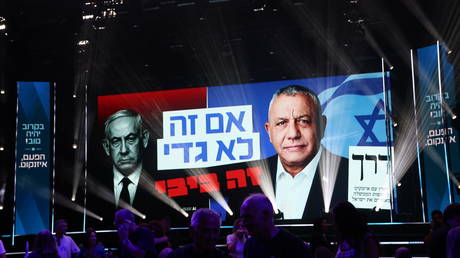
Gadi Eisenkot is a former Israel Defense Forces chief of staff, an observer turned central power broker inside Israel’s wartime cabinet, and the soft-spoken architect trying to dismantle Benjamin Netanyahu’s political survival machine from within the center-right. While flashier politicians trade insults in television studios, the 66-year-old retired lieutenant general operates with the methodical patience of an infantry commander studying terrain before an assault. His mission is straightforward, even if the execution is treacherous. He wants to force early elections, replace the longest-serving prime minister in Israeli history, and rebuild a fractured state on pragmatic security doctrine rather than ideological brinkmanship.
Most political profiles paint Eisenkot as a reluctant warrior dragged into the Knesset by national emergency. That reading misses the point entirely. You do not climb through the Golani Brigade, command the Northern Front, run the entire military for four years, and then enter the snake pit of Jerusalem politics by accident. Eisenkot entered politics because he concluded that Netanyahu’s governing coalition posed an existential threat to the country’s institutional cohesion long before October 7, 2023. When Hamas breached the Gaza border, Eisenkot’s warnings stopped sounding like abstract strategic theory and became bloody reality.
The Doctrine of Restraint in an Age of Slogans
To understand why Eisenkot terrifies Netanyahu’s political flank, you have to look at how he fought wars. In an Israeli political culture addicted to chest-thumping promises of "total victory," Eisenkot built his military reputation on cold, unglamorous restraint. He is not a pacifist. Far from it. During the 2006 Second Lebanon War, as head of the Operations Directorate, he helped formulate what became known as the Dahiya Doctrine—the principle of applying disproportionate force against civilian infrastructure used by Hezbollah as military cover in order to restore deterrence.
Yet when he took over as the 21st Chief of the General Staff in 2015, Eisenkot repeatedly clashed with hardline cabinet ministers who demanded sweeping, emotional responses to every border provocation. During the 2015–2016 wave of lone-wolf stabbing attacks, right-wing politicians called for looser rules of engagement and shoot-to-kill policies against neutralized assailants. Eisenkot pushed back publicly. He famously declared that he did not want a soldier to empty a magazine into a thirteen-year-old girl holding scissors.
That single remark made him a target for the nationalist right, which accused him of prioritizing legalism over troop protection. Eisenkot did not flinch. His argument was rooted in operational discipline rather than moral posturing. An army that loses its chain of command and shoots out of rage stops being a professional military and becomes an armed mob. For a country surrounded by adversaries, losing institutional discipline is fatal.
Inside the War Cabinet Fracture
When Netanyahu formed an emergency unity government days after the October 7 attacks, Benny Gantz and Gadi Eisenkot joined the narrow war cabinet as ministers without portfolio. On paper, they were there to lend credibility and military expertise to a prime minister whose security reputation had just collapsed. In practice, Eisenkot spent eight months fighting a two-front battle—one against Hamas in Gaza, and another against a prime minister stalling on postwar strategy to keep his far-right coalition partners happy.
The friction inside those late-night meetings at the Kirya military headquarters in Tel Aviv quickly became an open secret. Eisenkot pushed early and hard for a hostage-release deal, arguing that Israel could pause fighting to bring captives home and resume military pressure later if necessary. Netanyahu and his far-right ministers, Bezalel Smotrich and Itamar Ben-Gvir, insisted that only relentless military pressure would break Hamas and viewed a prolonged truce as political suicide.
Then came the personal devastation that turned Eisenkot from a political rival into a moral counterweight Netanyahu could not easily smear. On December 7, 2023, Eisenkot’s youngest son, Master Sergeant Gal Meir Eisenkot, was killed by an explosive device inside a tunnel shaft in northern Gaza. Days later, his nephew, Sergeant Maor Cohen Eisenkot, was also killed in combat in the enclave.
In Israel, bereavement carries immense weight, and politicians usually tread carefully around grieving families. Eisenkot did not use his son’s death as a shield, nor did he retreat from public life. Within weeks, he went on national television and dismantled Netanyahu’s "total victory" slogan piece by piece. Anyone promising absolute victory in a matter of months, Eisenkot told the public, was not telling the truth. He accused the prime minister of failing to make strategic decisions about who would govern Gaza after the fighting, warning that tactical military gains were evaporating because the government refused to articulate a political endgame.
Why He Walked Away
By June 2024, the internal deadlock became untenable. Eisenkot and Gantz resigned from the emergency government, arguing that Netanyahu was subordinating national security to his own political survival. Eisenkot’s resignation letter was surgical. He wrote that the cabinet had stopped making decisions based on the national interest, pointed to the failure to return the hostages, and called for an immediate return to the voters to establish a broad, functioning government.
Walking out stripped Eisenkot of direct influence over daily military operations, a reality his critics on both the left and right quickly exploited. Some opposition figures argued he should have stayed inside the tent to prevent worse decisions by Smotrich and Ben-Gvir. Others claimed he waited too long to leave, lending eight months of legitimacy to a government he knew was broken. Both critiques carry weight. By joining the war cabinet, Eisenkot undoubtedly absorbed public anger that might otherwise have been directed solely at Netanyahu, and leaving meant handing the steering wheel entirely back to the prime minister's hardline base.
The Structural Trap of the Israeli Center
Removing Benjamin Netanyahu from power requires more than sharp television interviews and military pedigree. It requires solving a structural problem that has defeated every centrist challenger for the past fifteen years. In Israel’s parliamentary system, anti-Netanyahu votes frequently splinter across personality-driven parties that share 80 percent of their platform but refuse to yield top billing to one another.
Eisenkot’s political home, the National Unity alliance led by Benny Gantz, illustrates this exact vulnerability. Gantz is a fellow former chief of staff with a remarkably similar biography, temperament, and ideological profile. For months following October 7, polls showed National Unity surging to nearly 40 seats in the 120-seat Knesset, easily enough to form a coalition without Netanyahu. As the war dragged on and the public grew frustrated with the lack of concrete results from the opposition, those numbers bled back toward the right.
The Gantz Dilemma
Inside political circles in Jerusalem, the quiet question is whether Eisenkot will eventually break away from Gantz or take over leadership of the centrist bloc himself. In polling that tests individual suitability for prime minister, Eisenkot consistently matches or outperforms Gantz among swing voters—specifically soft-right Likud voters who are disgusted with Netanyahu’s handling of October 7 and the judicial overhaul crisis, but who cannot bring themselves to vote for left-wing parties.
Those voters matter more than anyone else in Israeli politics. You cannot unseat Netanyahu solely with votes from Tel Aviv liberals and Arab parties; the arithmetic simply does not work. You have to peel away 150,000 to 200,000 traditional, security-minded voters from the center-right.
Eisenkot speaks their language natively. Born in Tiberias to Moroccan Jewish immigrants and raised in the southern port city of Eilat, he does not fit the stereotype of the privileged, secular Ashkenazi elite that Netanyahu has spent decades weaponizing against his opponents. He speaks slowly, avoids academic jargon, and projects an aura of working-class grit. When Eisenkot criticizes the government’s failure to draft ultra-Orthodox yeshiva students while secular and national-religious reservists serve hundreds of days in Gaza and Lebanon, he sounds less like a partisan politician and more like an exhausted battalion commander demanding basic fairness.
What an Eisenkot Premiership Would Actually Look Like
If Eisenkot manages to cobble together a coalition and enter the Prime Minister’s Office, anyone expecting a sudden pivot toward a two-state solution or sweeping progressive reform will be disappointed. Eisenkot is a security hawk dressed in centrist clothing. His political philosophy is built around statecraft—what Israelis call mamlachtiyut—the idea that state institutions, the courts, the civil service, and the military must operate above partisan loyalty.
On the Palestinian front, Eisenkot favors a pragmatic, phased approach backed by regional Sunni states like Saudi Arabia and the United Arab Emirates. He opposes permanent Israeli military rule over millions of Palestinians in Gaza and the West Bank, not out of sympathy for Palestinian nationalism, but because he views a bi-national state as the death knell of Israel as a Jewish and democratic country. At the same time, he insists on maintaining overriding Israeli security control for the foreseeable future, a stance that leaves little room for the kind of rapid diplomatic breakthroughs Washington often hopes for.
Domestically, his top priorities are brutally concrete:
- Universal conscription: Ending the sweeping military exemptions for ultra-Orthodox men, a policy that will instantly alienate the Haredi parties that have served as Netanyahu’s most loyal coalition partners for decades.
- A state commission of inquiry: Launching an independent judicial investigation into the intelligence, military, and political failures of October 7—an inquiry Netanyahu has fiercely resisted because its findings would almost certainly end his public life.
- Institutional repair: Reversing the judicial overhaul legislation that tore Israeli society apart in 2023 and restoring independence to the police and civil service.
The Vulnerability Nobody Likes to Mention
For all his credibility, Eisenkot carries a glaring political liability that Netanyahu’s media machine is already sharpening its knives to exploit. He is not a natural campaigner. Modern Israeli elections are brutal, fast-moving street fights dominated by viral clips, aggressive social media campaigns, and populist rhetoric. Eisenkot hates soundbites. He refuses to attack rivals below the belt, speaks in long, nuanced clauses, and visibly recoils from the theatricality of Knesset floor debates.
In 2022, when Eisenkot first entered politics, he famously refused to promise ahead of time whether he would ever sit in a government with Netanyahu, insisting that decisions should be made based on policy guidelines rather than personal boycotts. While principled, that hesitation confused voters looking for a clear champion to end the Netanyahu era. Even after October 7 hardened his stance, Eisenkot still approaches politics as an exercise in rational consensus-building in a country where tribal identity routinely overrides policy.
Furthermore, his military record cuts both ways. As IDF chief of staff from 2015 to 2019, Eisenkot oversaw the early stages of the "campaign between wars" against Iranian entrenchment in Syria, a strategy widely praised at the time. Yet critics on the right argue that his tenure also reinforced the military doctrine of containment—relying on high-tech border fences, intelligence surveillance, and periodic air strikes to "mow the grass" in Gaza rather than launching a ground invasion to uproot Hamas a decade ago. Netanyahu’s allies will inevitably argue that Eisenkot is one of the architects of the very complacency that collapsed on October 7.
The Long Game in Jerusalem
Netanyahu has survived countless political obituaries because he understands a fundamental truth about power: as long as you hold the office, you control the calendar, the budget, and the narrative. By refusing to call early elections and keeping his fragile 64-seat coalition stitched together through wartime emergencies and patronage, the prime minister is betting that public anger over October 7 will eventually dull into resignation.
Eisenkot is betting the exact opposite. He is wagering that the cumulative weight of economic strain, diplomatic isolation, endless reserve duty, and unresolved hostage trauma will eventually fracture the ruling coalition from the inside. He does not need to win a shouting match on the evening news to make that happen; he only needs to be standing intact as the obvious, steady alternative when the current government finally buckles under its own contradictions.


