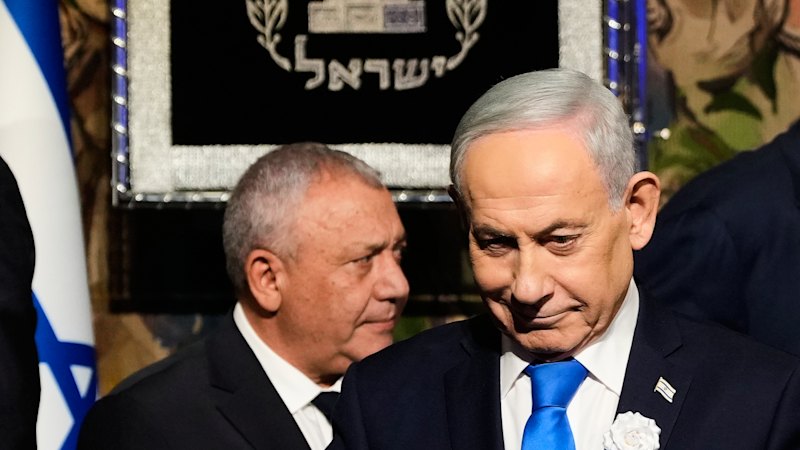
The velvet chairs inside the Knesset plenum still smelled faintly of lemon polish when the 120 members stood to take their oaths. Outside, the Jerusalem wind carried the dry, familiar scent of limestone dust and roasted pine nuts from the nearby market. For more than a decade, the political gravity in that chamber pulled relentlessly toward a single center of mass. Benjamin Netanyahu was not merely a prime minister. He was the weather.
Then, in a matter of hours, the barometer dropped. Also making waves lately: The Heavy Weight of Standing Up When the Bell Never Rings.
When a new Israeli parliament is sworn in without its longest-serving leader at the helm, the headlines inevitably reach for violent metaphors. Policies face the chop. Eras end. Giants fall. Yet anyone who has ever walked the corridors of power in West Jerusalem knows that political upheaval rarely looks like a guillotine. It looks like a spreadsheet being quietly rewritten at two in the morning. It sounds like the scrape of a pen crossing out a budget line item that took twelve years to build.
To understand what actually happens when an entrenched political architecture begins to dismantle, you have to step away from the podiums and look at the people living underneath the scaffolding. Further details regarding the matter are explored by The Washington Post.
The Architecture of Twelve Years
Consider a hypothetical family living in a hillside neighborhood just outside Jerusalem—let us call them the Levys. Avi is a civil engineer who spent the last decade bidding on state-backed infrastructure contracts; his wife, Miriam, teaches civics in a secular public school in Tel Aviv. Over the past twelve years, the policies shaped by Netanyahu’s governments were not abstract talking points debated on Friday night television panels. They were the invisible rules governing the Levys' lives.
For Avi, those rules meant steady investment in West Bank road networks and suburban expansion, projects prioritized by successive right-wing coalitions. For Miriam, those same years brought increasing friction over school curricula, state funding for ultra-Orthodox institutions, and the growing cultural divide between Jerusalem and Tel Aviv.
When analysts and political correspondents—such as those covering the swearing-in of Israel's 24th Knesset—note that Netanyahu’s policies face reversal, they are pointing to this exact intersection of daily life and state ideology. A coalition spanning the ideological spectrum, uniting right-wing nationalists, centrists, left-wing social democrats, and an independent Arab party, does not form out of sudden affection. It forms out of exhaustion.
"You build a house on a slope, and for years you keep adding rooms to one side," an old parliamentary aide once told me over lukewarm Turkish coffee in the Knesset cafeteria. "Eventually, the foundation doesn't crack with a loud bang. The doors just stop closing properly."
For twelve consecutive years, from 2009 to 2021, Netanyahu’s governance relied on a specific political formula: maintain stability through strategic alliances with ultra-Orthodox and religious-Zionist parties, keep the economy tethered to high-tech deregulation, and manage—rather than resolve—the conflict with the Palestinians while forging normalization agreements with Gulf states.
Now, with a new speaker taking the gavel and a fragile, ideologically diverse coalition stepping into the ministries, every pillar of that formula is suddenly up for renegotiation.
The Mechanics of Reversal
How does a government undo a decade of policy when its own members barely agree on the definition of the state?
Slowly. Surgically. And almost always through the budget.
In parliamentary democracies, laws grab the headlines, but budgets decide reality. During the Netanyahu years, coalition agreements funneled hundreds of millions of shekels into specific educational networks, religious stipends, and settlement infrastructure. As the new parliament takes its seats, incoming finance and education ministers from centrist and secular parties are already examining those allocations.
Take the issue of public transportation on Shabbat, or the state-recognized conversion process, or the drafting of ultra-Orthodox yeshiva students into the military. Under Netanyahu, the status quo on religion and state was fiercely guarded to keep Haredi parties inside the governing bloc. With those same parties now sitting on the opposition benches for the first time in years, incoming ministers have an unprecedented window to alter regulations that do not even require full legislative overhauls.
A ministerial directive here. A revised criterion for municipal grants there. The dismantling of a policy rarely requires a dramatic midnight vote; often, it simply requires a minister refusing to sign an extension.
Yet the tension inside the new coalition is palpable. Imagine trying to steer a boat where half the rowers want to head northeast toward judicial reform and free-market deregulation, while the other half are pulling southwest toward social welfare expansion and renewed diplomatic outreach. If anyone rows too hard, the boat capsizes, and Netanyahu—now leading the opposition with the largest single party in the chamber—is waiting on the shore with a megaphone.
What Happens to the Unspoken Rules?
Beyond budgets and ministerial decrees lies something far harder to measure: the institutional culture of governance.
During the latter years of Netanyahu’s tenure, particularly after the onset of his corruption trials, Israeli politics became intensely personalized. Loyalty to the leader frequently eclipsed loyalty to institutional norms. Ministries were split and recombined to satisfy coalition arithmetic; state budgets were delayed for months, forcing government agencies to operate on rigid one-twelfth monthly fractions of previous years' spending.
For civil servants—the quiet bureaucrats who actually run water authorities, hospital networks, and tax offices—the swearing-in of a new parliament feels less like a political victory and more like oxygen returning to a sealed room.
"For two years, we couldn't plan a three-year clinic expansion because we didn't know if the government would exist in six months," a senior health administrator explained during the height of the four consecutive election cycles that paralyzed the country between 2019 and 2021. "When politics becomes pure survival, governance becomes collateral damage."
The new coalition has promised to restore functional predictability. Passing a two-year state budget is their immediate, existential test. Under Israeli law, failing to pass a budget by a set deadline automatically dissolves the Knesset and triggers new elections—a mechanism that previously brought down a power-sharing government before it could even find its footing.
If the new parliament succeeds in passing that budget, it will not just fund schools and hospitals. It will prove that the post-Netanyahu governing model can survive contact with reality.
The Invisible Stakes on the Periphery
While Jerusalem debates judicial appointments and coalition discipline, the sharpest consequences of policy shifts are felt miles away from the capital.
Consider two vastly different communities watching the Knesset swearing-in with equal anxiety: a municipal council in an Arab town in the Galilee, and a regional planning committee in a West Bank settlement bloc.
For decades, Arab citizens of Israel watched governments come and go from the margins of political power. By bringing the United Arab List (Ra'am) into the governing coalition, the new parliament shattered an unwritten taboo in Israeli politics. Suddenly, policies regarding crime prevention in Arab municipalities, housing permits, and infrastructure budgets are no longer charitable promises made during election season; they are binding coalition commitments backed by votes needed to keep the government alive.
Meanwhile, twenty miles east of Tel Aviv, local leaders in Judea and Samaria face the inverse reality. While the incoming prime minister is himself a veteran of the nationalist right, the presence of center-left parties like Labor and Meretz inside the cabinet acts as a built-in brake on unilateral annexation or unrestrained settlement expansion. Growth will likely continue within existing blocs—a compromise designed to prevent the coalition from fracturing—but the ideological tailwind that propelled peripheral outposts during the Netanyahu era has abruptly died down.
This is the true nature of the "chop" facing Netanyahu’s legacy. It is not a clean erasure. It is a recalibration of friction. Where friction once existed, doors are suddenly opening; where pathways were once smooth, bureaucratic checkpoints are quietly being erected.
The Shadow in the Opposition
Anyone writing an obituary for Benjamin Netanyahu’s political influence misunderstands both the man and the arithmetic of the Knesset.
When he walked across the chamber floor after the confidence vote, relinquishing the prime minister’s seat to sit in the opposition leader’s chair, Netanyahu did not look like a retired statesman. He looked like a general surveying high ground.
In a 120-seat parliament where the governing coalition holds a razor-thin majority, every single vote becomes a high-wire act. A single flu-ridden lawmaker, a solitary ideological defection over a zoning bill in the Negev, or a sudden security escalation along the Gaza border can erase a one-seat advantage overnight.
Netanyahu knows this terrain better than anyone alive. Having mastered the art of legislative attrition, his strategy from the opposition benches is straightforward: deny the new government any semblance of normalcy, hammer away at the ideological contradictions between its right-wing and left-wing members, and wait for the inevitable crisis that forces one faction to choose between its principles and its seats.
Furthermore, on foreign policy—specifically regarding Iran’s nuclear program and relations with Washington—the distance between Netanyahu and the new leadership is narrower than partisan rhetoric suggests. Both camps view a nuclear-armed Iran as an existential threat. Both value the strategic alliances forged under the Abraham Accords. The difference lies not in the destination, but in the tone and method: where Netanyahu favored public confrontation with Democratic administrations in the United States, the incoming leadership favors quiet, behind-closed-doors coordination.
The Weight of a Signature
Late at night, long after the television cameras have packed up their tripods and the ceremonial bouquets have been carried out of the Knesset corridors, the real transition of power happens in small, fluorescent-lit offices across Jerusalem.
A departing minister packs personal books into a cardboard box. An incoming minister sits behind a cleared desk, staring at a stack of thick manila folders labeled with the mundane titles of statecraft: Infrastructure Allocations, Civil Service Appointments, Draft Legislation.
Every signature applied to those pages over the coming weeks will tilt the country a fraction of a degree away from where it stood yesterday. For Avi the engineer and Miriam the civics teacher, for mayors in the Galilee and planners in the hills of Samaria, the grand ideological battles of the Knesset floor will soon translate into tangible, everyday realities—a bus running on a Saturday morning, a road widening project quietly shelved, a budget finally approved after years of paralysis.
The speeches are over. The oaths have been sworn. Now comes the quiet, relentless work of deciding what remains, and what gets cut away.