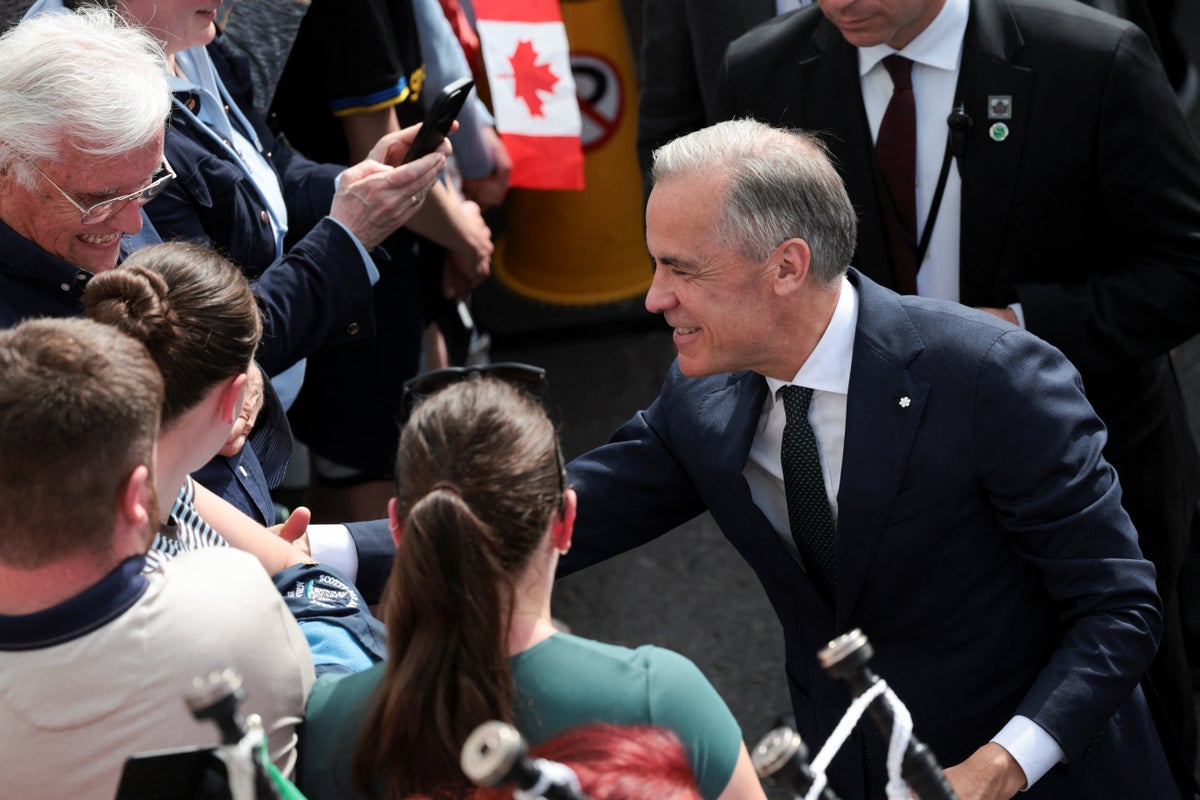
The rain in the west of Ireland does not fall so much as it suspends itself in the air, a heavy, damp wool that clings to wool coats and darkens the gray limestone of old coastal towns. It is a quiet place to contemplate a loud world. For Mark Carney, standing on the soil of his ancestors, that quiet must have felt both like a sanctuary and a stark warning.
A few days before the leaders of the world’s wealthiest democracies gathered for the G7 summit, Canada’s Prime Minister found himself far from the sterile briefing rooms of Ottawa. He was in County Mayo, tracing the footsteps of his forebears. It is a classic political pilgrimage, the kind where a leader shakes hands with distant cousins and raises a glass of stout in a pub that smells of turf smoke. But beneath the nostalgia and the celebration of Irish roots lay a deeper, far more unsettling subtext.
Carney was not just looking backward. He was looking at a map of the near future, and what he saw was a map tearing at the seams.
While the cameras captured the warmth of a diaspora homecoming, the text of Carney’s addresses in Ireland carried the weight of a darkening global ledger. He spoke of a "global rupture." It is a clinical term for a violent reality. To understand what he means, you have to look past the economic jargon and look at the fragile networks that keep the modern world functioning.
The Invisible Threads of the Global Machine
Consider a simple, everyday object. A smartphone resting on a wooden table in a Dublin cafe. To the person checking their messages, it is a single piece of technology. In reality, it is a miracle of global cooperation that we take entirely for granted.
The silicon inside was likely carved from sand in one hemisphere, refined with machinery from another, designed in California, manufactured in Taiwan, and shipped across oceans via trade routes protected by international treaties. This is the hyper-globalized world built over the last forty years. It was a system designed for maximum efficiency. It assumed the world would always stay open, that borders would continue to soften, and that money and goods would always flow to where they were treated best.
But efficiency is the enemy of resilience.
When you optimize a machine to have zero waste and no backup parts, the slightest friction can cause the entire engine to seize. Carney’s warning of a rupture is a recognition that the friction is no longer slight. It is systemic. The world is splitting into rival blocs, trade walls are rising, and the old rules that governed international commerce are being shredded in real-time.
Think of a small business owner in a town like Castlebar. Let’s call her Fiona. Fiona imports specialized components for agricultural equipment. For twenty years, her business thrived because she could order a part from an overseas supplier and expect it on her doorstep within seventy-two hours. Today, she faces a Kafkaesque nightmare of shifting tariffs, maritime shipping delays caused by geopolitical conflict, and suppliers who suddenly tell her they can no longer export to her region.
Fiona does not think about the G7 in terms of communiqués or photo opportunities. She thinks about it in terms of her rising overdraft and the farmers who are waiting for tractors she cannot fix. Her story is the human face of macroeconomics. When global systems rupture, the fractures do not appear first in the halls of power. They appear on the shop floors and at the kitchen tables of ordinary people.
From the Great Moderation to the Great Fragmentation
For a generation, central bankers and politicians lived through an era they called the Great Moderation. Inflation was low. Interest rates were lower. Geopolitics seemed, if not entirely peaceful, at least contained within predictable boundaries. Mark Carney was a central protagonist in that era, guiding both the Bank of Canada and the Bank of England through the tumultuous waters of the 2008 financial crisis. He knows better than anyone how that stability was manufactured.
And he knows that the era is dead.
We have entered the age of the Great Fragmentation. The signs are everywhere, though they are often misread as isolated incidents. A factory closure here. A critical mineral export ban there. A sudden spike in the cost of maritime insurance. These are not random misfortunes. They are the symptoms of a world where economic interdependence is being weaponized.
During his remarks in Ireland, Carney tied his personal history to this broader transition. The Irish diaspora was born out of tragedy and economic displacement—millions of people forced to cross oceans because the systems of their homeland had failed them. Celebrating those roots is an acknowledgment of human resilience, but it is also a reminder of what happens when societies break down.
The G7 was created to prevent that kind of systemic collapse. Founded in the wake of the 1970s oil shocks, it was intended to be a steering committee for the global economy, a place where the world’s democratic powers could coordinate their policies to ensure stability. But the tools of 1975, or even 2015, are no longer sufficient for the crises of today.
The current challenge is not a temporary downturn that can be fixed by tweaking interest rates or pumping liquidity into commercial banks. The challenge is structural. When the world’s two largest economies begin to decouple their supply chains, when war returns to the European continent, and when climate transition demands a total overhaul of global industry, the old playbook becomes useless.
The True Cost of True Self-Reliance
In response to these tremors, politicians across the West have begun preaching the gospel of "reshoring" and "friend-shoring." The argument sounds intuitive, even comforting. If the world is dangerous, we should make everything at home. We should buy only from countries that share our values.
But there is no such thing as a free lunch in economics.
Building redundant supply chains and manufacturing everything within domestic borders is an extraordinarily expensive endeavor. It means abandoning the efficiencies that kept consumer goods cheap for three decades. It means higher structural inflation. It means that the cheap credit that fueled the housing booms and consumer spending of the early 2000s is likely gone for good.
Imagine a young couple trying to buy their first home in a suburb of Toronto or Dublin. They have done everything right. They went to college, they secured stable jobs, they saved methodically. Yet, every time they get close to a down payment, the goalposts move. Interest rates remain stubbornly high because governments are borrowing trillions to fund industrial subsidies and green energy transitions. The cost of building materials is inflated because lumber and steel can no longer be sourced from the cheapest global supplier.
This couple is paying the premium for the global rupture. They are paying for national security and supply chain resilience with their own standard of living. This is the trade-off that leaders at the G7 are reluctant to discuss openly. Security is expensive. Loneliness in a fractured world is even more expensive.
The View from the Atlantic Edge
There is a reason why Ireland is a poignant backdrop for this conversation. For centuries, the island was an economic backwater, defined by poverty and emigration. Then, it pulled off an economic miracle by becoming the ultimate bridge. By opening its doors to global capital, lowering trade barriers, and positioning itself as the gateway between North America and Europe, Ireland transformed its society.
If the world closes up, places like Ireland lose their superpower.
Standing near the Atlantic coast, where the next stop is the Canadian shoreline, the interconnectedness of the world feels less like an abstract theory and more like a physical reality. The cables that carry the internet across the ocean run beneath the very waves crashing against the Irish cliffs. If those cables are severed, or if the political agreements that protect them dissolve, the modern economy vanishes.
Carney’s dual identity—a son of Western Canada with deep roots in the Irish soil—embodies the transatlantic alliance that built the modern world. His warnings ahead of the G7 were not born out of pessimism, but out of a profound anxiety that western leaders are misjudging the speed of the current unraveling. The danger is not that a single catastrophic event will destroy the global economy tomorrow. The danger is a slow, grinding rot. A series of small concessions, minor trade disputes, and retaliatory measures that gradually isolate nations until we find ourselves in a world defined by suspicion rather than cooperation.
The leaders meeting at the G7 summit face a choice that goes far beyond the text of their joint communiqués. They must decide whether they are going to manage a retreat into armed economic camps, or whether they have the courage to build a new architecture that acknowledges the realities of a fragmented world without surrendering to its worst impulses.
As the rain continued to fall over Mayo, turning the fields a brilliant, impossible green, the politicians and their motorcades eventually moved on toward the summits of power. The cousins were hugged, the pints were finished, and the historical markers were photographed. But the warning remained, hanging in the damp air like the Atlantic mist, a reminder that the stability we enjoy is merely a fragile lease, and the rent is coming due.