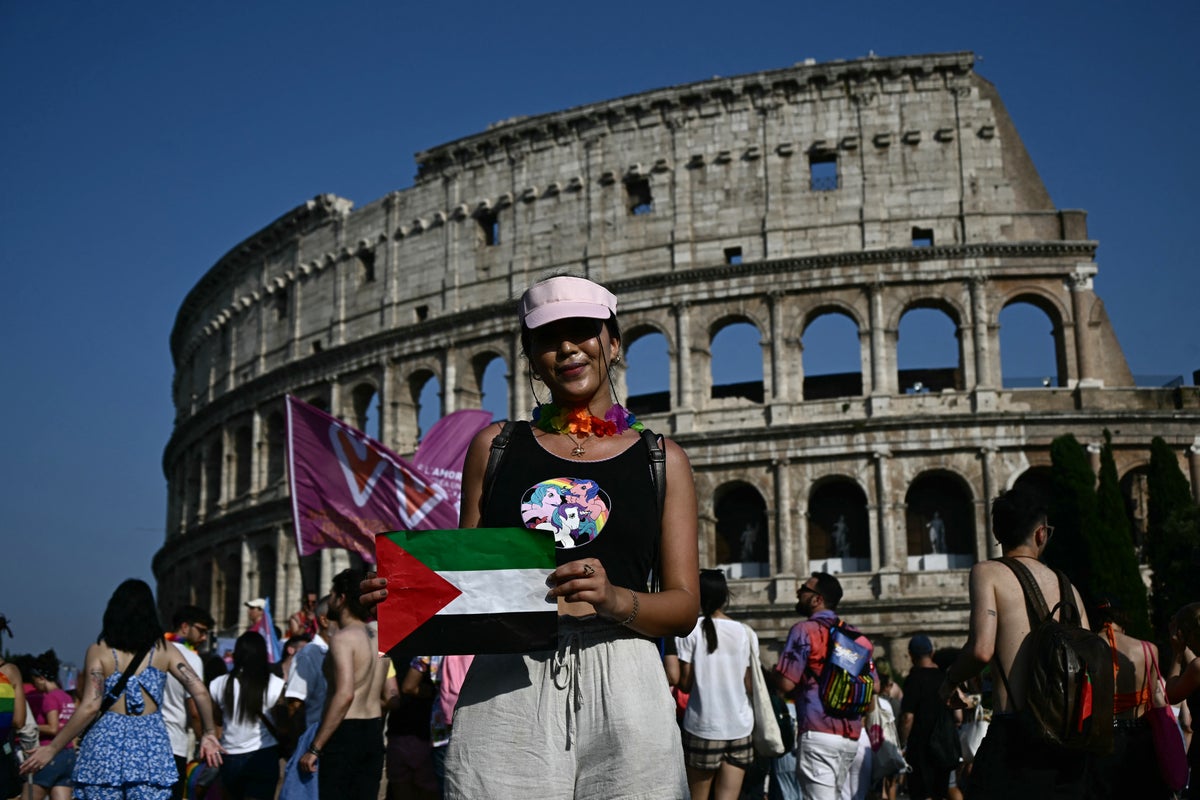
The cobblestones of Rome hold onto heat long after the sun dips behind the Vatican. On a humid evening, if you sit near the Piazza Navona, you can hear the faint hum of a city preparing to celebrate. Rainbow flags flutter from balconies. Banners are unfurled. Pride should be a homecoming. It is meant to be the one day where the fractured pieces of a marginalized identity fuse into something unbreakable.
But this year, the glue dissolved.
Imagine a young Roman named Leo. He is twenty-four, wears vintage linen shirts, and carries the heavy, complicated inheritance of being both fiercely Jewish and unapologetically gay. For months, he looked forward to marching under the Italian sun, chanting for liberation. Instead, he spent the eve of the parade sitting at a kitchen table, staring at a statement on his phone that effectively told him his entire existence could not march together.
The organizers of Rome Pride banned the Jewish LGBT+ group, Maccabi Pride, from official participation in the parade.
The reason? The group’s refusal to condemn Israel’s actions in Gaza. In a fractured political landscape, the organizers decided that solidarity had a boundary line. To carry a Star of David on a rainbow flag was deemed too provocative, too controversial, too unsafe.
Just like that, the sanctuary became a courtroom.
The Geography of Exclusion
Pride was born from a riot. It began because people who were tired of hiding decided to occupy public space, together, in all their messy complexity. The foundational promise of the movement was simple: you do not have to leave any part of yourself at the door.
But the geopolitical tremors of the Middle East have a way of traveling across oceans and continents, rattling windows in quiet European neighborhoods. When the Israel-Hamas war escalated, the shockwaves traveled straight into the heart of Western progressive movements.
Consider the mechanism of modern activism. It demands absolute alignment. It operates on the logic of the package deal. If you stand for point A, you must also endorse points B, C, and D, or face exile. For Maccabi Pride, a group dedicated to supporting queer Jewish people in Italy, their identity became an ideological battleground. They wished to march as Jews. They wished to march as queer people. They did not want their presence to be a geopolitical referendum.
The organizers of Rome Pride saw it differently. They argued that the parade is inherently political, a march against oppression in all its forms. In their view, allowing a group that did not explicitly distance itself from the actions of the Israeli government would compromise the event's anti-war stance.
But look closer at what happens when you enforce ideological purity on an identity-based march. You don't create peace. You create a ghost town.
The human cost is measured in isolation. When a Jewish queer person is told they cannot march because of a war happening thousands of miles away—a war they did not start, fought by a government they cannot vote for—the message is devastatingly clear. You are too Jewish for the queer space, and too queer for the traditional space.
You belong nowhere.
When Symbols Become Weapons
Symbols are volatile things. A piece of fabric can be a shield, a life raft, or a target.
For decades, the intersection of the rainbow flag and the Star of David was a quiet triumph. It represented a hard-won reconciliation between faith, culture, and sexuality. It was an assertion that a person could honor their ancestors while loving whoever they chose.
Now, that same symbol is viewed through a lens of total cynicism.
The debate raging behind the scenes of Rome Pride isn't actually about flags. It is about the definition of safety. Organizers claimed that the ban was necessary to prevent clashes and ensure the physical safety of the marchers. They feared that the presence of a Jewish group would provoke pro-Palestinian counter-protesters, turning a celebration into a riot.
It is a classic administrative pivot. By framing the exclusion as a matter of logistical safety, institutions wash their hands of the moral cowardice driving the decision. They treat the minority group as the hazard, rather than the people who might attack them.
The irony is thick enough to choke on. A movement built on defying the status quo, on braving the threat of violence to assert the right to exist, chose to preemptively hide a vulnerable segment of its own community to keep the peace.
Isolation. Silence. Fear.
These are the exact tools that have been used against LGBTQ+ people for centuries. To see those tools deployed by a Pride committee against a queer minority is a dizzying, disorienting betrayal.
The Invisible Stakes
We live in an era of terrifying binary choices. Black or white. With us or against us.
But human beings do not fit into binaries. We are made of contradictions, hyphenated identities, and overlapping loyalties. When institutions force us to choose which part of our soul to amputate in order to be accepted, we all lose.
What happened in Rome is not an isolated incident. It is part of a broader, creeping trend across global progressive spaces where Jewish identity is increasingly scrutinized, conditional, and policed. The demand for Jewish individuals to perform public rituals of denunciation just to gain entry into secular or progressive spaces has become a prerequisite for acceptance.
No other minority group is asked to sign a foreign policy manifesto before they are allowed to fight for their civil rights at home.
This is the hidden cost of the ideological purity test. It hollows out the movement from the inside. It replaces a vibrant, chaotic coalition of diverse human experiences with a sterile monolith of identical opinions. It turns a living, breathing movement into a dogmatic church.
The Empty Space on the Pavement
The day of the parade arrives. The music swells. The bass thuds through the ancient streets of Rome, echoing off the stone walls. Thousands of people move as one, a sea of glitter, sweat, and defiance. It looks magnificent on camera. It looks like a triumph.
But if you know where to look, you can see the gaps.
You can see the people who stayed home. The people who watched the livestream from their apartments, feeling a cold ache in their chests as the colorful crowds moved past the landmarks of their city. They are the ones who realized that the circle of inclusion is only wide enough if you think exactly like the person holding the compass.
True solidarity is easy when everyone agrees. It is cheap. It costs nothing to stand shoulder-to-shoulder with people who echo your own beliefs. The real test of a community's character happens at the margins. It happens when it hurts. It happens when you are forced to look at someone whose political views, heritage, or identity complicates your narrative, and you choose to say, "You still belong here."
Rome Pride marched on, loud and vibrant. But a shadow hung over the procession, a quiet reminder that when we start deciding who is worthy of pride based on the shifting tides of global politics, the rainbow loses its light.
The music eventually fades. The banners are packed away into cardboard boxes. The streets are swept clean of glitter, leaving only the bare, indifferent stone. And in the quiet after the party, the question remains, hanging in the warm Italian night air, unanswered and heavy.
Who will be left outside the gates next year?


