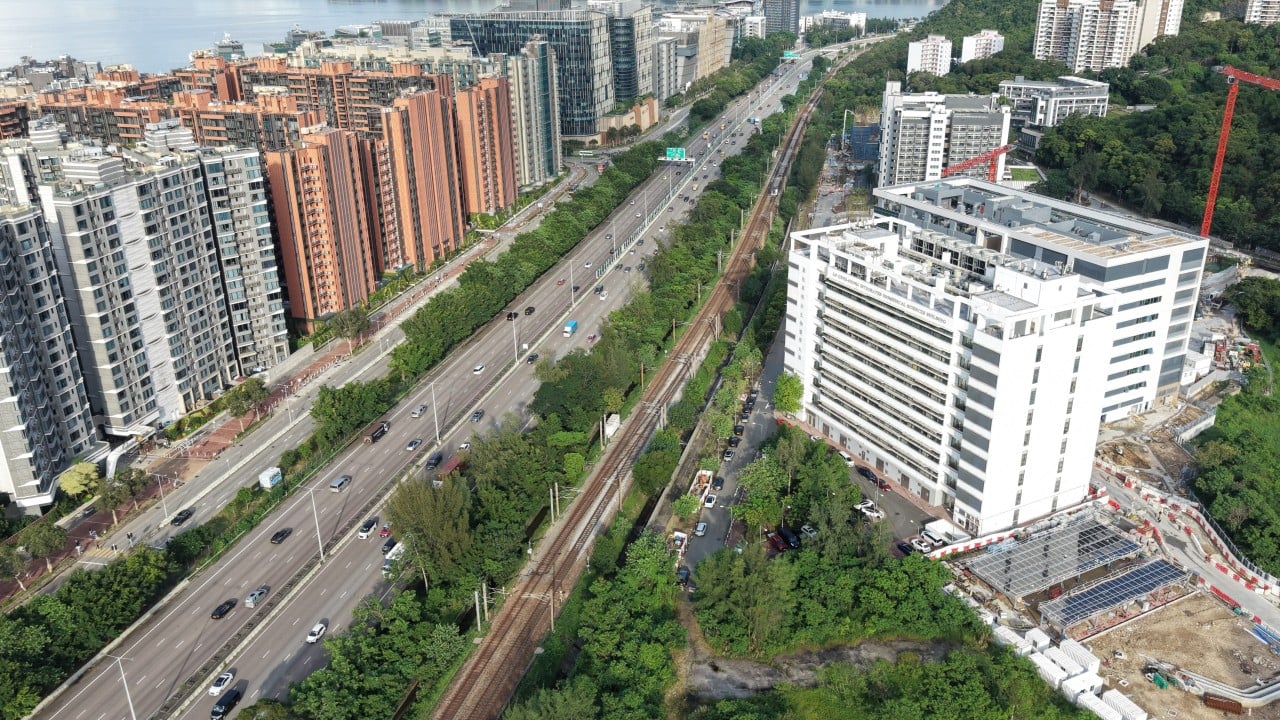
The Hong Kong government’s decision to scrub public housing from the upcoming Pak Shek Kok MTR station development exposes a stark reality about the city's current infrastructure math. By shifting exclusively to private residential units to finance the multi-billion-dollar transit project, officials have prioritized balancing the books over integrating public estates into a traditionally affluent enclave.
Permanent Secretary for Development Doris Ho Pui-ling publicly insisted that abandoning the original public-private housing mix would not derail the city’s ten-year target of delivering 294,000 public flats. However, the policy reversal reveals how economic pressures, existing utility overloads, and the financial demands of the MTR Corporation dictate urban planning far more than official blueprints suggest.
Behind the bureaucratic language of compatibility and community facility shortfalls lies a complex web of engineering hurdles, property developer anxieties, and a railway operator that expects to be paid in lucrative land rights.
The Financial Mechanics of a Railway Subsidy
Hong Kong has long relied on its "Rail plus Property" development model. The system functions as a self-sustaining financial loop. The government grants exclusive development rights for land adjacent to new railway lines or stations to the MTR Corporation at a "before-railway" land premium. The corporation then partners with private developers to build high-end residential towers, using the profits to fund the massive capital expenditure required for laying tracks and constructing stations.
Building a new station on an active, running transport line introduces severe structural complications. The proposed Pak Shek Kok station, nestled along the East Rail Line between University and Tai Po Market stations, cannot be constructed overnight. Work must occur during a narrow window of a few overnight hours when trains are stationary, driving up labor costs and extending the construction timeline toward a distant 2033 target.
To build this station without drawing directly from the Legislative Council's public coffers, the government had to offer the MTR Corporation a highly lucrative financial incentive. Public housing simply does not generate the profit margins required to offset these extreme engineering costs. By dedicating the sports center site and an additional parcel in Ma On Shan entirely to private luxury units, the authorities effectively turned the project into a self-funding enterprise, shielding the public treasury from immediate vulnerability.
This financial calculus became unavoidable as the city's broader property market experienced cooling trends. High-end residential land values dropped from their historic peaks, meaning more land area or higher-density private builds were required to generate the exact same cross-subsidy for the rail operator. Public housing, while socially desirable, became a luxury the project's internal ledger could no longer support.
The Infrastructure Strain of Subsurface Utilities
Beyond the financial balance sheet, the physical ground beneath Pak Shek Kok presents an unyielding constraint.
A quiet crisis involving drainage, sewage, and fresh water supply has been developing along the Tolo Highway corridor for years. The existing underground networks are operating near maximum capacity. When the area was originally conceived as a low-to-medium-density residential zone to support the adjacent Science and Technology Park, the long-term utility planning did not account for the massive, high-density tower blocks characteristic of public housing estates.
+--------------------------------------------------------------+
|             PAK SHEK KOK UTILITY CAPACITY BARRIER            |
+--------------------------------------------------------------+
| Current Load: Near 100% capacity for drainage and sewage.    |
|                                                              |
| Public Housing Demand: High-density, multi-generation        |
| occupancy requiring massive utility expansion.               |
|                                                              |
| Private Housing Choice: Lower density per square meter,      |
| minimizing immediate infrastructure breakdown risks.         |
+--------------------------------------------------------------+
Public housing units generally house more individuals per square meter than private developments. They feature higher household sizes and a more consistent, daily utilization of local resources. Injecting an estimated 10,000 mixed housing units into this fragile ecosystem would have required a complete overhaul of the regional trunk sewers and primary water mains.
Upgrading these systems requires deep excavation along critical transit arterials, which threatens to disrupt traffic flowing between the New Territories and urban Kowloon. By restricting the new developments strictly to private housing, the total projected population inflow drops significantly. The government avoids the immediate necessity of undertaking disruptive utility works that would cost billions of dollars and spark public frustration over traffic gridlock.
Class Segregation or Spatial Reality
The official defense of the U-turn highlighted a lack of community facilities and an incompatibility with the neighborhood's existing private identity. This explanation sparked immediate debate among urban planning experts and social advocates. Critics argue that this rationale reinforces spatial segregation, keeping lower-income residents out of well-planned, scenic waterfront districts while concentrating them in remote corners of the New Territories.
Pak Shek Kok has evolved into a premier residential neighborhood characterized by mid-rise luxury complexes, high-income professionals, and tech executives working at the Science Park. The introduction of public housing typically brings requirements for subsidized wet markets, cheaper retail options, and expanded welfare services.
Doris Ho noted that public housing residents would suffer a diminished quality of life without these specific amenities. Building those facilities requires a massive spatial footprint, which would reduce the land area available for profitable residential construction.
The government faced a difficult choice:
- Build public housing and dedicate massive parcels of premium waterfront land to community clinics, social centers, and low-cost markets, thereby destroying the financial viability of the railway station.
- Maintain the area's current high-income profile, use private residential development to pay for the station, and shift public housing quotas to areas where land is cheaper and large-scale social infrastructure is already under construction.
They chose the latter, revealing that when social integration clashes with infrastructure financing, financing wins.
The University Station Relief Myth
A secondary justification offered by the Development Bureau focuses on passenger distribution. Officials claim the new station will generate a net increase of only 7,000 new commuters on the East Rail Line. They argue that the remaining 53,000 expected daily users are individuals who already commute via the overcrowded University Station and will simply shift their entry point to the new Pak Shek Kok hub.
This perspective oversimplifies how transport networks behave. Providing an MTR station within walking distance of the Science Park changes commuter choices. Hundreds of workers who currently rely on corporate shuttle buses, franchised buses, or private vehicles will migrate toward the rail network. This shift will place additional stress on an East Rail Line that is already burdened by shorter nine-car train configurations implemented during the Sha Tin-Central link expansion.
The decision to build private housing rather than high-density public estates functions as a form of population management for the transit network. Had the original public housing initiative moved forward, the influx of thousands of daily commuters heading to work outside the district during peak morning hours would have strained the new station from its first day of service. Private residential projects, which have lower occupancy rates and higher percentages of car owners, offer a gentler trajectory for a transit line that is already carrying cross-border passengers from Shenzhen alongside domestic commuters.
The Shifting Site and Logistics Challenges
The physical relocation of the proposed station site further complicates the narrative. The government moved the planned station location south, shifting it away from the Education University of Hong Kong (EdUHK) Sports Centre and positioning it closer to the Chinese University of Hong Kong and the Science Park.
This logistical adjustment places the station directly opposite private estates like Solaria. While this positioning optimizes access for the 20,000 people working within the Science Park complex, it introduces complex engineering challenges during construction.
Original Proposed Site: EdUHK Sports Centre (Northern zone)
       │
       ▼ Shifted Southward due to cost and engineering realities
       │
Actual Approved Site: Near CUHK Biomedical Buildings / Opposite Solaria
Constructing an above-ground, two-storey station adjacent to premium private residential buildings means navigating strict environmental noise and dust regulations. The government must implement expensive mitigation measures, such as acoustic barriers and enclosed construction zones, to prevent a wave of complaints and legal challenges from affluent property owners.
To offset these expensive environmental protections, the administration had to optimize land values. It accomplished this by clearing the old EdUHK sports ground site and rezoning it entirely for private residential use and a commercial shopping mall. This move signals that every square meter of the development must generate maximum financial return to absorb the rising costs of building near active tracks and luxury homes.
A Precedent for Future Infrastructure Projects
The policy shift at Pak Shek Kok sets an important precedent for how Hong Kong intends to execute its massive development pipeline over the coming decades. With massive undertakings like the Northern Metropolis and the Kau Yi Chau Artificial Islands demanding unprecedented capital investments, the government can no longer afford to subsidize infrastructure through direct equity injections.
Every new transport link must pay for itself. If a neighborhood must be reserved exclusively for the wealthy to ensure a railway line can be built without increasing the public deficit, the government has proven it will make that trade.
The claim that this decision will not harm the overall 10-year housing plan relies heavily on a strategy of geographic concentration. Public housing will increasingly be funneled into large-scale, high-density hubs in the northern New Territories, where flat land is abundant and infrastructure can be designed from scratch.
Meanwhile, existing urban and semi-urban pockets with high land values will remain premium zones, used as financial engines to fund the expansion of the broader transit network. This approach keeps the city's transport infrastructure moving forward, but it moves Hong Kong further away from the goal of balanced, socially integrated neighborhoods. The Pak Shek Kok U-turn demonstrates that in the math of city planning, financial sustainability takes precedence over social ideals.