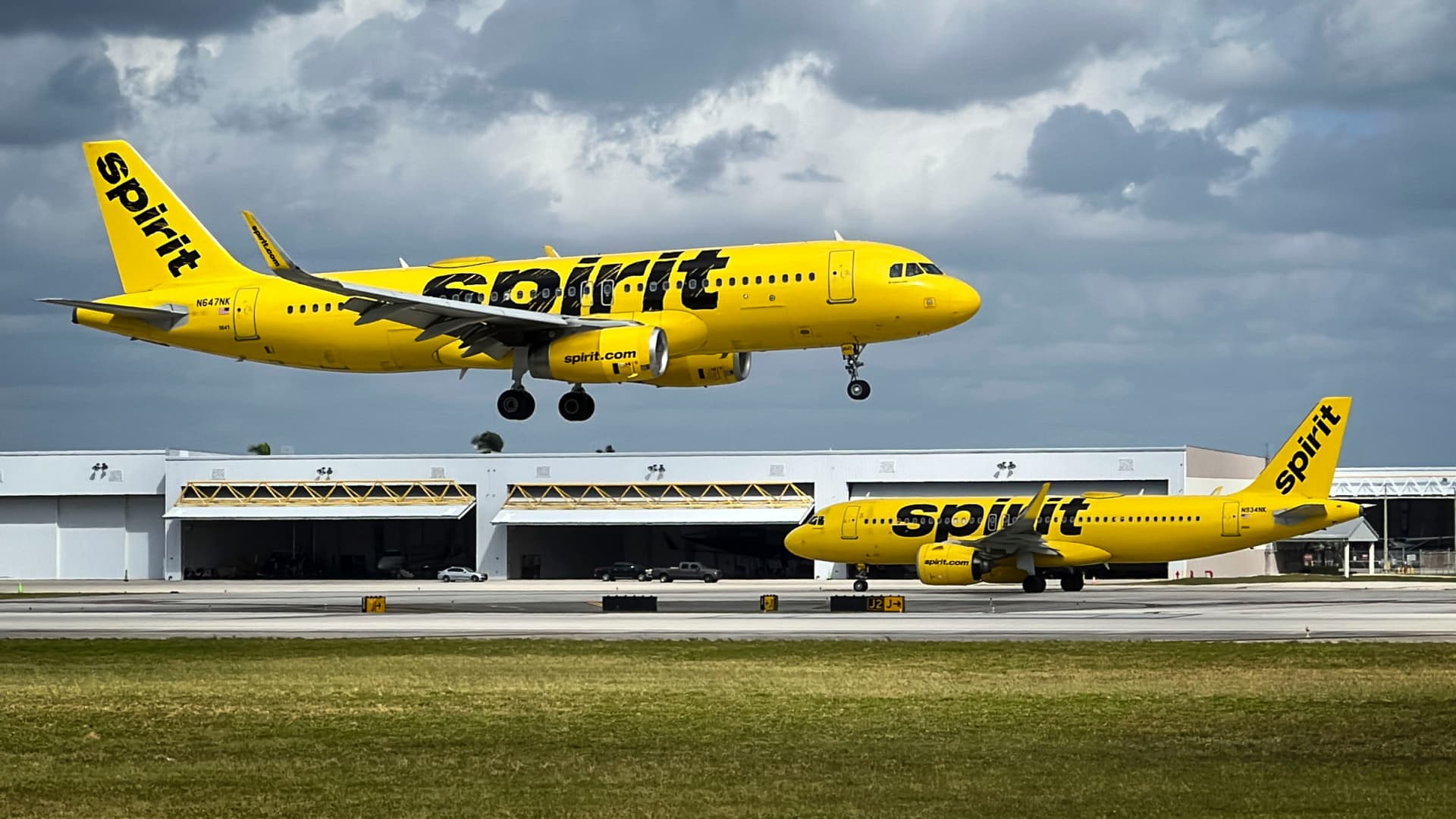
The yellow-tailed "maverick" of the American skies is currently flying on financial fumes, its engines sputtering under the weight of a second Chapter 11 bankruptcy in less than two years. For decades, Spirit Airlines thrived by being the company travelers loved to hate but couldn't stop booking. Now, the math that once allowed for $19 fares has finally broken. On April 21, 2026, the situation moved from critical to desperate as Spirit’s leadership reportedly dangled an extraordinary offer before the federal government: an equity stake in the carrier in exchange for hundreds of millions in emergency cash.
The primary reason Spirit is failing isn't just "bad luck" or a fickle customer base. It is the result of a catastrophic collision between a failed merger, a war-driven fuel spike, and a business model that simply cannot survive $4-a-gallon jet fuel. While President Donald Trump has signaled he "doesn't mind" helping and thinks "maybe" the government should intervene, the reality of a bailout is fraught with political and economic landmines. If the federal government does not step in, analysts warn that liquidation—the total shutdown and asset sale of the airline—could be triggered before the summer travel season even begins. If you liked this article, you should check out: this related article.
The Mathematical Implosion of the Restructuring Plan
Spirit entered its second bankruptcy in August 2025 with a plan to shrink its way to profitability. It cut headcount from 11,000 to roughly 7,500, slashed 200 underperforming routes, and reduced its fleet to about 80 aircraft. On paper, the plan worked—provided fuel stayed at 2024 levels.
Then the war in Iran began on February 28, 2026. For another angle on this story, see the recent coverage from Reuters Business.
Before the conflict, jet fuel averaged around $2.50 per gallon. By mid-April 2026, that price had rocketed to $3.79. For an ultra-low-cost carrier (ULCC) that operates on razor-thin margins, this wasn't just a hurdle; it was a wall. Industry data suggests that at current fuel prices, Spirit’s projected 2026 operating margin has collapsed from a manageable -7% to a staggering -20%. The airline reportedly has about $337 million in cash, but it faces $360 million in additional costs from the fuel spike alone.
The "restructuring" is now a race against a dry gas tank. The airline is burning through its remaining liquidity faster than it can negotiate with lenders, many of whom are growing weary of a carrier that has spent more time in bankruptcy court than in the black over the last twenty-four months.
Why the Trump Administration is Hesitating
President Trump’s comments to CNBC’s "Squawk Box" that the government should "take a look" at Spirit have provided a temporary boost to the airline's morale, but the Department of Transportation (DOT) is facing a complex dilemma. Transportation Secretary Sean Duffy is currently meeting with low-cost carriers to discuss air traffic modernization and the broader health of the industry, but the prospect of taking an equity stake in a failing airline is a radical departure from traditional conservative economic policy.
The Argument for Intervention
- Job Protection: Spirit still supports approximately 14,000 jobs, including pilots and flight attendants who were recently recalled from furlough. A total liquidation would be a massive hit to the labor market.
- Consumer Competition: Spirit is a "maverick" that keeps the "Big Four" (American, Delta, United, and Southwest) from price-gouging on leisure routes. Without the yellow planes, fares on routes to Florida, Las Vegas, and the Caribbean would likely skyrocket.
- National Interest: Proponents argue that losing a major national carrier during a period of global instability would further weaken the domestic transportation infrastructure.
The Case Against a Bailout
- Market Distortion: Competitors like Frontier and JetBlue are watching closely. If the government saves Spirit, it effectively punishes the airlines that managed their balance sheets more effectively.
- The "Zombie Airline" Problem: Critics argue that Spirit’s model is fundamentally broken for the 2026 economy. Investing taxpayer money into a company with a -101% net margin is seen by many as throwing good money after bad.
- Precedent: If the DOT bails out Spirit, every other ULCC facing fuel-related distress will be at the door with their hands out next week.
The Shadow of the JetBlue Merger
To understand the current crisis, one must look back at the $3.8 billion merger with JetBlue that was blocked by federal regulators. At the time, the Department of Justice argued that the merger would hurt consumers by removing a low-fare competitor. In hindsight, the block was a death sentence for Spirit’s original investors.
The merger would have provided Spirit with the capital and scale needed to pivot to a "premium-lite" model that consumers now prefer. Instead, Spirit was left at the altar with a massive debt load and an aging fleet strategy. The airline tried to pivot on its own, introducing more "premium" seating options and bundle packages, but it was too little, too late. The company’s stock, now trading on the OTC Pink sheets under the symbol FLYYQ, has seen its market cap crater to a mere $7.6 million. For context, that is less than the price of a single used Airbus engine.
The Liquidation Analysis: What Happens if the Plug is Pulled?
Spirit’s management has already prepared for the worst. According to recent disclosure statements, a Chapter 7 liquidation would value the airline's remaining assets—gates, slots, and aircraft—at between $1.43 billion and $1.71 billion.
In a liquidation scenario, the following would likely occur:
- Immediate Grounding: Flights would cease almost overnight to preserve remaining cash for the wind-down process.
- Asset Fire Sale: Frontier Airlines would likely move aggressively to acquire Spirit's gates in key markets like Fort Lauderdale and Orlando.
- Ticket Chaos: Hundreds of thousands of travelers would be left with useless tickets, relying on credit card chargebacks and "rescue fares" from other airlines that would inevitably be more expensive.
The "Equity for Cash" Gamble
The proposal for the federal government to take an equity stake is a "Hail Mary" pass. It mirrors the 2008-2009 automotive bailouts, where the government provided capital in exchange for ownership, eventually exiting once the companies stabilized. However, the airline industry is far more volatile than the car industry.
While the DOT has been instructed to "take a look," the technical feasibility is low. The government is currently grappling with a ballooning federal deficit and the geopolitical costs of the war in the Middle East. Writing a check for "hundreds of millions" to an airline that has already failed to restructure twice is a tough sell on Capitol Hill.
For travelers, the advice from industry analysts is grimly pragmatic: if you have a Spirit flight booked for later this summer, have a backup plan. The airline is "flying on financial fumes," and while the President may "not mind" a merger or a bailout, the creditors holding the keys to the hangars may not be so patient.
The fate of Spirit Airlines now rests on whether the administration views the carrier as a vital piece of national infrastructure or an outdated relic of a pre-war economy. Either way, the era of the $19 cross-country flight is officially over.
Book your backup flights now.