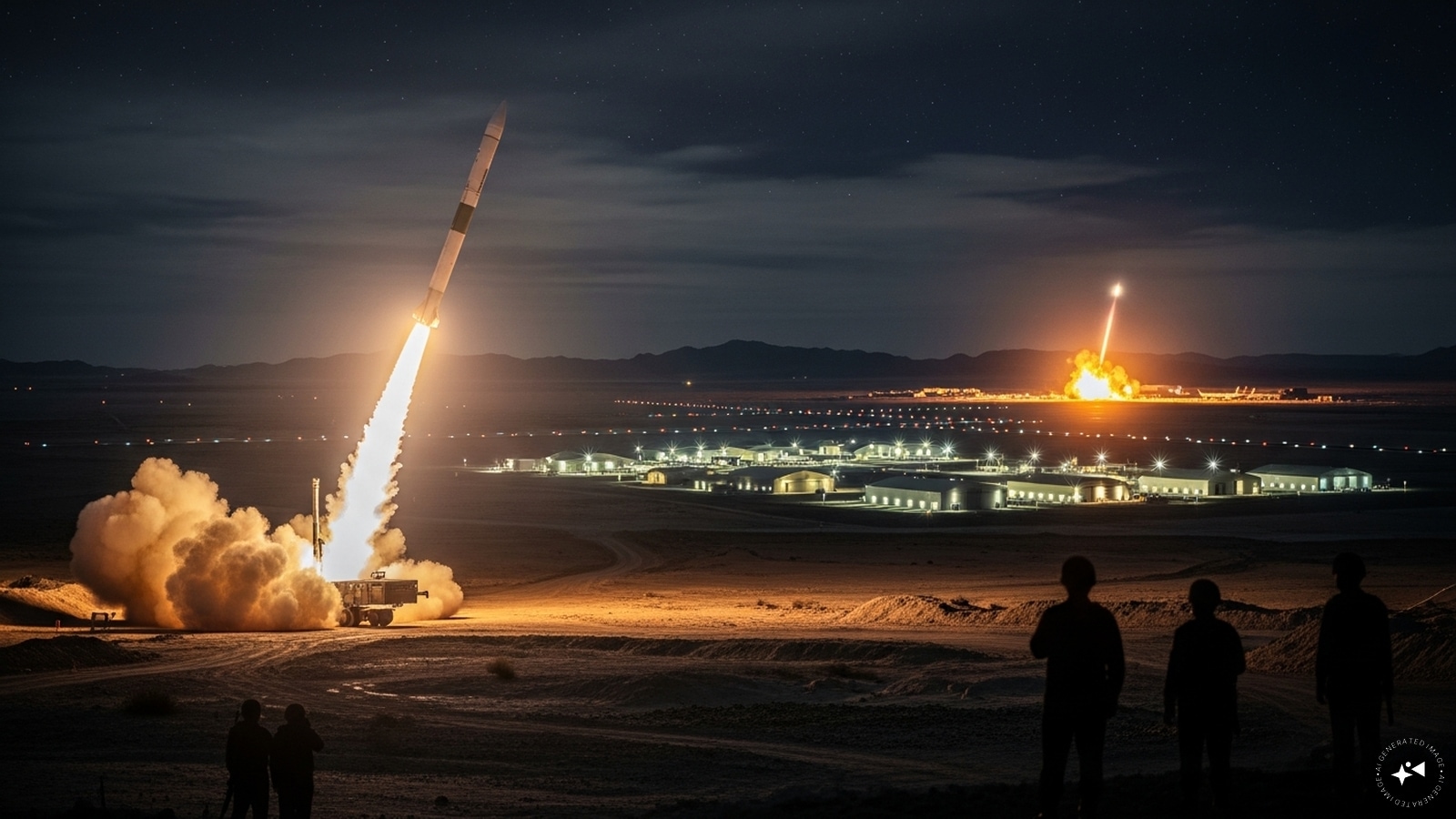
The direct military clash between Washington and Tehran reached a boiling point on Tuesday when Iran targeted an American-utilized air base in Jordan with ballistic missiles, closely following a five-hour wave of US airstrikes across southern Iran. This rapid exchange marks the complete collapse of recent back-channel diplomacy and exposes the volatility of President Donald Trump’s newly enacted naval blockade. At the core of this escalation is a radical shift in American foreign policy: the implementation of a 20 percent protection fee on all cargo transiting the Strait of Hormuz.
What began as an economic pressure campaign has transformed into a hot war over the world’s most vital energy choke point. The assumption that Washington could unilaterally impose financial tolls on international shipping without triggering a symmetric military response has been proven false. Instead of backing down under the weight of sustained aerial bombardment, Iran is expanding the geography of the conflict, dragging regional American allies like Jordan directly into the line of fire. Recently making waves in related news: The Phu Quoc Tragedy and the Harsh Reality of Holiday Safety Abroad.
The Failure of Tactical Deterrence
For three consecutive nights, US Central Command has directed precision strikes against Iranian military infrastructure. The five-hour operation on Tuesday targeted coastal defense systems, missile launch sites, drone depots, and naval facilities across six distinct locations, including Bandar Abbas, Bushehr, and Abu Musa Island. Pentagon officials framed these actions as defensive operations designed to protect commercial shipping and degrade Tehran's offensive capabilities.
The tactical outcomes tell a different story. Striking fixed positions on the Iranian coast does not eliminate a decentralized missile threat. Within hours of the American strikes, the Islamic Revolutionary Guard Corps demonstrated its reach by launching a volley of ballistic missiles aimed at Muwaffaq Salti Air Base and Prince Hassan Air Base in eastern Jordan. While Jordanian air defenses intercepted four of the incoming projectiles, the political message was delivered clearly. Tehran can hit American installations far beyond its immediate borders. Further insights into this topic are explored by USA Today.
The administration’s public rhetoric has amplified the friction. Appearing on the Hugh Hewitt Show, Trump declared that Iran would be hit very hard and that there was nothing they could do about it. This absolute confidence misjudges the strategic calculus of the Iranian regime. When faced with an existential economic blockade, Tehran views asymmetric retaliation not as a choice, but as a survival mechanism. The threat of overwhelming force has failed to produce compliance, resulting instead in an escalatory loop where both sides feel compelled to strike last.
Inside the Twenty Percent Shipping Tariff
The driving force behind this sudden military flare-up is an unprecedented attempt to monetize global maritime security. Trump announced via Truth Social that the United States would formally assume the role of the Guardian of the Strait of Hormuz. In exchange for keeping the waterway open to commercial traffic, the administration demanded a 20 percent reimbursement fee on the value of all cargo shipped through the passage.
This policy misunderstands how global trade and maritime law operate. Before the current hostilities broke out in February, roughly 15 million barrels of oil and gas moved through the Strait of Hormuz daily. At baseline market rates, that traffic represents more than $1.2 billion in daily commerce. A 20 percent toll would theoretically generate up to $240 million a day for the US Treasury. However, collecting such a fee requires either absolute international consensus or total military coercion.
International shipping firms and foreign governments view the proposed fee as an illegal shakedown rather than a legitimate security service. Iranian Foreign Minister Abbas Araqchi quickly criticized the proposal on social media, mocking the tariff and reasserting that Tehran remains the historical protector of the strait. By turning freedom of navigation into a commercial transaction, the US has alienated traditional maritime allies and given Iran a pretext to disrupt shipping, framing its actions as resistance against American extortion.
Jordan Caught in the Crossfire
Amman finds itself in an impossible position as the geographic buffer between competing powers. Following the missile strikes on Tuesday, the Islamic Revolutionary Guard Corps issued an open appeal to the Jordanian public, urging them to demand the immediate dismantling of all American military bases within the kingdom. The statement used conciliatory language toward the Jordanian population, attempting to exploit domestic anger over regional instability and the broader plight of the Palestinian people.
This is a deliberate attempt to destabilize the Jordanian monarchy from within. The kingdom relies heavily on US security assistance and hosts critical Western air defense nodes, radar installations, and logistics hubs. By forcing Jordan to publicly intercept Iranian missiles transiting its airspace, Tehran highlights Amman’s alignment with Washington, creating domestic political friction.
The military reality is equally stark. Jordan’s armed forces successfully brought down four missiles during the latest attack. Yet, continuous defense is a losing mathematical equation. Air defense interceptors cost millions of dollars per unit and are finite in supply. If Iran transitions from sporadic missile launches to saturated drone and ballistic missile salvos, Jordan’s defensive umbrella will face depletion, leaving both host nation forces and American personnel exposed to catastrophic strikes.
The Mechanics of the Five Hour Strike
The scale of the American aerial campaign reveals a shifting operational doctrine. This was not a limited symbolic strike, but a sustained five-hour bombardment utilizing precision-guided munitions launched from naval vessels in the Arabian Sea and combat aircraft stationed across the region. According to US Central Command, the target list focused heavily on the Iranian coastline overlooking the Strait of Hormuz.
In Bandar Abbas, the primary hub for the Iranian Navy, strikes targeted anti-ship missile batteries and command centers. Further west in Bushehr, explosions damaged radar installations linked to early-warning networks. On Abu Musa Island, an outpost directly adjacent to international shipping lanes, US munitions struck fast-attack craft pens and drone storage facilities.
Local Iranian media reported that four people were wounded in the southwestern city of Omidiyeh, with emergency operations continuing into the morning hours. Despite the duration and intensity of the attack, the structural core of Iran's military apparatus remains intact. The Islamic Revolutionary Guard Corps has spent decades burying its primary missile storage facilities deep inside underground mountain complexes. Five hours of conventional airstrikes can damage surface infrastructure, but they cannot erase Tehran’s ability to project force across the Persian Gulf.
The Unsustainable Calculus of a Maritime Blockade
The US Navy-led Joint Maritime Information Center has confirmed that the total shipping blockade on Iran will be strictly enforced along the entire Iranian coastline. This measure attempts to halt all Iranian oil exports, which had recently topped 80 million barrels in less than a month. By choking off Tehran’s primary source of hard currency, Washington hopes to force a renegotiation of the broader regional security order.
The global economy is already paying the price for this strategy. Brent crude futures surged past $86 per barrel immediately following the reports of the attacks. While this remains below the absolute peak seen when the war began in February, the upward trajectory threatens to reignite inflationary pressures in Western economies. Higher gasoline prices are an acute political vulnerability for the Trump administration, especially with critical congressional elections approaching in November.
A blockade is an act of war that requires constant, resource-intensive patrolling. It forces the US Navy to position high-value surface combatants in confined waters where they are vulnerable to low-cost swarming tactics, sea mines, and anti-ship ballistic missiles. If Iran retaliates by successfully disabling a major commercial vessel or an American warship in the strait, the entire logic of the protection fee collapses. Commercial insurers will refuse to underwrite ships entering the Gulf, regardless of American security guarantees.
The current conflict cannot be resolved by multiplying the number of targets struck or increasing the rhetorical heat. By tying maritime security to a 20 percent financial toll, the administration has backed itself into a corner where any retreat looks like financial and military weakness. Iran, sensing that the US public has little appetite for another protracted land war in the Middle East, has called the bluff. The United States must now choose between an endless, expensive naval enforcement campaign or a major diplomatic reset that abandons the illusion of treating global maritime defense as a revenue stream.