The capture of the strategic port city of Mocha by Iranian-backed Houthi forces marks a catastrophic turning point for global maritime trade and the geopolitical architecture of the Middle East. Sitting less than fifty miles from the narrow Bab el-Mandeb strait, this territorial shift gives the militia direct leverage over one of the most vital chokepoints on Earth, transforming a localized civil conflict into an immediate international security emergency. Standard wire reports frame this as a simple territorial exchange, but a closer examination of the military geography reveals an entirely different reality.
For over a decade, Yemen has bled through a grinding civil war that fractured its institutions and exhausted its population. A fragile truce brokered in 2022 provided a semblance of quiet, but the underlying structural fractures never healed. When regional flashpoints ignited broader confrontations involving Iran, Israel, and the United States, the localized restraint evaporated. The Houthi offensive through the western province of Taiz was not a random landgrab. It was a calculated, methodical campaign designed to sever government supply lines, isolate provincial capitals, and secure an uninterrupted corridor to the Red Sea coast.
The Geography of Coercion
To understand why the fall of Mocha matters to international markets, one must look at a map of the southern Arabian Peninsula. The Bab el-Mandeb strait is roughly twenty miles wide at its narrowest point. Contrast this with the Strait of Hormuz, which spans some fifty miles. That narrow span changes the math of naval warfare completely. Controlling the adjacent coastline means an actor does not necessarily need sophisticated anti-ship missiles or long-range drones to disrupt global commerce. Direct artillery placements and heavy crew-served weapons deployed along the littoral zones become sufficient to threaten commercial tankers and container vessels moving between the Indian Ocean and the Suez Canal.
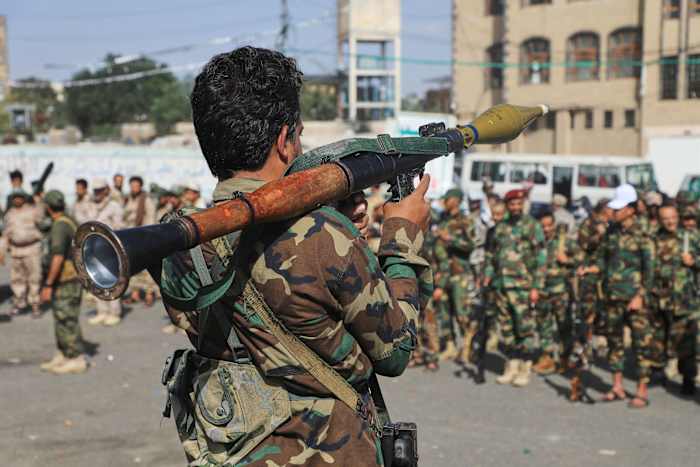
When Houthi units fanned out across Mocha's intersections and shuttered local commerce, they effectively squeezed the throat of global logistics tighter than at any point since the regional crisis began. Major shipping conglomerates that had gingerly resumed limited transits through the Red Sea are now reassessing their calculus. Insurance syndicates are adjusting risk premiums upward by orders of magnitude. Every container ship diverted around the Cape of Good Hope adds weeks of transit time and millions of dollars in fuel costs, expenses that invariably trickle down to consumer goods worldwide.
The Collapse of the Defensive Line
The loss of Mocha highlights the structural decay plaguing the anti-Houthi coalition. Forces aligned with the internationally recognized Presidential Leadership Council, including the National Resistance and various regional brigades, fractured under the weight of the coordinated Houthi assault. Reports from the ground indicate that defensive lines buckled because command structures lacked deep institutional cohesion. Pro-government commanders scrambled to establish alternative command centers outside the city limits, but the retreat was swift and disorganized.
This military failure exposes the limits of external air power and fragmented proxy alliances. Saudi-backed coalition airstrikes targeting Houthi reinforcements failed to blunt the momentum of the ground offensive. Ground engagements near Taiz and Hodeida demonstrated that light infantry units highly motivated by ideology can systematically outmaneuver bureaucratic, disjointed defense forces that lack unified strategic direction. The human cost has been immediate and devastating. Thousands have been displaced across Taiz and Hodeida within days, adding to a humanitarian ledger that has been neglected by an international community suffering from fatigue.
Escalation Beyond the Coastline
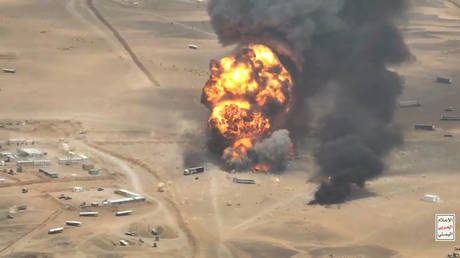
The offensive on the western coast is only one theater of a multi-front escalation. As fighting intensified around Mocha and the strategic Hanish Islands, the conflict spilled violently over international borders. Houthi forces launched coordinated ballistic missile and drone volleys targeting oil and industrial facilities deep inside southern Saudi Arabia, igniting fires at critical infrastructure hubs and wounding dozens. These retaliatory strikes came in direct response to renewed airstrikes hitting Houthi-held northern provinces, demonstrating that the cycle of action and reaction is accelerating out of control.
Diplomatic channels are currently running dry. Foreign ministers meeting in European and Eurasian capitals issue routine condemnations, warning of regional destabilization, yet none of these diplomatic communiques alter the balance of forces on the ground in Yemen. The Houthis have calculated that external powers are currently overextended across multiple Middle Eastern fronts, leaving them uniquely positioned to consolidate territorial gains along the maritime corridor without facing a unified, overwhelming military response.
The strategic reality along the Red Sea has fundamentally shifted. Global supply chains are once again held hostage by a militant movement that has mastered asymmetric warfare and coastal geography. As commercial vessels alter routes and maritime insurance rates spike, the fallout from the fall of Mocha will reverberate through global markets for months, proving that regional conflicts in forgotten corners of the world can instantly rewrite the rules of international commerce.