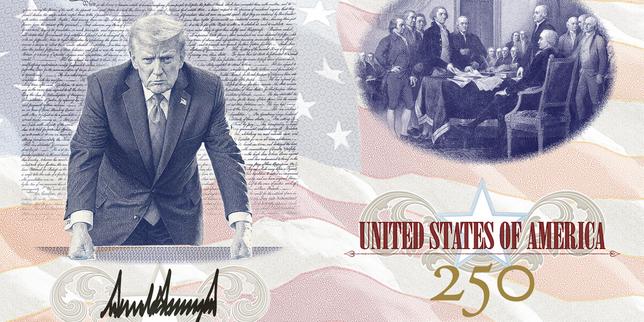
The United States State Department will begin issuing a limited-edition commemorative passport featuring a prominent, full-page portrait of President Donald Trump on the inside front cover. Announced as part of the "America 250" celebrations marking the semiquincentennial of the Declaration of Independence, the document—unofficially dubbed the Patriot Passport—replaces the traditional historical scene of Fort McHenry with modern executive imagery. Only 25,000 to 30,000 copies will be printed, distributed exclusively to citizens renewing their travel documents in person at the Washington Passport Agency starting July 6, 2026. This physical alteration of a primary sovereign document represents an unprecedented shift in federal branding, transforming a historically neutral bureaucratic instrument into a vehicle for contemporary political identity.
While standard international travel credentials rely on universally recognized national emblems to verify citizenship without domestic bias, this limited run embeds a sitting executive into the security framework itself. The decision has sparked intense debate over the boundaries of federal real estate and the commercialization of state identity.
The Mechanics of Sovereign Real Estate
A passport is not merely a travel document. It is a high-security legal instrument owned by the federal government, serving as the physical manifestation of state sovereignty at foreign borders. Historically, the aesthetic design of these documents has favored consensus historical motifs. The current standard issue passport features an illustration of the 1814 bombardment of Fort McHenry, accompanied by lines from the national anthem.
The new layout strips away this nineteenth-century imagery. In its place sits a high-contrast rendering of the president leaning over the Resolute Desk, flanked by his bold signature and superimposed over the text of the Declaration of Independence. The opposite page features John Trumbull’s classic oil painting of the 1776 Continental Congress.
+------------------------------------+------------------------------------+
|                                    |                                    |
|      [ PRESIDENTIAL PORTRAIT ]     |      [ TRUMBULL'S CONSTITUTION ]   |
|         Donald J. Trump            |           PAINTING ]               |
|         Oval Office Desk           |                                    |
|                                    |      "United States of             |
|    "Welcome, but be good!"         |       America 250"                 |
|                                    |                                    |
+------------------------------------+------------------------------------+
This structural shift bypasses decades of institutional norms. In private industry, altering the core visual asset of an organization requires years of focus groups and brand alignment studies. Here, the change was executed via an executive task force established to manage the 250th-anniversary festivities. By routing the distribution strictly through the Washington Passport Agency for in-person applicants, the administration has created an artificial scarcity engine within a monopoly system. Citizens cannot choose this design online; they must physically enter the capital’s central node of consular authority to secure it.
Consular Law and the Border Dilemma
The inclusion of a living political figure on an official travel credential introduces unprecedented friction into the mechanics of international border control. Consular law relies heavily on predictability. When a foreign customs officer reviews an American passport, they verify specific cryptographic chips, watermarks, and optical variable inks designed to prove authenticity, not convey political ideology.
A group of lawmakers has already dispatched an urgent inquiry to Secretary of State Marco Rubio, questioning whether public funds can legally be used to manufacture documents carrying partisan imagery. The statutory argument rests on anti-politicization laws governing federal agencies. Under long-standing federal guidelines, the use of public resources to promote the likeness of an incumbent candidate during an election cycle faces extreme restrictions.
Beyond the domestic legal battle lies a deeper operational risk for American travelers abroad. Border officials in less stable or politically hostile nations are trained to look for standard anomalies to detect counterfeit papers. A sudden, hyper-limited variant showing a defiant executive bearing the inscription "Welcome, but be good!" could trigger extended secondary screenings for American citizens. The State Department must now brief international border authorities on the validity of this short-run print to prevent systemic delays at foreign ports of entry.
The Production Bottleneck
Manufacturing a secure passport is a complex industrial task handled by specialized federal contractors and the Government Publishing Office. It requires multi-layered polycarbonate data pages, intaglio printing press systems, and tactile security elements to deter forgery. Introducing a separate, low-volume production run disrupts these automated manufacturing pipelines.
The procurement process for this project reveals significant logistical friction. The specialized ink formulations and paper stocks required to print the new design require retooling specific machinery that is currently optimized for maximum volume throughput. This comes at a time when the State Department is managing an overall surge in standard renewals due to summer travel and the 2026 FIFA World Cup. Isolating the print run to less than 30,000 units driving through a single geographic location indicates that the logistics could not support a nationwide deployment without causing massive processing backlogs.
Furthermore, the document must remain compatible with the digital scanning infrastructure used at global e-gates. If the optical character recognition zones or facial recognition data embedded in the chip conflict with the non-standard background art, the passport becomes a liability rather than an asset. Security analysts note that even slight modifications to the ink densities on the inner covers require rigorous testing against ultraviolet and infrared passport scanners to ensure the embedded security threads remain legible to automated border systems.
The Evolution of Official Endorsements
This passport initiative is not an isolated design choice. It forms part of a broader, systemic effort to integrate executive branding into daily commercial and administrative touches. The Treasury Department has confirmed that the presidential signature will soon appear on the one-dollar bill, and the U.S. Mint is finalizing a commemorative gold coin bearing the identical likeness used in the Patriot Passport.
Historically, American currency and documentation have avoided featuring living leaders, a tradition established by George Washington to deliberately separate the American republic from European monarchical practices. The breaking of this norm alters how the state communicates with its population. When administrative portals—ranging from government-run pharmaceutical websites to international travel booklets—are branded with the identity of a specific leader, the distinction between the permanent state bureaucracy and the temporary political administration begins to dissolve.
This shift creates a permanent artifact out of a temporary political moment. Long after the 2026 anniversary fair concludes and the campaign rallies fade from the National Mall, these 30,000 passports will remain in active circulation for their full ten-year validity period. They will be presented at hotel check-ins, bank counters, and military checkpoints around the globe, acting as a persistent physical reminder of a highly specific era in American governance. The document ceases to be an unvarnished declaration of citizenship and becomes a permanent statement of alignment, forcing the traveler to carry a domestic political debate across international borders.