The notification light on a smartphone pulsing in the dark at 2:00 AM has a specific, low-grade dread attached to it. For anyone with family stationed in the Middle East, that flash of light is a physical blow to the chest. On a Sunday night, three families received the news that changes everything. Three American service members were dead. Dozens more were injured, their bodies torn by shrapnel after a one-way attack drone slammed into a remote desert outpost known as Tower 22, tucked neatly near the Jordanian border.
In the immediate aftermath of such violence, time behaves strangely. It stretches. In Washington, bureaucratic machinery begins to grind. In Georgia and Texas and Oklahoma, phone calls are made that will end life as certain families knew it.
But in the arena of modern political theater, the clock ticks differently. Grief is a currency. Accountability is an obstacle to be bypassed.
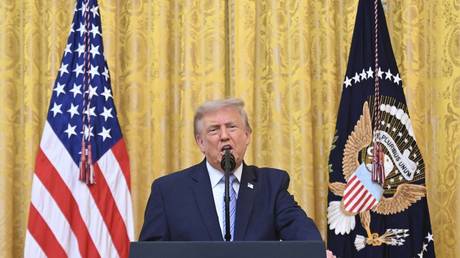
Before the names of the fallen were even released to the public, the machinery of political communication was already spinning its gears. The standard playbook for an opposition leader in the wake of a national tragedy is well-worn: condemn the enemy, question the current administration's strategy, call for strength. Yet, the statement that emerged from Mar-a-Lago chose a different trajectory entirely. It was a masterclass in a very specific, highly effective psychological maneuver.
Deflection.
The Art of the Pivot
To understand the mechanics of what transpired next, one has to look past the partisan shouting matches and analyze the structural DNA of the communication itself. The strategy deployed is not new. It has roots in Cold War diplomacy, but it has been refined in the digital age into something far sharper.
It is called whataboutism.
When a crisis demands a direct answer, a pivot redirects the spotlight toward an entirely unrelated grievance. The statement issued regarding the drone strike did not dwell long on the strategic implications of Iran-backed militias operating on the Syrian border. Instead, it instantly shifted the focus backward. It pointed toward the southern border of the United States. It pointed toward political prosecutions. It pointed toward the general state of national decline.
Consider how this works in a standard human interaction. Imagine a captain who loses a ship because they ignored a storm warning. When questioned about the navigation error, the captain turns to the crew and says, "But what about the chef who burned the dinner three weeks ago? Why aren't we talking about that?"
It is a conversational trap. It works because it forces the listener to choose between two unrelated realities. Suddenly, the conversation is no longer about the holes in the hull of the ship. It is an argument about the menu.
The strategy serves a dual purpose. First, it insulates the speaker from any potential shared responsibility or the messy, complicated reality of geopolitical strategy. Second, it feeds a hungry media landscape that thrives on conflict rather than nuance. A headline about a complex regional proxy war is difficult to digest. A headline about a political feud is instant traffic.
The Invisible Stakes in the Sand
While the political commentary bounced around television studios, the actual reality of Tower 22 remained stark, hot, and quiet.
Tower 22 is not a massive, fortified fortress with movie-theater amenities and thick concrete blast walls. It is a logistics hub. It sits in a desolate expanse where Jordan, Syria, and Iraq meet. It is a place of dust, heavy machinery, and long, monotonous hours of vigilance. The people stationed there are not chess pieces on a board; they are twenty-year-olds from small towns who joined the military for a chance at college tuition or a sense of purpose.
When a drone strikes an installation like that, it reveals the massive asymmetry of modern warfare. A cheap, low-flying piece of Styrofoam and lawnmower-engine technology can bypass millions of dollars of defense systems if the conditions are right. It is a terrifying reality that military planners are desperately trying to solve.
This is the substance of the issue. This is what requires deep, agonizing policy debate.
- How do we protect isolated logistics nodes from low-altitude aerial threats?
- What is the precise threshold for a military response that deters Iran without igniting a regional conflagration?
- How does the United States maintain its commitments to regional stability without leaving its personnel as sitting ducks?
These are heavy, exhausting questions. They do not fit into a social media post. They do not lend themselves to applause lines at a rally.
By substituting these questions with a laundry list of domestic political grievances, the public discourse is effectively hijacked. The real danger here isn't just that a politician avoided a question. The danger is that the collective attention span of a nation is steered away from a critical vulnerability at precisely the moment it needs to be examined.
The Language of Disconnection
There is a profound disconnect between the language of statecraft and the language of survival.
When a statement reads that an event "would never have happened if I were president," it enters the realm of historical counterfactuals. It is an unprovable assertion designed to evoke nostalgia rather than provide a roadmap. It operates on the assumption that global adversaries move only in response to the personality of the American executive, completely discounting the deeply entrenched, decades-old religious, economic, and territorial ambitions of regional actors like Iran's Axis of Resistance.
The world is messy. It resists simple narratives of strength versus weakness.
The militia groups operating in Iraq and Syria, under the loose umbrella of the Islamic Resistance, are savvy political actors. They watch American cable news. They read the statements. They understand American political polarization intimately. When they see a major political figure use a strike on U.S. troops to attack the current American administration, they do not see a display of national resolve.
They see a fracture.
They see evidence that their strategy is working. The goal of a proxy strike is rarely to defeat the United States military in a pitched battle; they know they cannot do that. The goal is to cause just enough pain to create domestic political chaos within America, forcing a retreat or a strategic blunder born of anger.
The Cost of the Noise
Walk through a grocery store or sit in a diner anywhere in the country, and you will find people who are bone-tired of the noise. They know, instinctively, that the arguments happening on their screens do not match the gravity of the world outside.
When everything becomes a tool for domestic political advantage, meaning begins to erode. Words lose their weight. A tragedy in the Jordanian desert becomes indistinguishable from a legislative dispute over a budget bill or a scandal involving a local politician.
The real casualty of continuous whataboutism is empathy.
It becomes impossible to mourn the three soldiers killed at Tower 22 when their deaths are instantly converted into a talking point about immigration policy. Their names—William Jerome Rivers, Kennedy Ladon Sanders, and Breonna Alexsondria Moffett—risk being swallowed by the relentless, churning news cycle, replaced by arguments over who tweeted what and when.
The light on the phone will continue to pulse in the middle of the night. The drones will continue to fly in the dark over the Syrian border. The real question is whether the public conversation can grow up fast enough to meet the danger, or if it will remain trapped in a loop of endless deflection, arguing about everything else while the desert sand grows cold.