The screen flickers on a desk in a quiet apartment three thousand miles away, casting a faint, pale amber glow against a wall that has seen too many identical mid-week evenings. Outside, traffic hums in low, relentless waves. Inside, time seems to stretch.
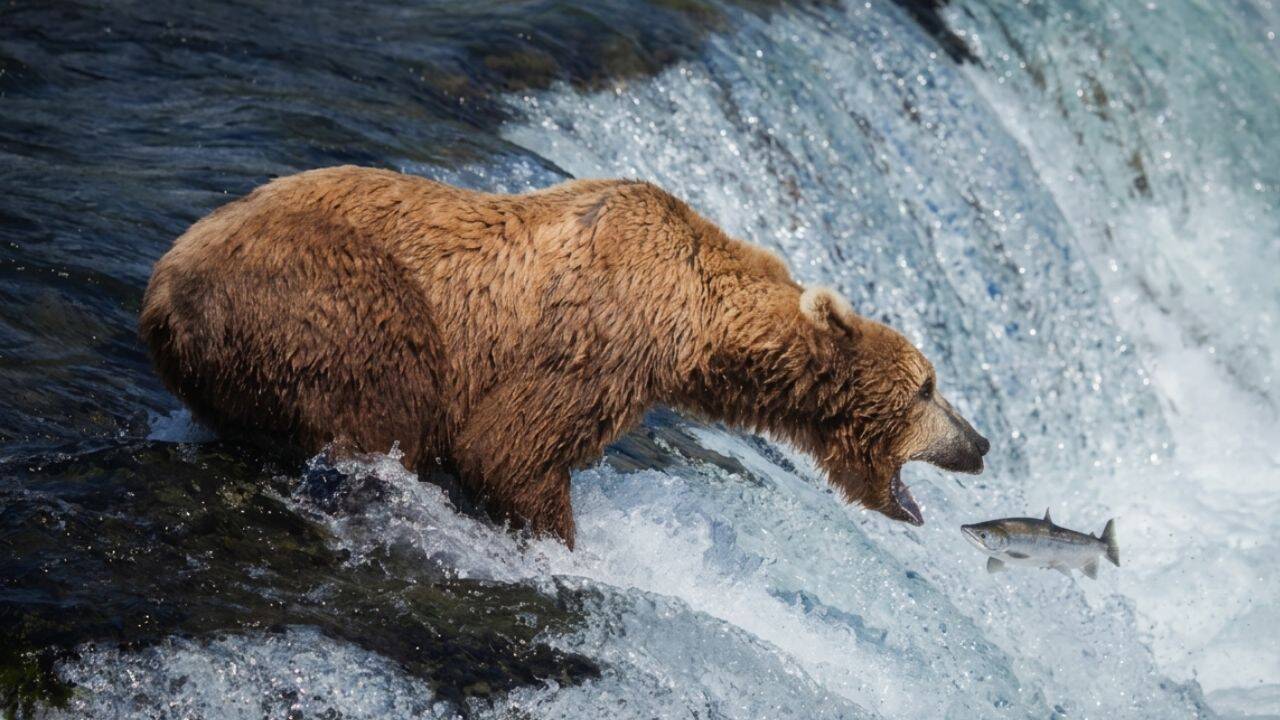
On the display, the water of Brooks Falls rushes with a violent, white-knuckled roar that you can almost feel in the soles of your feet if you turn the volume up high enough. It is a deafening, beautiful chaos. And right in the middle of it stands a mountain of muscle, fur, and raw intention.
Summer in Katmai National Park, Alaska, smells of wet earth, freezing glacier melt, and the sharp, metallic tang of fresh salmon. But none of that reaches the apartment. What reaches the viewer is something stranger, something more hypnotic. Millions of people are currently staring at this exact patch of wilderness. They are sitting in Tokyo cubicles, London train carriages, and suburban kitchens in Ohio, completely transfixed by a brown bear waiting for a fish.
We call it a live bearcam. That is the cold, functional term given to it by the developers and park rangers. But to the millions who tune in year after year, it is something closer to an anchor.
Consider what happens next on the falls. A massive boar, scarred across his snout from ancient territorial disputes, plants his heavy paws into the slippery, moss-covered bedrock. The water crashes against his shins, waist-high and freezing enough to numb a human limb in seconds. He does not flinch. His eyes are locked onto the churning soup of foam beneath the ledge. Silver streaks flash through the dark water—sockeye salmon hurling themselves upward, defying gravity, gravity's ancient enemy, driven by an unyielding genetic imperative to spawn or die trying.
This is not a nature documentary with edited cuts and dramatic musical scoring. This is real time. This is unfiltered, brutal, magnificent boredom punctuated by explosive seconds of violence and grace.
For the person watching from the glowing glass of a laptop, the appeal is not merely about watching animals hunt. It is about witnessing a world that operates entirely independent of human anxiety. While stock markets fluctuate, deadlines loom, and text messages demand immediate attention, the bear does not care about any of it. He cares only about fat reserves, winter sleep, and the exact trajectory of a silver fish hurtling through the air.
Let us be honest about why we are here. We are lonely. Or perhaps we are just exhausted by the frantic noise of modern existence.
Anthropologists and wildlife biologists note that the Brooks Falls cam attracts a staggering global audience each summer for reasons that go far beyond simple entertainment. It taps into a deep, evolutionary nostalgia. For most of human history, our survival depended on our ability to read the landscape, to understand animal behavior, and to respect the raw power of apex predators. Today, we sit in climate-controlled rooms and swipe glass screens. The bearcam bridges that chasm. It lets us sit by the river without getting wet.
Yet, there is a profound vulnerability in watching these animals.
Imagine, hypothetically, standing on the viewing platform at Brooks Camp yourself. The air is so crisp it burns your nostrils. The sound of the waterfall is a physical weight pressing against your chest. You realize with a sudden, sinking jolt of perspective how small you are. A brown bear can weigh over a thousand pounds, run up to thirty-five miles per hour, and snap a salmon in half with a casual flick of its jaws. To watch them on a screen is safe. To stand in their backyard is to remember your place in the food chain.
And yet, the bears have learned to tolerate our digital and physical presence with astonishing nonchalance. Over the years, the regulars at the falls—bears with names like Bear 480 Otis, a legendary elder statesman of the river known for his preternatural patience and weathered dignity, or the fierce, dominant matrons who teach their cubs how to fish the rapids—have become global celebrities.
Otis is a masterclass in stillness. While younger, more hot-headed bears charge up and down the riverbank wasting precious calories, Otis often claims the best spot on the lip of the falls and simply waits. He sits down, lets the water rush around his massive, shaggy frame, and dozes off. When a salmon happens to leap directly into his open mouth—and it happens more often than probability suggests—he closes his jaws with quiet efficiency.
Viewers in the live chat cheer for him. They track his weight fluctuations with the anxiety of worried parents. They notice when a new scar appears on his flank or when he misses a fishing season, sparking frantic internet threads across Reddit and conservation forums. When Otis reappears gaunt and weary after the winter thaw, thousands of people breathe a collective sigh of relief.
We have anthropomorphized them, certainly. We project our hopes for survival, our respect for aging, and our fascination with resilience onto these wild creatures. But the bears do not care about our narratives. They are simply living out the oldest story on Earth: eat, grow, survive, repeat.
The transformation of Brooks Falls from a remote Alaskan wilderness secret into a digital summer phenomenon mirrors our changing relationship with the natural world. We can no longer easily step into the wild, so we invite the wild into our living rooms through high-definition lenses powered by solar panels and satellite uplinks.
Park rangers at Katmai often speak of the delicate balance required to manage this virtual tourism. Millions of virtual visitors mean heightened global awareness. People who have never left a major metropolis suddenly find themselves donating to salmon habitat preservation, writing to their legislators about watershed protection, and learning the intricate, fragile mechanics of the Bristol Bay ecosystem. The screen becomes a conduit for empathy.
Back in the apartment, the blue light shifts. On the screen, Otis finally stands up, shakes the water from his coat in a shimmering cloud of droplets, and plods heavily into the evergreen forest, swallowed by the twilight.
The stream keeps running. The white noise of the waterfall fills the empty room. Outside, the city keeps moving, but the river in Alaska keeps flowing, indifferent, eternal, and waiting for tomorrow's dawn.