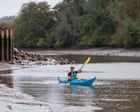
The water does not argue. It simply carries what we leave behind, winding past moss-draped stones and ancient alders until it meets the sea. For generations, the River Dart has been the beating pulse of Devon—a place where children learned to swim in the amber-tinted shallows, where salmon fought their way upstream against the autumn current, and where locals found a quiet kind of sanctuary away from the noise of the modern world.
Yet, something has shifted in the mist over Dartmoor.
Walk down to the riverbank on a warm afternoon after a heavy downpour, and you might notice it before anyone tells you. The scent of wild garlic and damp earth is pierced by something sharper, something artificial. Look closer at the surface, and you will see strange flecks swirling near the eddies, reminders of an invisible infrastructure working overtime beneath our feet. We built our towns, paved our roads, and tucked our modern conveniences out of sight, trusting that out of sight meant out of mind.
The Dart is proving us wrong.
Across Devon, communities are waking up to a stark reality. Ordinary residents, armed with little more than clipboards, waterproof boots, and an stubborn refusal to look away, have turned themselves into citizen scientists. They are tracking the frequency of River Dart sewage spills, logging data that paints a troubling portrait of a waterway under siege. These are not professional hydrologists with corporate backing; they are artists, retired teachers, kayakers, and anglers who watch the water the way a parent watches a feverish child.
Consider what happens behind the scenes when the skies open up over the southwest. Our Victorian-era drainage systems, never designed to cope with modern populations or intense, climate-driven storms, face an impossible math problem. When millions of gallons of rainwater rush into the combined sewers, the system reaches a breaking point. To prevent catastrophic backups into homes and streets, storm overflows are deliberately triggered. Millions of liters of untreated wastewater, containing everything from storm runoff to domestic sewage, pour directly into the river.
Legal mechanism. Necessary evil. Call it what you will. But to the person whose skin breaks out in a rash after an open-water swim, these sanitized bureaucratic terms ring hollow.
Let us step into a hypothetical morning with Sarah, a lifelong resident of a village nestled along the lower reaches of the Dart. Sarah remembers diving into the deep pool near the weir when she was twelve years old, her hair smelling of river weed and sunshine. Today, before she lets her Labrador retrieve a stick from the current, she pulls out her smartphone. She checks a community tracking app, scanning recent water quality alerts. The red warning icon flashes, telling her what she already suspected: the river has taken another hit.
"It changes how you love a place," Sarah admits, standing by the gravel bank where the water laps quietly against her boots. "You stop taking the simplest things for granted. You look at a beautiful, sunlit morning on the water, and instead of feeling peace, you feel a low-grade anxiety."
This emotional tax is the hidden cost of our aging infrastructure. It alters the relationship between a community and its landscape. When people can no longer trust the purity of their local waters, a fracture occurs in the social fabric. The river ceases to be a commons—a shared heritage that belongs to everyone and no one—and becomes a hazard to be managed, avoided, or endlessly debated in council chambers.
To understand why this is happening, we have to look past the finger-pointing between water companies and regulators and examine the sheer mechanics of our neglect. Imagine a sponge that has been soaked, wrung out, and then subjected to a relentless firehose. That is essentially what happens to our drainage networks during heavy rainfall. Concrete and tarmac replace permeable soil, sending water rushing into storm drains at unprecedented speeds. The system simply cannot digest the volume.
Yet, treating this solely as an engineering failure misses the deeper truth. It is a cultural crisis masquerading as a plumbing problem. For decades, we treated our waterways as infinite disposal systems, a convenient way to externalize the messy consequences of modern life. We prized convenience over continuity, speed over stewardship.
The citizen monitors tracking the Dart are changing that dynamic through sheer persistence. Armed with water testing kits and turbidity meters, they are gathering empirical evidence that forces authorities to acknowledge the true scale of the discharges. They take samples at dawn, recording pH levels, bacterial counts, and clarity before the morning commuter traffic builds up on the nearby bridges. Their spreadsheets are filled with cold numbers, but behind every data point lies a tangible human experience—a cancelled regatta, a sick pet, a local fisherman watching his favorite stretch of water grow murky with neglect.
What makes their effort so compelling is not just the science, but the refusal to accept resignation. In a world where environmental degradation often feels like an overwhelming, distant abstraction happening in melting ice caps or burning rainforests, this is happening right here, fifty yards from the village bakery. It is intimate. It is personal.
When you spend time talking to the people who monitor the Dart, you realize they are not radicals. They are conservatives in the truest sense of the word—they wish to conserve something precious that is slipping away. They know that once a river system loses its resilience, bringing it back is an uphill battle against decades of accumulated damage.
The data they collect tells a story of frequency and volume that shocks even those who suspected the worst. Spills that were once thought to be rare anomalies occurring during freak storms are now happening with alarming regularity, sometimes triggered by only moderate rainfall. The system is chronically overburdened, gasping for breath every time the weather turns sour.
And so the community organizes. They share alerts on group chats. They attend parish council meetings with printed charts in hand. They look water company executives in the eye and ask uncomfortable questions about dividends, investments, and timelines that stretch decades into the future. They are rewriting the script from passive consumers to active guardians.
There is a quiet power in paying attention. While policy debates rage in distant parliaments and corporate boardrooms, the real transformation is happening at the water's edge, where ordinary people refuse to look away from the things that matter most.
The River Dart keeps flowing, carving its ancient path through the Devon hills, indifferent to our politics, our pipe networks, and our excuses. It holds the history of the land in its amber currents, reflecting the grey skies above and the green canopies beside it. Whether it will also carry the burden of our indifference, or finally reflect our renewed resolve to protect it, depends entirely on what we choose to see when we look down at the water.