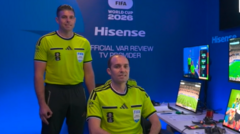
The air inside a Video Assistant Referee hub smells faintly of ozone, stale coffee, and collective panic. It is a windowless sanctuary of screens, humming servers, and high-stakes isolation. Outside, eighty thousand screaming fans provide a muffled, bass-heavy thud through the concrete walls. Inside, three people in matching tracksuits are tasked with an impossible mandate: stripping the chaos out of human error.
We have been told that technology would save football from its own flaws. The cameras would see what the human eye missed. The lines drawn across the grass would settle the arguments that used to last for decades in pubs and on street corners.
Then, a finger rises. A wrist turns. A gesture is made.
Suddenly, the multi-million-dollar apparatus of modern sports officiating is reduced to a playground dispute.
When FIFA demanded an urgent official explanation from a high-profile VAR official regarding an ambiguous hand gesture caught on a broadcast feed, they weren't just policing a breach of protocol. They were trying to stop a leak in the dam of public trust. The moment an official crosses the line from an objective observer into a human being with an attitude, the entire illusion of the impartial machine crumbles.
The Myth of the Sterile Screen
Sports broadcasting likes to present the VAR studio as a laboratory. It is framed as a place of absolute clinical precision, where logic reigns supreme. But go closer. Look at the sweat on the collar of the replay operator. Listen to the clipped, tense breathing into the headsets.
It is a pressure cooker.
Imagine sitting in that chair. You have twelve different angles of a tackle that happened in a fraction of a second. One angle makes it look like a textbook slide. Another makes it look like an assault. The stadium is waiting. The referee on the pitch—a colleague whose career could be derailed by a high-profile blunder—is listening to your voice in his ear, waiting for a lifeline. Millions of people at home are already clipping the footage and uploading it to social media, ready to dissect your character based on a frame-by-frame slowdown.
Under that kind of psychological weight, the human body reacts. Gestures happen.
In this specific instance, the official’s hand movement became a flashpoint. To the cynical viewer, it looked like a dismissive shrug, a sign of collusion, or a mockery of a team’s protest. To the governing body, it looked like a public relations nightmare.
The mistake wasn't necessarily the decision made on the pitch. The mistake was letting the audience see the strings behind the puppet show. Football fans can tolerate a bad call; they have been doing it for over a century. What they cannot tolerate is the suspicion that the person making the call is laughing at them.
The Invisible Stakes of Neutrality
We look at referees as authority figures, but they are actually the ultimate servants of the game. A great referee is like a great stagehand—if you notice them, they haven't done their job correctly.
Technology was supposed to make them invisible. By outsourcing the final judgment to a bank of monitors, the human element was meant to be minimized, protected behind layers of digital bureaucracy. Instead, the cameras have merely shifted our scrutiny from the grass to the glass.
Consider the psychology of the modern supporter. Football is no longer just a game; it is an emotional and financial investment. When a VAR official makes a gesture that can be interpreted as biased or flippant, it violates a sacred, unwritten contract. That contract states that while the players may cheat, the fans may riot, and the managers may lie, the officials will remain as cold and unyielding as the laws of physics.
When FIFA demands an explanation, they are trying to piece that contract back together.
The governing body operates on a simple principle: perception is reality. If the public perceives that the VAR booth is a place of casual arrogance rather than agonizing deliberation, the credibility of every single result is compromised. The integrity of the league doesn't collapse because a ball crossed a line; it collapses because the people in charge of the line stop being taken seriously.
The Breakdown of the Binary
Every weekend, we witness the clash between a sport that is inherently fluid and a technology that demands absolute binaries. A player is either offside or he is not. A ball is either over the line or it is not.
But football is rarely binary. Most of the game exists in the gray area of intent, force, and natural body movement.
When we force human beings to sit in a dark room and reduce those gray areas into black-and-white certainties, we create a profound cognitive dissonance. The VAR official is caught between the poetry of the game and the prose of the rulebook. They are trying to measure a heartbeat with a ruler.
When the pressure peaks, the mask slips. The hand gesture in question was a physical manifestation of that breaking point. It was a moment of raw, unscripted humanity entering a space that was designed to eliminate it.
FIFA's scramble for damage control proves that they know how fragile this system truly is. They built a multi-million-dollar monument to technological perfection, only to realize that it can still be brought down by something as simple, and as flawed, as a flick of a wrist.
The screens will keep humming. The lines will keep being drawn. But the next time the game stops and the referee puts his hand to his ear, the crowd won't just be looking at the pitch. They will be staring at the sky, wondering what is happening in the dark, and wondering if the house always wins.