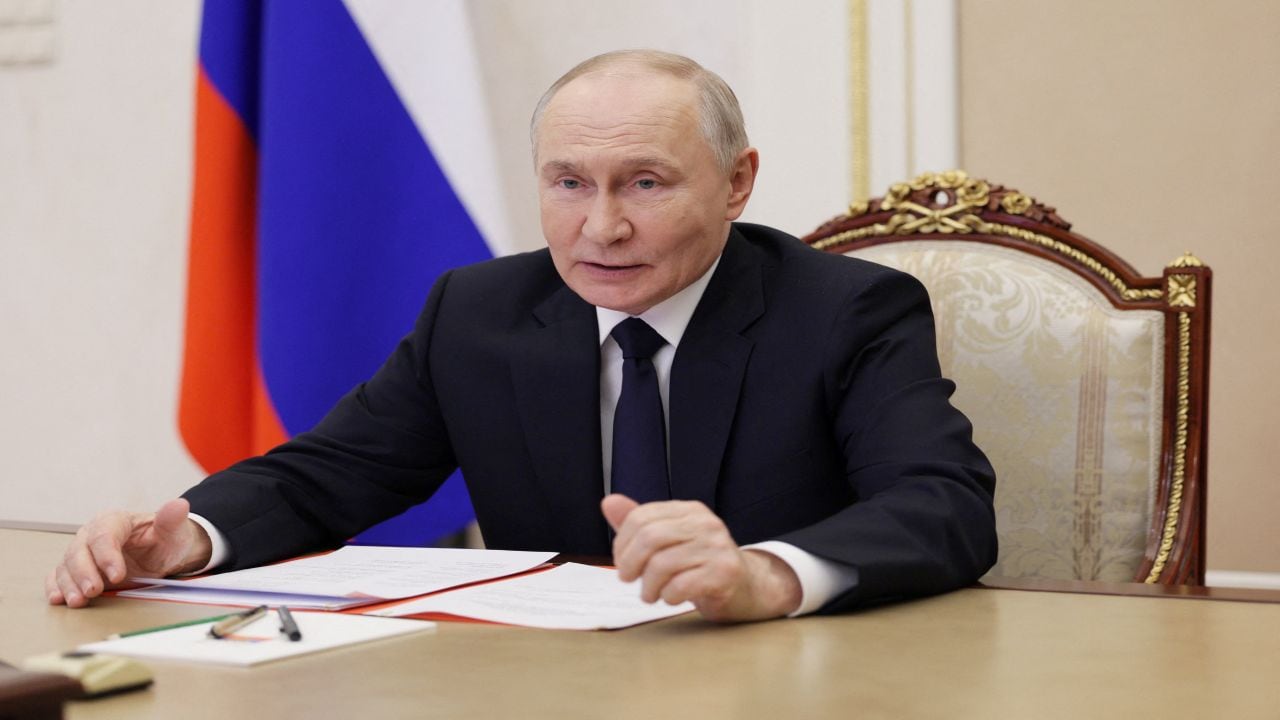
Vladimir Putin claims he is not thinking about the 2030 presidential election. Speaking to global news agency editors in St. Petersburg, the Russian president deflected inquiries about his intentions to remain in power until 2036 by invoking divine will and personal mortality. Yet, this public performance of humility masks a highly calculated political strategy. By leaving his future ambiguous, Putin prevents internal fracturing among Kremlin elites while maintaining full operational control over Russia's wartime economy and its protracted geopolitical confrontation with the West. The refusal to commit to 2036 is not a sign of hesitation; it is the fundamental mechanism by which he stabilizes his regime.
The Choreography of Eternal Ambiguity
The St. Petersburg media forum provided the classic setting for what Kremlinologists recognize as a recurring piece of political theater. When pressed on whether he possesses the physical stamina and desire to govern Russia for another decade, Putin deflected. He remarked that only God knows who will have the health to live until tomorrow, framing his political longevity as an issue of biology rather than ambition.
This performance accomplishes a vital domestic objective. In highly centralized, authoritarian systems, the moment a leader designates a successor or sets a definitive departure date, they instantly trigger a lame-duck dynamic.
Power centers within the state—the intelligence services, military commanders, oligarchs, and regional governors—instantly begin shifting their allegiance toward the future. By maintaining absolute uncertainty, Putin ensures that every competing faction must continue to route its loyalty, resources, and disputes directly through him.
The 2020 constitutional amendments explicitly reset presidential term limits. This legal maneuvering opened the door for Putin to run again in 2030 and stay in office until 2036.
By law, the path is entirely clear. By rhetoric, it remains a question mark. This duality is intentional. It forces the Russian political elite into a state of permanent suspension, rendering anyone who tries to plan for a post-Putin transition an automatic traitor to the state.
The Problem of the Eternal Present
The true vulnerability of this system lies in its inability to handle the passage of time. Putin will turn 83 years old in 2036. While the Kremlin works tirelessly to project an image of physical vitality, the biological reality cannot be entirely ignored by the state apparatus.
+--------------------------------------------------------------+
|                    THE KREMLIN POWER LOOP                    |
|                                                              |
|   +------------------------------------------------------+   |
|   |                  Absolute Monocracy                  |   |
|   |  - Power routes entirely through a single leader    |   |
|   +--------------------------+---------------------------+   |
|                              |                               |
|                              v                               |
|   +------------------------------------------------------+   |
|   |                 Deliberate Ambiguity                 |   |
|   |  - Future succession plans are withheld              |   |
|   +--------------------------+---------------------------+   |
|                              |                               |
|                              v                               |
|   +------------------------------------------------------+   |
|   |                 Elite Immobilization                 |   |
|   |  - Factions cannot organize around a new heir        |   |
|   +--------------------------+---------------------------+   |
|                              |                               |
|                              +--- Loops back to preserve ----+
+--------------------------------------------------------------+
The internal stability of Russia depends entirely on an intricate balance between various competing networks, often divided broadly into the siloviki (security and military officials) and the technocrats (who manage the economy and financial systems).
- The Siloviki: This faction requires a hardline executive to maintain defense spending, justify aggressive foreign policy, and protect their immense domestic monopolies.
- The Technocrats: This group focuses on economic survival, sanction-evasion mechanisms, and basic infrastructural continuity.
The current system lacks any functional institutional mechanism to arbitrate disputes between these two camps without Putin at the top. The Russian parliament acts as a rubber stamp, the judiciary is entirely subservient to the executive branch, and the ruling United Russia party possesses no independent political will.
Therefore, every time Putin sidesteps a question about 2036, he is actively preventing these two factions from engaging in an open turf war. The moment he acknowledges an end date, the struggle to control the trillions of rubles flowing through the defense sector will spill out into the open.
Governing Through Perpetual Crisis
By focusing public attention on immediate, large-scale domestic issues, the Kremlin shifts the conversation from systemic political stagnation to national survival. The narrative presented to the Russian public is straightforward: the nation is locked in an existential conflict with a hostile Western coalition, and changing leadership during an active storm is an unacceptable luxury.
This framework transforms political longevity from a matter of personal ambition into an act of sacrifice. The message to ordinary citizens and elites alike is that the president remains in office not because he craves power, but because the defense of the state demands his continued presence.
This brings a distinct psychological benefit to the regime. It lowers expectations for internal reform or economic modernization. When survival is the primary objective, institutional stagnation is easily rebranded as stability.
The Long-Term Operational Risk
The fatal flaw of this strategy is that it accumulates risk over time rather than resolving it. A system that cannot openly discuss its own future is inherently brittle. The longer the succession question is suppressed, the more explosive the eventual transition will become.
History shows that regimes built entirely around a single individual face acute danger when that individual can no longer govern. Without a transparent, trusted process for transferring authority, the transition period invariably triggers an intense, unpredictable power struggle among the inner circle.
For now, the ambiguity serves its purpose. It keeps international analysts guessing, keeps domestic rivals off-balance, and keeps the entire Russian state machinery tethered directly to the fate of one person. Putin’s reliance on divine providence to answer questions about his political horizon is not an admission of weakness. It is a calculated declaration that, for the foreseeable future, there is simply no alternative.