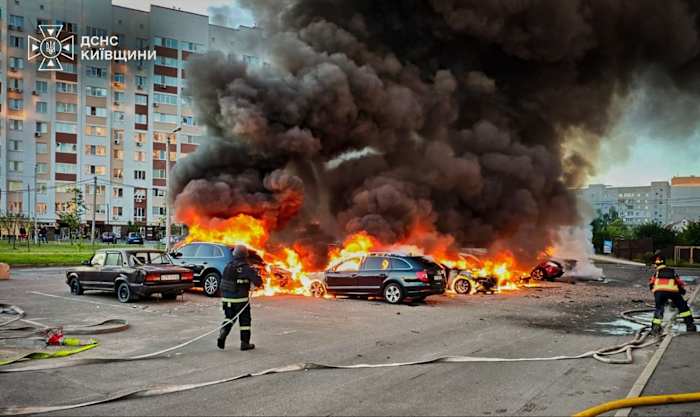
Air raid sirens don't just sound warnings in Ukraine anymore. They dictate the rhythm of survival. For two consecutive days, waves of Russian attack drones have smashed into residential apartment blocks, private homes, and commercial storage hubs across the Kyiv region.
When you look past the raw casualty numbers, a clear tactical shift emerges. Moscow isn't just trying to hit military installations. The strategy targets the psychological endurance of the civilian population and the economic arteries feeding the capital.
The Anatomy of a Dual-Wave Assault
The numbers coming out of the Kyiv regional military administration paint a grim picture. Recent strikes damaged fourteen commercial warehouses, sixteen private houses, three multi-story apartment buildings, and sixteen vehicles.
What makes these recent aerial bombardments particularly dangerous is the methodology. Military analysts note an increase in small, fast-moving, jet-powered drones launched in rapid waves. Andrii Kovalenko, head of Ukraine's Center for Countering Disinformation, points out that the explicit goal is exhaustion—wearing down both air defense networks and civilian morale through relentless disruption.
Residents spent fifteen hours locked down under air raid alerts during the initial wave. When the second wave hit, emergency services faced a terrifying tactic known as the "double tap." A second drone struck a blast site precisely after rescue crews arrived, injuring and killing first responders. It is a brutal playbook designed to make rescue operations nearly impossible.
Choking the Capital Economy
Warehouses storing civilian goods—ranging from food and books to postal sorting hubs operated by companies like Nova Poshta—have taken direct hits. This is intentional economic strangulation. By destroying distribution depots around Kyiv, supply chains fracture.
Ukraine's Ministry of Economy has already been forced to downgrade its GDP growth forecasts for 2026. Port blockades, combined with systematic attacks on logistics and energy hubs, keep the country operating under immense economic strain. When a warehouse burns, it isn't just a financial loss for a retailer; it represents a severed link in the daily supply chain of a nation at war.
Air quality in parts of the Kyiv region plummeted following the blazes, forcing local authorities to issue urgent warnings telling residents to keep windows tightly shut and limit time outdoors. Life under drones means breathing toxic smoke while waiting for the next alert to clear.
The Broader Campaign
The pressure on Kyiv isn't happening in a vacuum. Down south in the Kherson region, authorities are urging mass evacuations as winter approaches because critical infrastructure faces total destruction. Oleksandr Prokudin, head of the Kherson regional administration, notes that hundreds of glide bombs and thousands of attack drones have targeted the south over recent weeks, aiming to wipe out heating and electricity before sub-zero temperatures hit.
Meanwhile, the drone war has grown reciprocal. Ukrainian long-range strikes continue to hit industrial and logistics sites deep inside Russian territory, triggering fires at fuel depots and damaging residential areas in border and central regions like Yaroslavl.
The war of attrition grinds forward. For the people living beneath the flight paths of Kyiv's skies, each night brings the same choice: head to the shelter, watch the tracking apps, and hope the next wave misses home.