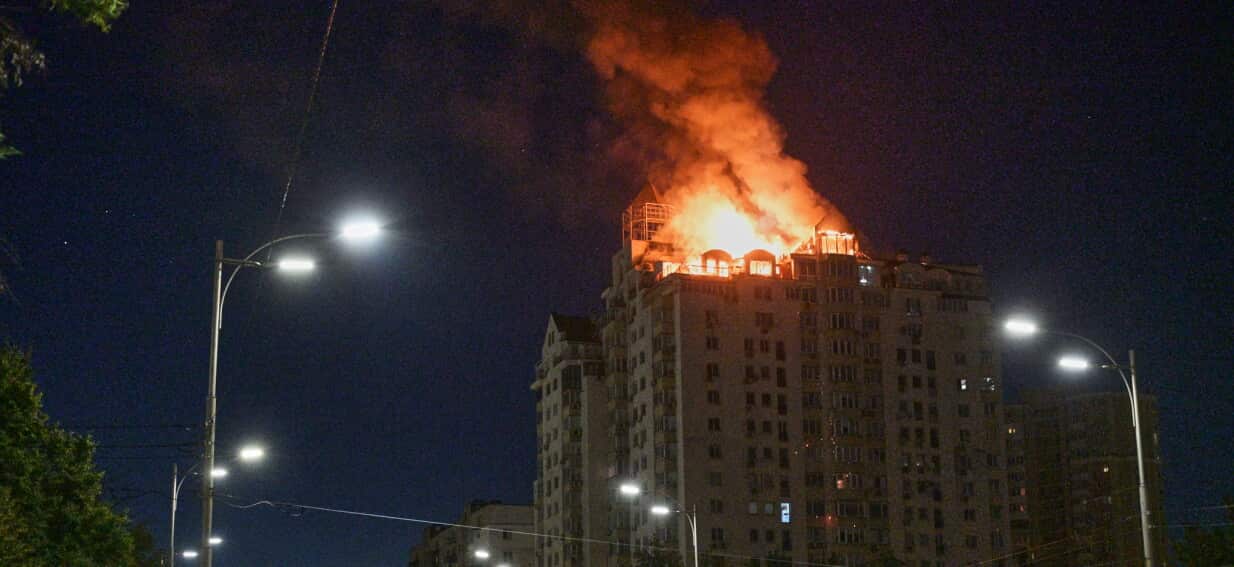
You can't hide a burning oil refinery. When a wave of drones bypassed Moscow's thickest air defense networks to slam into the Kapotnya refining units, the thick black plumes of smoke written across the sky made one thing obvious. Ukraine's domestic drone industry has evolved from a chaotic group of garage startups into a terrifyingly efficient, mass-producing military machine.
For months, people wondered if Kyiv's long-range strikes were just lucky one-offs or temporary stunts. They aren't. By systematically targeting the heavy machinery that cooks crude oil into fuel, Ukraine has triggered fuel shortages inside the world’s biggest hydrocarbon producer. This isn't just about blowing things up. It's a calculated masterclass in asymmetric warfare, proving that cheap, locally built tech can systematically dismantle a superpower's economic engine.
The Shift From Spectacular Images to Cold Math
When Ukraine first started hitting Russian infrastructure, the tactics were a bit scattered. Operators focused heavily on export terminals and storage tanks, like the Baltic port of Ust-Luga. Those attacks made for incredible videos, but the actual strategic impact was short-lived. A storage tank is basically a giant bucket. If you punch a hole in it, you lose the oil inside, but you can patch the metal or route the pipeline to another tank within a couple of weeks.
Kyiv realized this and completely shifted its playbook.
Instead of hitting the storage units, Ukrainian drones are now aiming directly for the primary processing units, cracking towers, and hydrotreating installations. This is where the real damage happens. These sophisticated machines break crude oil down into usable gasoline, diesel, and jet fuel. They are packed with complex, custom-engineered components. Because of tight sanctions, Russia can't just order replacement parts on the open market.
Look at what happened at the Kapotnya refinery in Moscow. During a massive modernization push, the facility replaced its scattered processing units with just two highly integrated installations built close together. It made perfect sense for peacetime efficiency. In wartime, it turned the facility into a massive, concentrated target. Drone strikes knocked out both units, instantly wiping out massive chunks of refining capacity.
The economic toll is staggering. Data from industry insiders and financial analysts, including insurance reports from Mains, estimate that Russian oil companies faced over $13 billion in total losses across recent campaigns. While direct physical damage makes up a little over a billion of that, the rest comes from lost profits, ruined equipment, and total operational paralysis.
Inside the Domestic Drone Factories
This campaign isn't being fought with imported Western weapons. Washington and European capitals have long been terrified of escalation, explicitly banning Ukraine from using Western-supplied missiles to strike deep inside Russian territory. That restriction forced Kyiv's hand, sparking a massive, localized industrial boom.
Ukraine basically had to invent its own long-range air force from scratch.
Instead of waiting for multi-million-dollar cruise missiles, Ukrainian engineers built the Lyutyi and the FP-1. These aren't hobbyist quadcopters. The Lyutyi is a sleek, long-range drone capable of flying over 1,000 kilometers deep into Russian territory. It flies low, runs quiet, and carries a warhead heavy enough to shatter industrial steel. Recently, locals filmed a Lyutyi flying completely unbothered through the skies toward a major refinery center in Ufa, roughly 1,400 kilometers away from the Ukrainian border.
Then there's the FP-1, produced by the Ukrainian defense company Firepoint. They are churning out roughly 100 of these long-range strike drones every single day. When these systems first rolled out, they took Russian air defenses by complete surprise, boasting success rates around 70 percent. Russia has since adapted, jamming signals and throwing up denser anti-aircraft nets, but the sheer volume keeps overwhelming them. Even if Russian air defenses shoot down 90 percent of an incoming swarm, the 10 percent that get through are more than enough to set a multibillion-dollar facility on fire.
Frontline Brutes and Flying Motherships
While long-range drones hammer the Russian rear, a completely different class of domestic tech is rewriting the rules on the front lines. You've probably heard of the "Baba Yaga." That is the terrifying nickname Russian troops gave to a family of heavy Ukrainian multirotor drones, including the Vampire and Kazhan systems.
Originally built as heavy agricultural octocopters for spraying crops, Ukrainians bolted on thermal imaging cameras, heavy armor, and custom bomb racks. Operating almost exclusively under the cover of darkness, these massive drones hover over Russian trenches, dropping mortar-sized munitions with terrifying precision.
But Kyiv's engineers didn't stop there. They transformed the Baba Yaga into a flying mothership.
Because small, cheap kamikaze drones have limited battery life and suffer from signal loss when flying low to the ground, Ukraine started mounting directional antennas, anti-jamming circuitry, and signal repeaters directly onto the heavy Baba Yaga platforms. The large drone hovers high in the sky, acting as an airborne communications hub linked via Starlink. It forwards control signals to a swarm of tiny, $500 FPV killer drones buzzing beneath it. This clever trick extends the strike range of cheap kamikaze drones from a measly 10 kilometers to well over 30 kilometers. It basically turns cheap toy components into a highly precise alternative to heavy artillery.
Real Crisis or Just a Speed Bump
Is this campaign actually working? The answer depends on what you mean by "working."
If the goal is to trigger an immediate collapse of the Russian government or force a sudden retreat, then no. The Kremlin remains stubbornly dug into its positions. Vladimir Putin has even used recent speeches to project total confidence, demanding massive territorial concessions and refusing to back down from his war aims. Russia also keeps generating massive revenue by exporting raw, unrefined crude oil, which is harder for Ukraine to stop and still fetches 75 to 80 percent of the value of refined products on the global market.
But if the goal is to degrade Russia's internal logistics and bring the friction of war home to ordinary citizens, the strategy is working perfectly.
The strikes have thrown Russia into a rolling summer fuel crisis. Wholesale prices have fluctuated wildly, and supply shortages have hit dozens of regions simultaneously. Long lines are snaking away from gas stations. Fuel rationing has been introduced in multiple provinces, forcing local officials to bring portable toilets to massive car queues. The situation got so tight that Russia, one of the globe's premier oil giants, had to start buying fuel from foreign neighbors just to keep its domestic market from panicking. Furthermore, acute energy blackouts and severe fuel deficits have plagued the occupied Crimean peninsula, choking off vital military supply routes north of the Sea of Azov.
What This Means for Global Warfare
The genie is completely out of the bottle. What Ukraine proved is that you don't need a multi-billion-dollar aerospace industry to wage a devastating strategic bombing campaign. You just need a vibrant software ecosystem, a network of agile component factories, and the engineering grit to iterate faster than your enemy can adapt.
The traditional defense procurement cycle—where governments spend a decade planning, testing, and manufacturing a single aircraft platform—is completely dead. Ukraine's drone companies are modifying their software and hardware on a weekly basis to bypass new Russian electronic jamming codes. This rapid, iterative cycle is the new baseline for global conflict.
If you want to track where this conflict goes next, stop looking at territorial maps of the Donbas mud. Watch the skies over Russia's energy hubs. The real story of modern warfare is being written by the whir of cheap fiberglass propellers flying deep into the night.