The Caribbean breeze carries the scent of salt and sun-baked earth, a smell that usually signals the start of a vacation. But for those staring at the razor wire of Guantánamo Bay, that same wind tastes like iron and old mistakes.
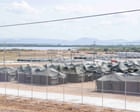
Deep within the naval base, far from the polished dining halls of officers and the gray decks of destroyers, lies a stretch of land known as Camp Bulkeley. It is a place of temporary structures and permanent anxieties. Recently, the United States government dusted off plans to house Cuban migrants here—a decision that treats human beings like logistical errors to be filed away in a drawer no one wants to open.
Think of a man named Elias. He is not a real person in the legal sense, but he is the composite of a thousand stories told in whispers across the Florida Straits. Elias sells his grandfather’s watch and his neighbor’s bicycle to fund a seat on a boat that looks more like a floating scrap heap than a sea-faring vessel. He isn't looking for a handout; he is looking for a breath of air that doesn't feel like it’s being squeezed out of his lungs by a collapsing economy and a tightening political fist.
He survives the waves, the dehydration, and the predatory currents. But instead of the neon glow of Miami or the soft sand of Key West, he sees the silhouette of a watchtower. He is brought to Guantánamo.
The Geography of Nowhere
The legal status of Guantánamo Bay is a labyrinth designed to make people vanish. It is a piece of Cuba controlled by the United States, yet it exists in a jurisdictional shadow where the Constitution is more of a suggestion than a rule. When a migrant is taken there, they aren't technically on American soil. They are in a waiting room with no clock.
Human rights advocates have spent decades shouting into this void. They see the camp not as a solution, but as a deliberate attempt to bypass the law. By processing migrants at the naval base, the government effectively strips them of the right to legal counsel and the ability to claim asylum through standard judicial channels. It is a shortcut. A trapdoor.
The Biden administration defends the move as a humanitarian necessity, a way to handle sudden surges in migration without overwhelming domestic facilities. They point to the infrastructure already in place. They speak of "orderly processing."
The reality on the ground feels less like order and more like an echo of the 1990s. Back then, tens of thousands of Cubans and Haitians were intercepted at sea and held behind the wire at Gitmo. The images from that era are haunting: rows of tents baking in the 100-degree heat, children playing in the dirt under the watchful eyes of armed guards, and a sense of profound, soul-crushing boredom.
The Weight of the Wire
Why does this matter to someone sitting in a comfortable chair in Ohio or Oregon?
Because how a nation treats the most desperate reflects the true strength of its soul. When we choose to hide people in a naval base rather than face them in a courtroom, we admit that our systems are too brittle to handle the truth of the world. We are choosing convenience over conscience.
The "invisible stakes" here are the precedents we set. If we can bypass the law for a Cuban migrant today, the path is cleared to bypass it for someone else tomorrow. History shows that once a government finds a way to operate outside its own rules, it rarely gives that power back.
Consider the psychological toll of being held in a place synonymous with "War on Terror" detainees. Even if the migrant camp is physically separate from the high-security prison, the aura of the base is one of suspicion and confinement. For a family fleeing a regime that monitored their every move, arriving at a military fortress is not a rescue. It is a lateral move.
A Cycle of Broken Tides
The migration numbers are not just statistics; they are a pulse. In 2022 and 2023, the number of Cubans attempting the crossing skyrocketed, fueled by the worst economic crisis the island has seen in thirty years. When the lights go out in Havana, people start looking at the horizon.
The U.S. government views these people as a "mass migration event." It is a cold, clinical term that ignores the terror of the journey. It ignores the reason Elias got on the boat in the first place.
Human rights groups like Amnesty International and the ACLU argue that by using Guantánamo, the U.S. is essentially creating an "offshore" processing center that avoids the gaze of the public and the reach of the courts. This isn't just about bed space or food rations. It’s about the right to be seen as a person rather than a problem.
There is a specific kind of cruelty in being held on the very island you fled, yet being barred from its soil and its future. You can smell the Cuban earth on the wind, but you are separated from it by a fence and a foreign flag. You are home, and yet you are more lost than you have ever been.
The Cost of Looking Away
We often talk about the "cost" of migration in terms of dollars and cents. We calculate the price of fuel for Coast Guard cutters and the cost of meals in a detention center. We rarely calculate the cost to our own integrity.
The plan to utilize Guantánamo is a symptom of a larger failure—a failure to create a regional immigration strategy that doesn't rely on barbed wire. It is a reactive measure, a panic button pressed by a government that knows its domestic politics are too fractured to pass meaningful reform.
When we look at the maps and the blueprints for these camps, we should see more than just tents and latrines. We should see the faces of people who were told that the North Star would lead them to freedom, only to find themselves in a legal twilight zone.
The salt remains. It stings the eyes and rusts the fences. And as long as we continue to treat Guantánamo as a convenient hole in the world, the salt will continue to wash away the very values we claim to be protecting.
A boat sits empty on the shore of the base, its wood bleached white by the sun. It is a ghost of a journey that ended not with a handshake, but with a headcount. Behind the fence, the wind continues to blow, indifferent to the citizenship of those who breathe it.