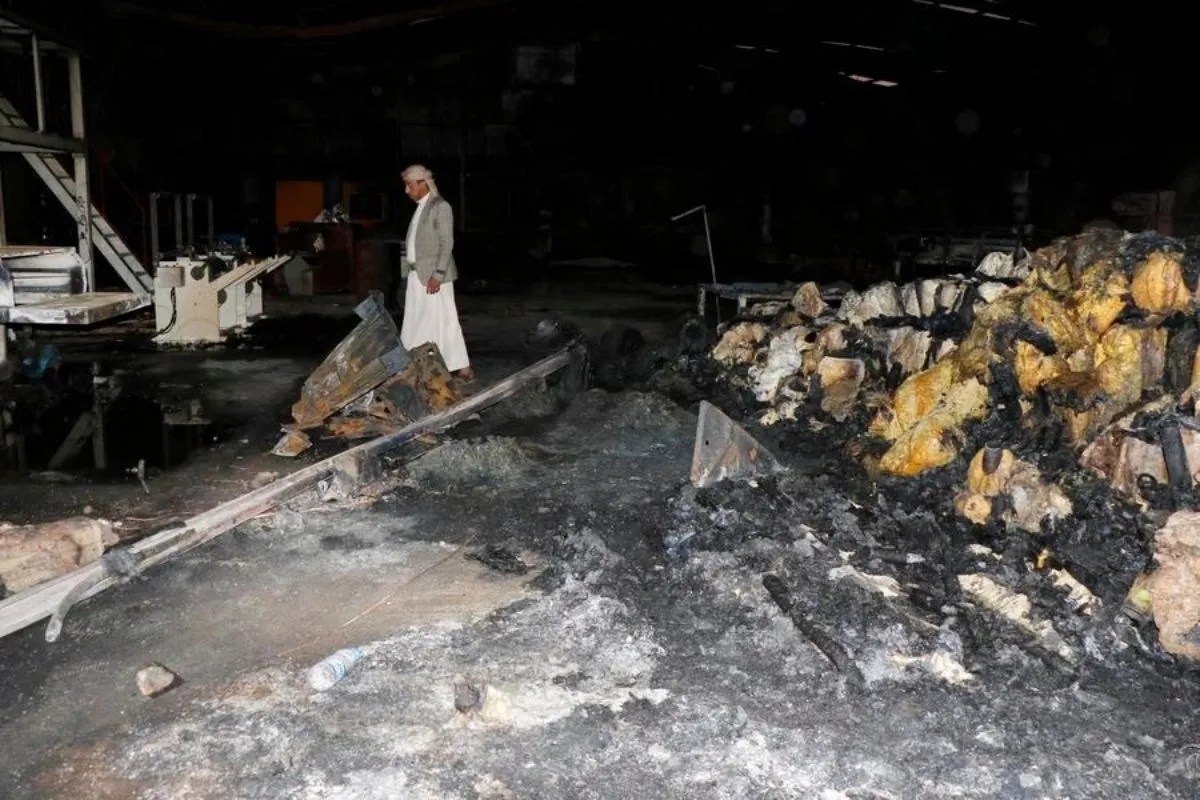
Breaking news coverage of airstrikes on the Al-Sabaha oil facility in Sanaa—exemplified by headlines reporting an area shaken by explosions and claims of an aerial strike on an oil hub—typically stops at the immediate sensory impact: blasts, smoke, and rival claims. That surface-level reporting misses the operational logic driving target selection, the escalation loop triggered across the Arabian Peninsula, and the energy-security pressures connecting Yemen to wider regional choke points.
To understand what a strike on Al-Sabaha actually alters on the ground, analysts must separate verified actions from unverified wartime claims, map the fuel supply chain as a physical network rather than a single building, and trace how counter-value threats respond to counter-infrastructure strikes.
How Basic Breaking News Flattens the Event
Standard wire-style coverage around the Al-Sabaha central station of the Yemen Petroleum Company treats the incident as an isolated kinetic event: explosions occur, an oil depot burns, and warring sides trade accusations. While that sequence satisfies immediate curiosity about whether an attack happened, it leaves out the structural mechanics that give the strike meaning.
First, breaking reports often blur pre-strike signaling with post-strike damage assessment. When coalition forces issue public warnings urging civilians to evacuate a named facility before an operation, the warning itself changes the operational calculus—reducing expected civilian casualties while signaling deliberate intent rather than a stray munition. Second, short dispatches rarely distinguish between confirmed strikes, coalition announcements, Houthi claims, and third-party media reports, even when those accounts diverge sharply on target counts and casualties.
Third, treating fuel infrastructure as a generic "oil site" obscures the functional difference between upstream extraction, maritime import terminals, bulk storage depots, and retail distribution. Hitting a central storage and distribution station near a capital affects urban mobility, diesel generators, transport costs, and military logistics differently than striking an offshore loading terminal or a local service station.
The Supply Chain Cost Function of Fuel Infrastructure
Energy logistics in conflict zones operate under a tight cost function where physical destruction is only the first term. When a central petroleum station is struck or taken offline, the total cost to the local economy and armed actors rises through four compounding mechanisms:
- Buffer Depletion: Central depots act as shock absorbers between irregular supply arrivals and daily consumption. Removing buffer capacity forces rationing and makes any delay in replenishment immediately visible at the pump.
- Rerouting Friction: Fuel that cannot pass through a primary hub must be trucked from secondary depots or dispersed storage points, increasing transit time, road exposure, and per-liter transport costs.
- Price and Scarcity Contagion: Even partial capacity loss triggers hoarding and black-market markups, raising operating expenses for commercial freight, hospitals, water pumping, and agricultural transport.
- Military-Civilian Coupling: Because both armed groups and civilian households rely on diesel and petrol—often through overlapping commercial networks—targeting fuel depots exerts coercive pressure on governance and logistics simultaneously, while carrying acute humanitarian risks for essential services.
What a strike cannot do on its own is permanently erase demand or immediately paralyze all movement if informal stockpiles, jerrycan distribution, or alternative storage sites remain intact. Analysts must therefore evaluate throughput degradation rather than dramatic fire plumes alone.
Escalation Loops and Retaliatory Signaling
Strikes on high-visibility economic or logistical sites rarely occur in a vacuum; they sit inside an action-reaction escalation loop shaped by asymmetric capabilities. In this dynamic, one side targets infrastructure or military launch nodes inside adversary-held territory, while the opposing side responds with long-range missiles, drones, or threats against high-value economic and aviation nodes across the border.
Consider how that retaliation mechanism works in practice. When Houthi forces face airstrikes in Sanaa or across multiple governorates, their counter-signaling frequently aims at Saudi aviation hubs, energy assets, or urban centers—such as warnings directed at Riyadh airport or energy infrastructure alongside reported missile and drone launches and air-defense interceptions. Even when air defenses intercept incoming projectiles, interception debris, airspace disruptions, and security alerts impose real economic and psychological costs.
This escalation is further amplified when local or bilateral clashes intersect with broader regional crises. Reporting from the autumn 2026 escalation cycle highlights how fighting in Yemen has unfolded alongside wider regional confrontations involving Iran, Gulf states, and maritime chokepoints such as the Strait of Hormuz and the Red Sea corridor. When multiple fronts heat up simultaneously, cross-theater coupling makes de-escalation harder because an action in one arena is read as a move in a much larger contest over deterrence and shipping security.
Separating Verified Facts From Educated Hypotheses
Rigorous analysis requires maintaining a strict boundary between what is established and what is inferred:
- Known Facts: Reports and coalition statements around mid-October 2026 placed the Yemen Petroleum Company's Al-Sabaha facility near Sanaa at the center of an evacuation warning and subsequent strikes accompanied by major fires and explosions, amid wider exchanges of airstrikes, missile/drone launches, and interceptions. Subsequent reporting in November 2026 also documented ongoing strikes on Sanaa sites—including petroleum-related infrastructure—alongside contested claims of strike counts and ongoing air-defense interceptions toward Saudi cities.
- Educated Hypotheses: Analysts can reasonably infer that striking Al-Sabaha is intended to degrade fuel distribution and logistics supporting Houthi administration and operations in the capital, and that retaliatory threats against airports and oil facilities are designed to raise Riyadh's political and economic cost of continued air operations. However, exact structural damage at Al-Sabaha, precise fuel reserve levels, and the true operational tempo of both sides remain difficult to verify independently in real time amid fog of war and conflicting propaganda claims.
Practical Analytical Checklist and Key Limitations
To evaluate future reports on Sanaa or similar strikes without getting swept up in headline volatility, apply a disciplined four-step filter:
- Audit the Source Chain: Separate first-party military statements, state-aligned media claims, independent wire reporting, and geolocated visual evidence before treating numbers of strikes or casualties as settled.
- Identify the Node Type: Classify whether the struck site is a storage depot, distribution terminal, retail station, administrative office, or weapons launch site, since each has a distinct operational half-life.
- Track Secondary Spillovers: Watch for flight suspensions, air-defense alerts, fuel price spikes, and aid/service bottlenecks over the following 72 hours rather than relying on initial blast reports.
- Account for Information Lag: Expect early reports to overstate certainty during active exchanges and revise details days later as satellite imagery, municipal reports, or diplomatic assessments emerge.
Every analytical framework has limits. Open-source intelligence cannot reliably measure underground fuel reserves, hidden drone or missile caches, or internal leadership calculations behind closed doors. Moreover, infrastructure strikes carry strategic trade-offs: they can constrain an adversary's logistics, yet they also risk hardening public resolve, complicating humanitarian conditions, and inviting retaliatory strikes against critical export and aviation nodes.
For decision-makers, risk managers, and analysts tracking the conflict, the most effective immediate move is to build a structured infrastructure-and-retaliation tracker that pairs each reported strike in Sanaa or other governorates with downstream indicators—specifically aviation advisories, air-defense interception reports, energy infrastructure alerts across the Gulf, and local fuel/commodity price shifts—rather than reacting to single-day explosion headlines in isolation.