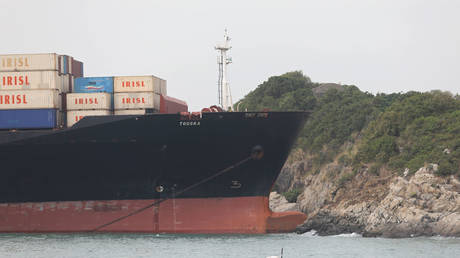
The global headlines are screaming "piracy." They point at Iran for seizing a tanker in the Gulf of Oman, echoing the US State Department’s scripted outrage about "international law" and "freedom of navigation." It is a tired, predictable dance. But if you strip away the diplomatic theater and look at the ledger, the narrative collapses.
The US calls it a seizure; Iran calls it a recovery of stolen property. The truth is far more uncomfortable. We aren't looking at a breakdown of maritime law. We are looking at the death rattle of a financial hegemony that uses the high seas as its personal repossession lot.
The Shell Game of Global Oil
To understand why the "maritime piracy" label is a joke, you have to look at the history of the Suez Rajan, the vessel at the heart of this specific spat. A year ago, the US Department of Justice didn't just ask nicely for Iranian oil; they effectively hijacked it under the guise of civil forfeiture. They redirected a tanker, offloaded its cargo in Texas, and sold it for a profit.
When the US does it, it’s "enforcement." When the victim retaliates, it’s "terrorism."
This isn't about safety. It’s about the Office of Foreign Assets Control (OFAC). The US has weaponized the dollar to the point where every drop of oil on the ocean is subject to American jurisdiction, regardless of who produced it or who bought it. If you believe the competitor headlines, you believe that a country seizing its own diverted assets is the aggressor. That isn't logic. That's Stockholm Syndrome.
The Myth of Neutral Waters
International law, specifically the United Nations Convention on the Law of the Sea (UNCLOS), is supposed to protect the flow of trade. But UNCLOS has become a cafeteria menu for superpowers. The US hasn't even ratified it, yet they cite it as the holy gospel when someone else blocks a strait.
The Strait of Hormuz is not a highway; it’s a choke point. Approximately 20% of the world’s petroleum passes through this 21-mile-wide strip. The "consensus" view is that Iran is a "bad actor" for threatening this flow. The reality? Iran is the only actor playing a transparent game. They are signaling that if their economy is choked by Western sanctions—essentially a financial blockade—they will reciprocate with a physical one.
Sanctions are a siege. In medieval warfare, a siege was an act of war. Today, we call it "foreign policy." If you cut off a nation’s ability to sell its primary resource, you have already fired the first shot. Complaining about a ship seizure after you’ve frozen a nation's bank accounts is like punching someone in the face and calling the police when they grab your wrist.
Sovereignty is a One-Way Street
I have watched analysts for decades try to frame these incidents as "unprovoked." It is the most intellectually dishonest word in the geopolitical lexicon. Nothing in the Persian Gulf is unprovoked.
Let’s talk about the mechanics of a "seizure."
- The Legal Pretense: The US identifies a ship carrying Iranian crude.
- The Pressure: They threaten the Greek or Liberian ship owners with secondary sanctions—essentially threatening to bankrupt their entire fleet.
- The Theft: The owner "voluntarily" redirects the ship to a US port.
- The Sale: The US sells the oil and puts the money into the "United States Victims of State Sponsored Terrorism Fund."
This is a sophisticated carjacking. Iran’s response—boarding the ship with masked commandos—is optics-heavy and brutal, but it’s a mirror. They are reclaiming the value that was stripped from them in a Texas courtroom. If we want to talk about "rules-based order," we have to admit the rules are written in pencil and the US holds the eraser.
The High Cost of "Safety"
The common "People Also Ask" query is: Will this drive up gas prices?
The short answer is yes, but not for the reasons you think. Prices don't spike because a single tanker was taken. They spike because the insurance industry—Lloyd's of London and the like—recognizes that the US can no longer guarantee the "rules" it pretends to enforce.
When the US seizes Iranian oil, it adds a "sovereign risk premium" to every barrel on the water. We are paying at the pump for the DOJ’s legal experiments. We are subsidizing a maritime tug-of-war that serves no strategic purpose other than to prove we can still bully the mid-market players.
The Illusion of Global Consensus
The competitor article wants you to think the world stands united against "Iranian aggression." Look at the BRICS+ expansion. Look at the shipping lanes. China, India, and Russia aren't issuing "condemnations." They are building a parallel economy that doesn't rely on the SWIFT system or the whims of a judge in D.C.
By using "piracy" as a political label, the West is destroying the very concept of maritime law. If "law" only applies to your enemies, it’s not law—it’s a weapon. And weapons eventually run out of ammunition.
The US maritime strategy is currently a mess of contradictions. We claim to protect the "freedom of navigation" in the South China Sea while simultaneously claiming the right to seize any ship anywhere if it carries "sanctioned" cargo. You cannot have it both ways. You are either for open seas or you are for a gated community. Right now, the US is the HOA president from hell, and Iran just stopped paying its dues.
Stop Asking if it’s Legal
Stop asking if Iran's move was "legal" under international law. That question is a trap. The real question is: Is the current system of maritime enforcement sustainable? The answer is a resounding no. We are entering an era of "Kinetic Arbitrage." If you can take it, it’s yours. The US started this game by seizing the Suez Rajan (now the St. Nikolas). Iran just finished the round.
If you’re a shipping executive, you aren't looking for a "condemnation" from the White House. You’re looking for a way to stay out of the crossfire of two giants who have forgotten how to negotiate. The era of the US as the global maritime sheriff is over. We’ve become just another gang on the docks, and we’re upset because someone else finally brought a bigger stick.
The next time you see a headline about "piracy" in the Gulf, ask yourself who stole what first. The answer usually isn't in the press release. It’s in the bank records.
Get used to the sight of masked men on decks. This isn't a glitch in the system. It is the system.


