A single telephone call shattered four years of quiet along the Saudi-Yemeni border. US President Donald Trump gave Saudi Crown Prince Mohammed bin Salman explicit American backing to restart offensive military operations in Yemen, effectively ending the fragile truce that had contained the region's most volatile civil war since 2022. Within hours of the diplomatic green light, airstrikes cratered the runway at Sanaa International Airport, triggering immediate retaliatory ballistic missile barrages against civilian infrastructure inside Saudi Arabia. The war is back on, and Washington signed the check.
The sudden escalation catches a fragile Middle East completely unprepared. Observers had spent years hoping that the quiet diplomacy brokered by regional mediators would yield a permanent peace statement. Instead, the sudden return to active warfare reveals a deeper, more aggressive shift in American foreign policy. Washington is no longer merely attempting to contain the conflict. The current administration is actively facilitating a regional counter-offensive, gambling that raw military pressure can force the Houthi movement into submission where years of economic isolation failed.
To understand how a quiet borderland transformed back into an active combat zone overnight, one must look at the mechanics of the specific intelligence trigger that forced Riyadh’s hand.
The Trigger Flight from Tehran
The immediate catalyst for the airstrikes was a commercial airliner. Specifically, a flight operated by Mahan Air, an Iranian carrier long scrutinized by Western intelligence agencies for its deep, operational ties to the Islamic Revolutionary Guard Corps.
The aircraft had been dispatched to transport a high-level Houthi delegation back from Tehran. The officials had been attending the funeral of Iran's Supreme Leader, Ayatollah Ali Khamenei. To the intelligence services in Riyadh and Washington, the passenger list was only half the problem. The real concern lay in the cargo hold. Intelligence intercepts suggested the plane was packed with sophisticated guidance kits for anti-ship ballistic missiles, drone components, and specialized Iranian technical advisers destined for the battlefields of northern Yemen.
Saudi Arabia initially attempted to block the flight through diplomatic and regulatory maneuvers, refusing authorization for the plane to enter its monitored airspace. The pilot pressed on anyway.
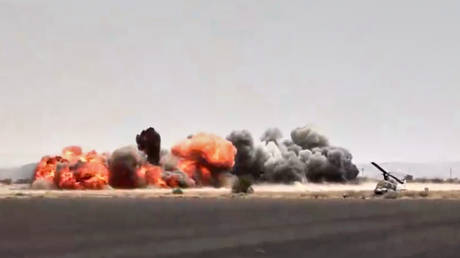
The response was swift and violent. Bombs struck the runway at Sanaa International Airport directly, rendering the tarmac unusable and forcing the Iranian aircraft to divert toward the Red Sea coast, eventually landing at the Houthi-controlled port city of Al Hudaydah. Officially, the internationally recognized Yemeni government based in the south claimed sole responsibility for the operation. They asserted it was an act of national sovereignty to prevent an illegal foreign flight from landing on occupied territory.
Nobody in the region believed the southern government acted alone. The anti-Houthi coalition in the south lacks the sophisticated, real-time aerial intelligence and target-acquisition capabilities required to execute such a precise strike without direct Saudi operational management.
The Houthis certainly knew who pulled the trigger. They immediately announced that the period of de-escalation was officially over, describing the airport strike as a blatant act of aggression that demanded immediate, symmetric violence. Within hours, the skies over southwestern Saudi Arabia filled with the familiar drone of incoming suicide aircraft and the supersonic roar of ballistic missiles.
Behind Closed Doors in Washington
Riyadh did not act on impulse. The Saudis spent days securing their diplomatic flanks before a single jet left the tarmac.
The diplomatic offensive began in Washington. The Saudi ambassador met with US Secretary of State Marco Rubio to outline the growing threat of Iranian re-armament via the Sanaa air bridge. Rubio followed up with an extensive discussion with the Saudi foreign minister, signaling that the State Department shared the kingdom’s alarm over the collapsing regional architecture. The final seal of approval came from the very top. Donald Trump spoke directly with Crown Prince Mohammed bin Salman, providing the crucial political guarantee that Washington would back the kingdom against any subsequent international blowback or retaliatory escalations.
This is a classic return to the playbook of the first Trump administration. During his initial term, Trump consistently prioritized the alliance with Riyadh, famously vetoing a bipartisan congressional resolution in 2019 that attempted to sever US military and logistical support for the Saudi-led coalition in Yemen.
The current authorization fits perfectly into a broader, resurrected doctrine of maximum pressure against the Islamic Republic of Iran. Simultaneously with the Yemen escalation, the White House notified Congress that it was reinstating a targeted maritime blockade against Iranian vessels transiting the strategic Strait of Hormuz. Washington also announced a controversial twenty percent fee on all commercial shipping moving through the strait to fund its expanded naval operations.
By backing the Saudi strikes, the administration is treating the war in Yemen not as an isolated civil conflict, but as a secondary theater in a larger confrontation with Tehran. The strategy assumes that by cutting off Iran's proxy networks at the periphery, the central government in Tehran can be forced into diplomatic capitulation.
This approach ignores the historical reality of the Houthi movement. The group is not a simple franchise of the Iranian state. They are a deeply rooted, highly motivated domestic force with their own political objectives, tribal grievances, and ideological motivations. They have proven over a decade of brutal warfare that they are entirely willing to absorb massive structural damage while continuing to project power across their borders.
The Fallacy of the Proxy Proxy War
The primary target of the initial Houthi retaliation was Abha International Airport in southwestern Saudi Arabia.
While Saudi air defense systems intercepted several of the incoming threats, the messaging from the Houthi military command was unmistakable. They declared that Saudi airspace is no longer safe for commercial aviation. They warned international airlines that any flight entering the kingdom’s skies could face intercept or destruction as long as the blockade on Sanaa airport remains in effect. This is an economic threat aimed directly at the heart of Saudi Arabia’s massive domestic diversification plans.
The kingdom is currently pouring hundreds of billions of dollars into mega-projects designed to transition its economy away from oil dependency. Tourism, international aviation hubs, and foreign direct investment are the foundational blocks of this new economic vision.
An active war on the southern border ruins that pitch. Foreign investors do not park capital in countries where international airports are regularly targeted by ballistic missiles. Tourists do not flock to resorts located within the strike radius of cheap, highly effective suicide drones. By resuming the war, Riyadh is putting its long-term economic transformation at immediate risk to address a short-term security anxiety.
Furthermore, the anti-Houthi coalition itself is fundamentally fractured. The initial partnership between Saudi Arabia and the United Arab Emirates, which formed the backbone of the original 2015 intervention, has largely disintegrated.
The UAE backed a separate separatist movement in the south, creating a complex web of rival factions that frequently fight each other for territorial control rather than focusing on the Houthis in the north. This internal splintering means that any renewed ground offensive is doomed to fail. The forces on the ground lack a unified command structure, a shared political vision, or a coherent strategy for governance. Riyadh is effectively entering a boxing ring with one hand tied behind its back, relying almost entirely on airpower to achieve results that airpower alone has never been able to deliver.
Regional Fallout and the Economic Threat
The consequences of this policy shift will be felt far beyond the borders of the Arabian Peninsula. The renewed fighting immediately threatens the stability of two of the world's most critical maritime chokepoints: the Strait of Hormuz and the Bab al-Mandab Strait.
| Strategic Chokepoint | Primary Commodity | Immediate Security Threat |
|---|---|---|
| Strait of Hormuz | Crude Oil and LNG | US Maritime Blockade and Iranian Retaliation |
| Bab al-Mandab | Global Container Freight | Houthi Anti-Ship Missile and Drone Strikes |
When the Houthis are pushed into a corner at home, they invariably strike outward at international shipping lanes. The Red Sea is already one of the most perilous commercial waterways in the world due to previous drone and missile campaigns. By re-escalating the war inside Yemen, the US and Saudi Arabia have guaranteed that the shipping industry will face a renewed wave of asymmetric attacks on commercial vessels.
Maritime insurance rates will inevitably spike. Shipping companies will once again be forced to route their vessels around the Cape of Good Hope, adding weeks to transit times and billions of dollars to global supply chain costs. These expenses are always passed down directly to the consumer, fueling inflation and complicating global monetary policy.
The United Nations Security Council convened an emergency session to address the sudden collapse of the truce, with diplomats expressing deep alarm over the potential for a catastrophic humanitarian regression.
Yemen has barely survived a decade of conflict that created what the UN previously categorized as the world's worst humanitarian crisis. Millions of people rely exclusively on international aid delivery through the very ports and airports that are now returning to the target list. If Sanaa airport remains closed to humanitarian flights and the ports of Al Hudaydah are subjected to renewed bombardment, the fragile logistical networks keeping millions of civilians alive will simply snap.
The Illusion of Control in a Broken Borderland
The overarching flaw in Washington’s renewed strategy is the illusion of control. The administration operates under the assumption that a conflict can be turned on and off like a spigot, utilizing regional allies to apply pressure until a favorable diplomatic equilibrium is achieved.
Wars rarely follow a script written in Washington briefing rooms. The Houthi movement has spent the last decade adapting to aerial bombardment. They have buried their command infrastructure deep inside the mountainous terrain of northern Yemen, decentralized their supply lines, and perfected the art of low-cost, high-impact asymmetric warfare. They cannot be bombed into submission because their political survival depends entirely on maintaining a state of perpetual confrontation with external adversaries.
By giving the green light for these strikes, Trump has tied American credibility to a military campaign that has no clear exit strategy, no viable ground force, and an opponent that thrives on chaos. The truce was imperfect, frequently violated, and frustratingly slow to produce a political settlement. But it provided a baseline of stability that protected global shipping and allowed for a modest measure of humanitarian relief.
That baseline is gone. The region has transitioned from a flawed peace back into an open-ended war of attrition. Washington may believe it is projecting strength across the Middle East, but the reality on the ground suggests it has simply lit a match in a room full of gunpowder.