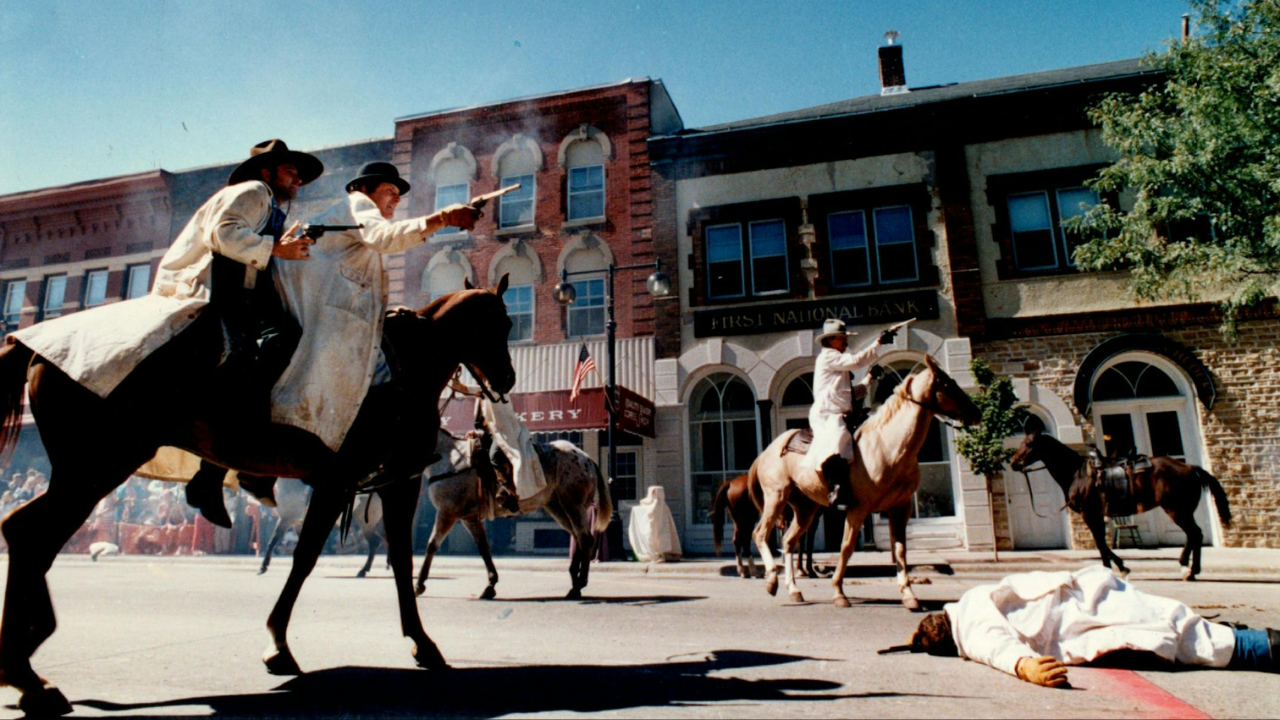
The air in Northfield, Minnesota, on a September afternoon in 1876, tasted of dry wheat and impending rain. It was the kind of small-town afternoon where the loudest sound was usually a horse shifting its weight against wooden hitching posts, the heavy thud of leather, and the low murmur of men trading the price of corn.
Then came the thunder.
Not from the sky, but from the hard-packed dirt of Division Street. Eight men on horseback crossed the Cannon River bridge, their coats buttoned high against the chill, their wide-brimmed hats pulled low to shadow eyes that had seen too much of the Kansas border wars and too little of honest peace. They were the James-Younger gang. They had ridden hard from Missouri, chasing the phantom of an easy score, convinced that the First National Bank of Northfield was ripe for the plucking.
They thought it would take seconds. They were catastrophically wrong.
The Anatomy of Chaos
History often records violence in broad strokes, summarizing battles and heists with neat tallies of the dead and the stolen. But true chaos lives in the micro-seconds. It lives in the hesitation of a finger on a trigger. It lives in the sudden, deafening shriek of a teller who refuses to break.
As Cole and Bob Younger and Clell Miller dismounted and strode toward the limestone building, Jesse James and the rest hung back to secure the perimeter. Inside, the bank was quiet. Cashier Joseph Lee Heywood sat at his desk. Assistant Nikolaus Gustafson and student bookkeeper Frank Wilcox were nearby.
When the outlaws burst through the doors, waving revolvers and screaming demands, the atmosphere shifted from pastoral calm to absolute terror in a heartbeat.
"Hand over the money!"
Heywood looked up. He didn't flinch. In that split second, a quiet, stubborn defiance gripped the cashier. The vault behind him had a heavy round door, and while the outer door was open, the inner time-lock mechanism was engaged. It could not be opened on command. It required patience, precision, and time—three things the gang was rapidly running out of.
"It's locked," Heywood said, his voice steady.
A gun pressed against his temple. The metal was cold. The threat was absolute. "Open it or die."
Heywood shook his head. He would not surrender the depositors' gold.
Outside, the town was waking up.
Northfield was not a collection of sheep waiting for the slaughter. It was a community of stubborn Scandinavian immigrants, Civil War veterans, and merchants who recognized the unmistakable signature of a raid. Hardware merchant Joseph Lee—no relation to the cashier—heard the commotion, grabbed a heavy Sharps rifle from his stock, and slipped out a back door. Medical student Willis Bunker scrambled to the roof of the Dampier Hotel with an old army musket.
The seven-minute clock had started, and the hunters were about to become the hunted.
The Weight of a Century
One hundred and fifty years later, we look back at those seven minutes through the amber glow of myth. Hollywood has spent a century turning Jesse James into a cinematic anti-hero, a tragic rebel with a smoking six-shooter. We love the romance of the outlaw. We romanticize the man who defies the system, riding away into the sunset with saddlebags bulging with stolen coin.
We forget the blood on the floorboards.
We forget Nikolaus Gustafson, a Swedish immigrant who spoke little English, stepping out into the street during the confusion, failing to understand the outlaws' shouted orders to halt, and taking a fatal bullet through the head simply because he was standing in the wrong place at the wrong time.
We forget Joseph Lee Heywood, dragged from behind the counter and murdered in cold blood just as the town's resistance reached its boiling point.
When we revisit these historical flashpoints, the temptation is to view them as isolated episodes of frontier drama. But human nature does not evolve nearly as fast as our technology. The psychology of a bank raid in 1876 shares a strange, dark DNA with the modern high-stakes robberies of our own era—whether those take the form of armed men in ski masks or faceless digital syndicates draining accounts through lines of malicious code.
At the core of every financial system is trust. And at the core of every crisis is the terrifying realization that trust can be shattered in the time it takes to draw a breath.
Consider what happens when the veneer of civilization cracks. In Northfield, the citizens didn't cower. They ran toward the gunfire. Hardware store clerks became militia. Students became snipers. Ordinary people, faced with an extraordinary violation of their sanctuary, chose resistance over resignation.
The Cost of Defiance
Back inside the bank, the situation for the outlaws was deteriorating into a nightmare.
Bullets were splintering the window frames. Clell Miller took a bullet to the heart fired from the street by college student Henry Wheeler, tumbling backward off his horse into the dust. Bob Younger was shot in the elbow, shattering his arm and rendering his revolver useless.
Realizing the vault was an impenetrable fortress and the town was mobilizing an entire armed defense, Jesse James barked the order to retreat. They hadn't stolen a single cent from the vault. They had grabbed a meager few dollars from a front drawer, but the prize was lost.
They leaped onto their horses and scattered into the Minnesota countryside, wounded, desperate, and hunted by a posse that would eventually track them down into the swamps of Madelia. Most of the gang would die in a hail of lead or spend the rest of their lives rotting in Stillwater prison. Jesse and Frank James managed to slip away, splitting from the Youngers, but their legendary invincibility was permanently broken.
The myth died on Division Street.
Standing in modern Northfield today, the ghosts of 1876 are quiet, but they are undeniably present. Plaques mark the historic sites. The bank building stands restored, a brick-and-mortar monument to a moment when a small town refused to bow to intimidation.
We live in an age obsessed with speed, efficiency, and instant outcomes. We measure our lives in megabits and transactions. Yet, when we strip away the machinery of the twenty-first century, we are left with the exact same fundamental truths that faced Joseph Heywood and the citizens of Northfield.
Character is forged in fractions of a second. Courage is not the absence of fear, but the refusal to yield when the gun is pressed to your head. And history is rarely made by the grand architects of ambition; it is written by ordinary human beings who, when the moment demands it, simply stand their ground.